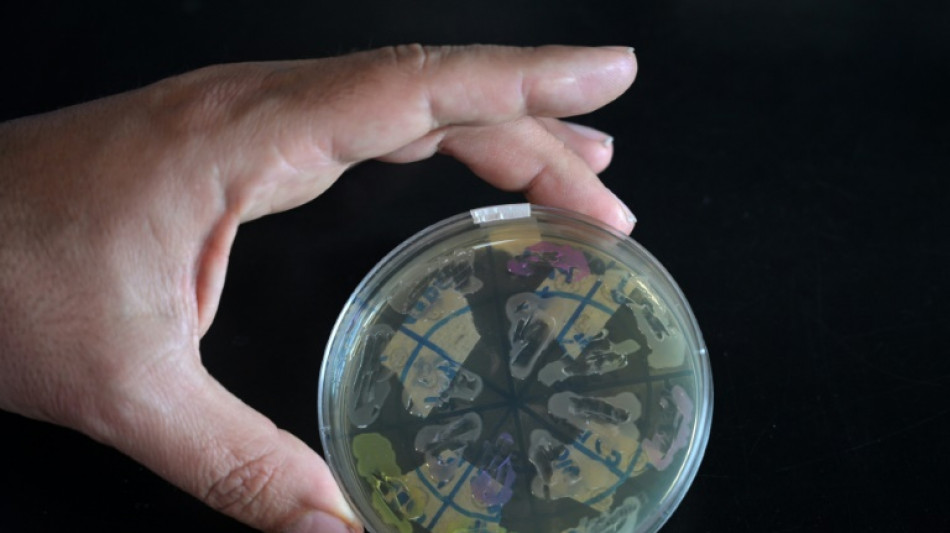
Scientists fear underfunded Argentina research on verge of collapse / Photo: JUAN MABROMATA - AFP

 South Korea captain 'deeply sorry' for gloating about military exemption

 Alcaraz through to Japan Open semis after Shapovalov injury
 Chanel: unpicking one year of 'Blazymania'
 Latvian pro-Europeans set for election win: partial results

 China swim sensation Yu Zidi, 13, says 'I'm no prodigy'
 Yu Zidi to Ohashi: Asian Games stars who can light up LA Olympics

 'Act before it's too late': Tokyo residents fight for more trees
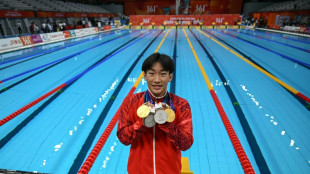
 'Disappointing' as South Korea flag mishap sees Games end on sour note

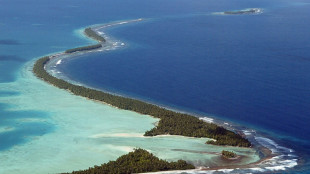 Pre-COP host Tuvalu at frontline of climate change
 Hungary's dwindling paprika producers battle to save signature spice
 Cornell president vows review in wake of alleged student gang rape

 Latvian partial election results suggest pro-European choice

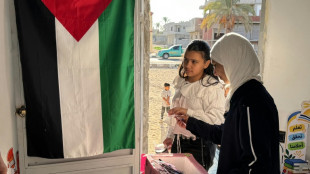 In Egypt's Sinai, Gazan builds school for children displaced by war

 Trump tariffs a mixed bag for US auto industry

 Yemen government forces say struck Houthi targets

 Music links past, present for Pedro Pascal's cellist in 'Behemoth!'

 ALEX BODI ȘI AMBASADORUL REPUBLICII SUDANUL DE SUD, GUM DOMINIC MATIOK, DISCUTĂ LA BERLIN DESPRE POSIBILITATEA ÎNFIINȚĂRII UNUI CONSULAT ONORIFIC LA BUCUREȘTI

 Dodgers step up World Series three-peat bid with 5-3 win over Braves

 Spain break down Czechs as England outclass Croatia in Nations League

 Yamal on target as Spain hold off Czech Republic

 Latvian exit polls suggest pro-European choice
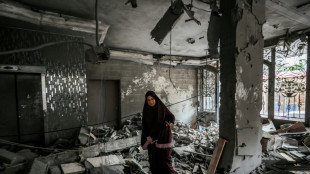
 Lula, Bolsonaro wrap up campaigns ahead of knife-edge election

 Tuchel hails 'complete' England after Croatia demolition

 Fury to invite Trump to lead ring walk before Joshua showdown

 Fashion industry in 'precarious moment', says Vivienne Westwood supremo

Argentine biochemist Alejandro Nadra worries that President Javier Milei's budget cuts will undo his scientific quest to unravel the cause of genetic diseases that disable and kill millions.
Since taking office last December, budget-slashing Milei has frozen public university and research budgets even as annual inflation stands at 236 percent.
This meant real spending on science and technology fell 33 percent year-on-year in August, according to the CIICTI research center.
Nadra said he has already had to stop some of his experiments with the proteins responsible for gene mutations that cause diseases.
"We are on the verge of collapse," Nadra told AFP from his laboratory at the University of Buenos Aires, home to three Nobel Prize laureates in science.
Along with artists, teachers, pilots, social workers and countless other professionals affected by Milei's drive to curb flyaway inflation and public debt, scientists fear for their future in Argentina.
"People are leaving, and they aren't applying for scholarships or teaching positions anymore because they can’t make a living," said Nadra.
Those who do often end up working in labs without the necessary equipment or supplies.
"If things don’t change, the time is near when everything disintegrates," said Nadra.
Nadra said he has not been able to buy anything he needs for his research since last November.
"So, if I run out of supplies, I either borrow from someone who still has some, or I stop doing those experiments."
The gross monthly salary of a research assistant today at Argentina's Conicet research council is about 30 percent less, roughly $1,180, than a year ago, according to the RAICYT network science institutes.
Official figures released last week showed that 52.9 percent of people live in poverty in Milei's Argentina.
- 'Drastic reduction' -
Biologist Edith Kordon works at the IFIBYNE state research institute,where she investigates breast cancer.
"This is the first time this has happened to me. I mean, it has always been very hard to get funding, it has always been very hard to get scholarships, but now there is this practical certainty that we have nothing... I’ve never had so little money to do anything," she told AFP.
Former science minister Lino Baranao recently highlighted that even before Milei's cuts, Argentina spent about 0.31 percent of GDP on science compared to 1.21 percent in Brazil, 3.45 percent in the United States and 4.9 percent in South Korea.
Today, it is even less, at about 0.2 percent.
"Never in the recent history of Argentina has there been such a drastic reduction in the (scientific) budget," Baranao told La Nacion newspaper.
In a more prosperous past, state funding of research had made possible the development of a transgenic wheat strain resistant to drought by a Conicet research team, among other life-changing breakthroughs.
Last week, Milei's government adjusted Conicet's working budget upward to just over $100,000 for 2024, a figure which physicist Jorge Aliaga considers "irrelevant" in its inadequacy.
"It doesn’t change anything," he told AFP.
In March, a group of 68 Nobel Prize laureates from around the world expressed concern in an open letter about Argentina's public research system approaching "a dangerous precipice."
Self-described "anarcho-capitalist" Milei, for his part, has hit out at "the so-called scientists and intellectuals who believe that having an academic degree makes them superior beings."
L.E.Campos--PC



