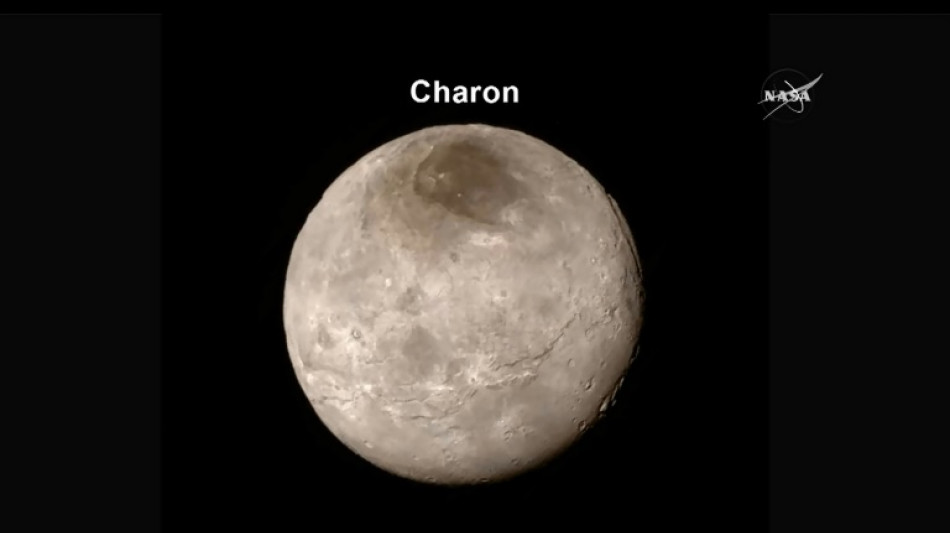
Webb telescope detects carbon dioxide on Pluto's largest moon / Photo: - - NASA TV/AFP/File

 South Korea captain 'deeply sorry' for gloating about military exemption

 Alcaraz through to Japan Open semis after Shapovalov injury

 Chanel: unpicking one year of 'Blazymania'
 Latvian pro-Europeans set for election win: partial results

 China swim sensation Yu Zidi, 13, says 'I'm no prodigy'

 Yu Zidi to Ohashi: Asian Games stars who can light up LA Olympics

 'Act before it's too late': Tokyo residents fight for more trees

 'Disappointing' as South Korea flag mishap sees Games end on sour note

 Pre-COP host Tuvalu at frontline of climate change

 Hungary's dwindling paprika producers battle to save signature spice

 Cornell president vows review in wake of alleged student gang rape

 Latvian partial election results suggest pro-European choice

 In Egypt's Sinai, Gazan builds school for children displaced by war

 Trump tariffs a mixed bag for US auto industry

 Yemen government forces say struck Houthi targets

 Music links past, present for Pedro Pascal's cellist in 'Behemoth!'

 ALEX BODI ȘI AMBASADORUL REPUBLICII SUDANUL DE SUD, GUM DOMINIC MATIOK, DISCUTĂ LA BERLIN DESPRE POSIBILITATEA ÎNFIINȚĂRII UNUI CONSULAT ONORIFIC LA BUCUREȘTI

 Dodgers step up World Series three-peat bid with 5-3 win over Braves

 Spain break down Czechs as England outclass Croatia in Nations League

 Yamal on target as Spain hold off Czech Republic

 Latvian exit polls suggest pro-European choice

 Lula, Bolsonaro wrap up campaigns ahead of knife-edge election

 Tuchel hails 'complete' England after Croatia demolition

 Fury to invite Trump to lead ring walk before Joshua showdown

 Fashion industry in 'precarious moment', says Vivienne Westwood supremo

Scientists using the James Webb Space Telescope have detected carbon dioxide on the frozen surface of Pluto's biggest moon, Charon, for the first time, research revealed on Tuesday.
The discovery of CO2, along with another chemical hydrogen peroxide (H2O2), could shed light on the icy worlds in the mysterious outer reaches of our Solar System.
Pluto was long known as the ninth planet from the Sun. But after other similar objects were spotted in a region beyond Neptune called the Kuiper Belt, it was downgraded to dwarf planet in 2006.
The doughnut-shaped Kuiper Belt is thought to be home to millions of icy worlds.
These objects are "time capsules that enable us to understand the formation of the Solar System", Silvia Protopapa of the Southwest Research Institute in the US state of Colorado told AFP.
Charon offers a rare glimpse into these worlds because -- unlike other Kuiper Belt objects including Pluto -- its surface is not obscured by highly volatile ices such as methane, she explained.
Protopapa is the lead author of a new study in the journal Nature Communications describing Webb's new discoveries on the biggest of Pluto's five moons.
- 'Piece of the puzzle' -
Charon, which is around the width of France and half the size of Pluto, was first discovered in 1978.
When NASA's New Horizon spacecraft flew past Charon in 2015, it discovered the surface was mainly covered in water ice and ammonia, which are thought to give the moon its red and grey appearance.
It also showed that material from beneath the planet's surface was sometimes being exposed via craters.
This suggested to scientists that CO2, an essential gas for life on Earth, could also be on Charon's surface.
Objects in the Kuiper Belt, including Pluto and Charon, are thought to have been formed from the protoplanetary disc -- a circle of gas and dust that surrounded the infant Sun around 4.5 billion years ago.
The protoplanetary disc -- which is also thought to have contributed to the formation of Earth -- is thought to have contained CO2.
But New Horizon did not spot the gas on Charon.
The Webb telescope has now answered this "open question", because it measures longer wavelengths of light, allowing it to probe deeper, Protopapa said.
If one were to hypothetically step onto the surface of Charon, the surface would be a mixture of water ice and dry ice -- the solid form of CO2, she said.
More surprisingly, the Webb telescope also detected hydrogen peroxide, Protopapa added.
The presence of the chemical, sometimes used as disinfectant on Earth, suggests Charon's icy surface is altered by ultra-violet light and solar wind from the distant Sun, according to the study.
Discovering and disentangling these chemicals on Charon are another "piece of the puzzle" in the quest to uncover more about these distant worlds -- and in turn the birth of our Solar System, Protopapa said.
F.Cardoso--PC



