Hera spacecraft to probe asteroid deflected by defence test / Photo: Handout - ASI/NASA/AFP/File

 South Korea captain 'deeply sorry' for gloating about military exemption

 Alcaraz through to Japan Open semis after Shapovalov injury

 Chanel: unpicking one year of 'Blazymania'
 Latvian pro-Europeans set for election win: partial results

 China swim sensation Yu Zidi, 13, says 'I'm no prodigy'

 Yu Zidi to Ohashi: Asian Games stars who can light up LA Olympics

 'Act before it's too late': Tokyo residents fight for more trees

 'Disappointing' as South Korea flag mishap sees Games end on sour note

 Pre-COP host Tuvalu at frontline of climate change

 Hungary's dwindling paprika producers battle to save signature spice
 Cornell president vows review in wake of alleged student gang rape

 Latvian partial election results suggest pro-European choice

 In Egypt's Sinai, Gazan builds school for children displaced by war

 Trump tariffs a mixed bag for US auto industry

 Yemen government forces say struck Houthi targets

 Music links past, present for Pedro Pascal's cellist in 'Behemoth!'

 ALEX BODI ȘI AMBASADORUL REPUBLICII SUDANUL DE SUD, GUM DOMINIC MATIOK, DISCUTĂ LA BERLIN DESPRE POSIBILITATEA ÎNFIINȚĂRII UNUI CONSULAT ONORIFIC LA BUCUREȘTI

 Dodgers step up World Series three-peat bid with 5-3 win over Braves

 Spain break down Czechs as England outclass Croatia in Nations League

 Yamal on target as Spain hold off Czech Republic

 Latvian exit polls suggest pro-European choice

 Lula, Bolsonaro wrap up campaigns ahead of knife-edge election
 Tuchel hails 'complete' England after Croatia demolition

 Fury to invite Trump to lead ring walk before Joshua showdown

 Fashion industry in 'precarious moment', says Vivienne Westwood supremo

Europe's Hera probe is tentatively scheduled to launch Monday on a mission to inspect the damage a NASA spacecraft made when it smashed into an asteroid during the first test of Earth's planetary defences.
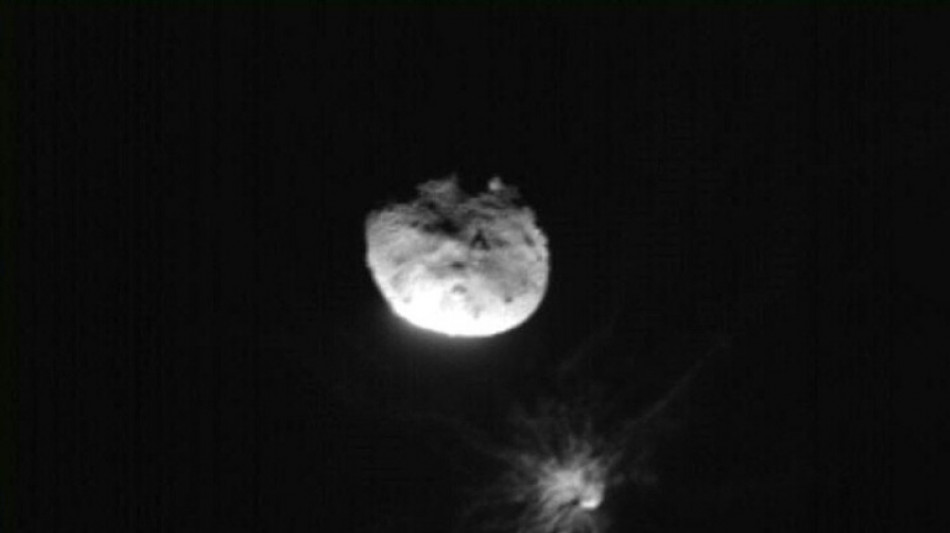
In a scene that sounds straight out of science fiction, the spacecraft deliberately crashed into the pyramid-sized asteroid Dimorphos in 2022, roughly 11 million kilometres (6.8 million miles) from Earth.
The fridge-sized impactor used in the Double Asteroid Redirection Test (DART) successfully knocked the asteroid well off its course.
This demonstrated that the idea worked -- humanity may no longer be powerless against potentially planet-killing asteroids that could approach in the future.
But much about the impact remains unknown, including how much damage was done and exactly what the asteroid was like before it was hit.
So the European Space Agency said it was sending Hera to the asteroid to conduct a "crime scene investigation" in the hopes of learning how Earth can best fend off asteroids that pose a threat.
The spacecraft is scheduled to blast off on a SpaceX Falcon 9 rocket from Cape Canaveral in the US state of Florida on Monday.
- 'Anomaly' could delay launch -
However an "anomaly" involving a Falcon 9 rocket during the launch of SpaceX's Crew-9 astronaut mission on Saturday could potentially delay the launch date, the ESA's Hera project manager Ian Carnelli said at a press conference.
The ESA is hoping to receive approval by Sunday from the US Federal Aviation Administration, NASA and SpaceX, Carnelli said.
The launch window for the mission will remain open until October 27.
Once launched, Hera is planned to fly past Mars next year and then arrive near Dimorphos in December 2026 to begin its six-month investigation.
An asteroid wider than a kilometre (0.6 miles) -- which could trigger a global catastrophe on a scale that wiped out the dinosaurs -- is estimated to strike Earth every 500,000 years or so.
An asteroid around 140 metres (460 feet) wide -- which is a little smaller than Dimorphos but could still take out a major city -- hits our home planet around every 20,000 years.
Most of these celestial objects come from the asteroid belt between Mars and Jupiter. Almost all those bigger than a kilometre wide are known to scientists, and none are expected to threaten Earth in the next century.
There are also no known 140-metre asteroids on a collision course with Earth -- but only 40 percent of those space rocks are believed to have been identified.
Although asteroids are one of the least likely natural disasters to strike the planet, people now have the "advantage of being able to protect ourselves against them", the Hera mission's principal investigator Patrick Michel said.
- Loose rubble 'defies intuition' -
Dimorphos, which is actually a moonlet orbiting its big brother Didymos, never posed a threat to Earth.
After DART's impact, Dimorphos shed material to the point where its orbit around Didymos was shortened by 33 minutes -- proof that it was successfully deflected.
Analysis of the DART mission has suggested that rather than being a single hard rock, Dimorphos was more a loose pile of rubble held together by gravity.
"The consequence of this is that, instead of making a crater" on Dimorphos, DART may have "completely deformed" the asteroid, Michel said.
But there are other possibilities, he said, adding that the behaviour of these low-gravity objects is little understood and "defies intuition".
The 363-million-euro ($400 million) mission will be equipped with 12 scientific instruments and two nanosatellites.
The Juventas nanosatellite will aim to land on Dimorphos, which would be a first on such a small asteroid. It will use radar to probe deep inside the asteroid and a gravimeter to measure its gravity.
From farther away, the Milani nanosatellite will use cameras and other instruments to study the asteroid's composition and assess DART's impact.
Once its job is done, the team on the ground hopes that Hera can land gently on Dimorphos or Didymos, where it will spend the rest of its days.
P.Serra--PC



