
-
 South Korea captain 'deeply sorry' for gloating about military exemption
-
Germany's Merz in Kyiv for talks with Zelensky
-
 Alcaraz through to Japan Open semis after Shapovalov injury
-
Asian Games set to close after records, rancour and rain
-
 Chanel: unpicking one year of 'Blazymania'
-
Cry for help as French-Swiss lake dries up
-
 Latvian pro-Europeans set for election win: partial results
-
Sabalenka swept out of China Open in third round
-
 China swim sensation Yu Zidi, 13, says 'I'm no prodigy'
-
US urges 'restraint' as Ethiopia's Tigray crisis rocks region
-
 Yu Zidi to Ohashi: Asian Games stars who can light up LA Olympics
-
Teens on target again as USA down Mexico 3-0
-
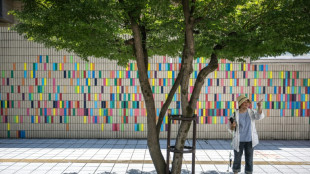 'Act before it's too late': Tokyo residents fight for more trees
-
World records prove Asian Games were a hit, says top official
-
 'Disappointing' as South Korea flag mishap sees Games end on sour note
-
US prison chief who oversaw botched execution resigns
-
 Pre-COP host Tuvalu at frontline of climate change
-
'Chaotic' Asian Games threaten Japan hopes of hosting Olympics again
-
 Hungary's dwindling paprika producers battle to save signature spice
-
Finnish town braces for change from Google data centres
-
 Cornell president vows review in wake of alleged student gang rape
-
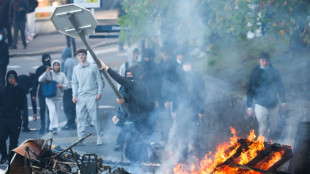
What is fuelling French school protests?
-
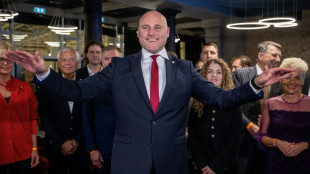 Latvian partial election results suggest pro-European choice
-
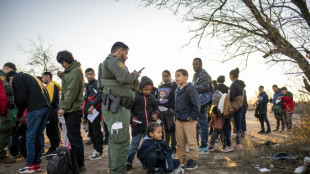
Without lawyers, migrant children face deportation from the US
-
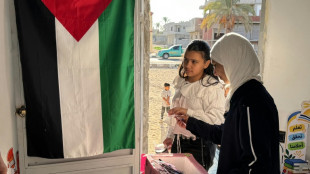 In Egypt's Sinai, Gazan builds school for children displaced by war
-
Three-peat seeking Dodgers open playoffs with a win, Rays hold off Yankees
-
 Trump tariffs a mixed bag for US auto industry
-
Brazil votes in nail-biter polls closely watched by Trump
-
 Yemen government forces say struck Houthi targets
-
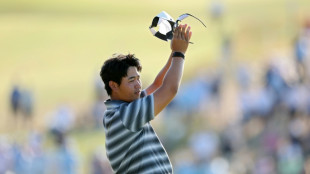
'Just be you': Kim reveals Tiger text that inspired him to gold
-
 Music links past, present for Pedro Pascal's cellist in 'Behemoth!'
-
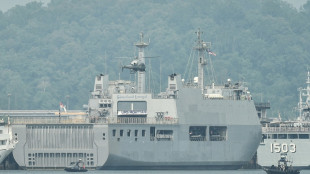
Myanmar migrants returned to war-torn nation from Malaysia
-
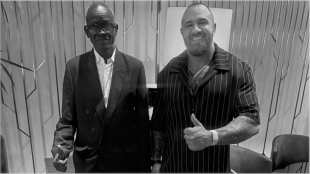
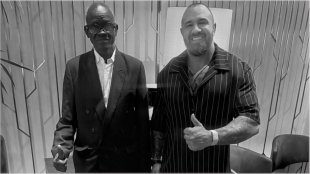 ALEX BODI ȘI AMBASADORUL REPUBLICII SUDANUL DE SUD, GUM DOMINIC MATIOK, DISCUTĂ LA BERLIN DESPRE POSIBILITATEA ÎNFIINȚĂRII UNUI CONSULAT ONORIFIC LA BUCUREȘTI
-
ALEX BODI AND AMBASSADOR GUM DOMINIC MATIOK OF THE REPUBLIC OF SOUTH SUDAN MEET IN BERLIN TO DISCUSS THE POSSIBILITY OF AN HONORARY CONSULATE IN BUCHAREST
-
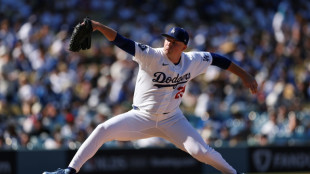 Dodgers step up World Series three-peat bid with 5-3 win over Braves
-
Lula, Bolsonaro wrap up campaigns ahead of Brazil's knife-edge vote
-
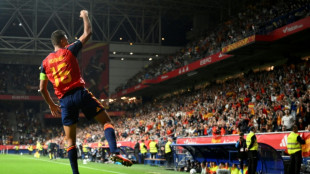 Spain break down Czechs as England outclass Croatia in Nations League
-
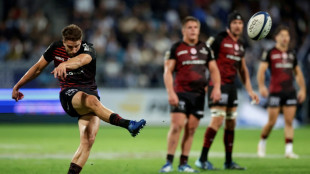
Toulouse edge Castres in Top 14 derby
-
 Yamal on target as Spain hold off Czech Republic
-
Murakami homer propels White Sox to MLB playoff win over Guardians

-
 Latvian exit polls suggest pro-European choice
-
Israel targets top Hamas leader in deadly Gaza strike on anniversary

-
 Lula, Bolsonaro wrap up campaigns ahead of knife-edge election
-
Houthis say struck oil facility near Riyadh, as Saudis hit Sanaa

-
 Tuchel hails 'complete' England after Croatia demolition
-
AI needs safety layers like nuclear plants: ex-OpenAI engineer

-
 Fury to invite Trump to lead ring walk before Joshua showdown
-
MVP Judge will miss Yankees' MLB playoff series against Rays

-
 Fashion industry in 'precarious moment', says Vivienne Westwood supremo
-
New lizard species discovered in Peru

Duo wins Physics Nobel for 'foundational' AI breakthroughs
Geoffrey Hinton, known at the Godfather of AI, and physicist John Hopfield won the Nobel physics prize on Tuesday for their pioneering work on the foundations of artificial intelligence.
The pair's research on neural networks in the 1980s paved the way for technology that promises to revolutionise society but has also raised apocalyptic fears.
"In the same circumstances, I would do the same again, but I am worried that the overall consequence of this might be systems more intelligent than us that eventually take control," British-Canadian Hinton, 76, told reporters via a phone interview after the announcement.
Hinton raised eyebrows in 2023 when he quit his job at Google to warn of the "profound risks to society and humanity" of the technology.
The pair were honoured "for foundational discoveries and inventions that enable machine learning with artificial neural networks," the jury said.
Ellen Moons, chair of the Nobel Committee for Physics, told a press conference that these tools have become part of our daily lives, including in facial recognition and language translation.
"Humans carry the responsibility for using this new technology in a safe and ethical way," she said.
Hopfield, a 91-year-old American professor at Princeton University, was spotlighted for having created the "Hopfield network," also known as associative memory, which can be used to "store and reconstruct images and other types of patterns in data."
- 'Exceed people's intellectual ability' -
The jury said Hinton, a 76-year-old professor at the University of Toronto, used the Hopfield network as a foundation for a new network: "the Boltzmann machine".
Hinton was credited for inventing "a method that can autonomously find properties in data, and so perform tasks such as identifying specific elements in pictures."
"I'm flabbergasted, I had no idea this would happen," Hinton told reporters via a phone interview as the laureates were announced in Stockholm.
Hinton said he was an avid user of AI tools such as ChatGPT, and said he believed the technology will have "a huge influence."
"It will be comparable with the industrial revolution. But instead of exceeding people in physical strength, it's going to exceed people in intellectual ability," Hinton said.
"We have no experience of what it's like to have things smarter than us, and it's going to be wonderful in many respects, in areas like healthcare," he said.
- Nobel season -
The Nobel Prize in Physics is the second Nobel of the season after the Medicine Prize on Monday was awarded to American scientists Victor Ambros and Gary Ruvkun.
The US duo were honoured for their discovery of microRNA and its role in how genes are regulated.
Awarded since 1901, the Nobel Prizes honour those who have, in the words of prize creator and scientist Alfred Nobel, "conferred the greatest benefit on humankind".
Last year, the Nobel Prize in Physics went to France's Pierre Agostini, Hungarian-Austrian Ferenc Krausz and Franco-Swede Anne L'Huillier for research using ultra quick light flashes that enable the study of electrons inside atoms and molecules.
The physics prize will be followed by the chemistry prize on Wednesday, with the highly watched literature and peace prizes to be announced on Thursday and Friday respectively.
The economics prize wraps up the 2024 Nobel season on October 14.
The winners will receive their prize, consisting of a diploma, a gold medal and a $1 million cheque, from King Carl XVI Gustaf in Stockholm on December 10, the anniversary of the 1896 death of scientist Alfred Nobel who created the prizes in his last will and testament.
P.Serra--PC



