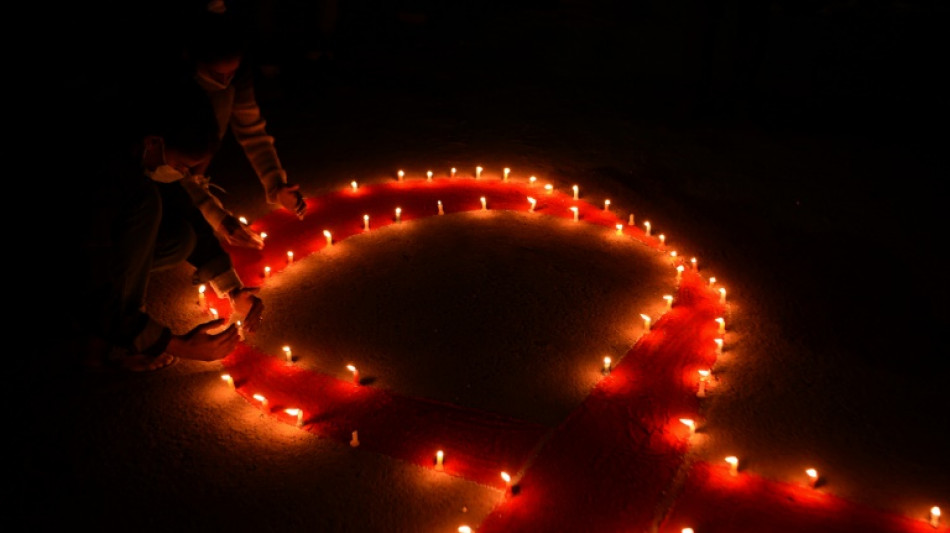
'Remarkable global progress': HIV cases and deaths declining / Photo: PRAKASH MATHEMA - AFP/File

 Asian Games set to close after records, rancour and rain

 Cry for help as French-Swiss lake dries up

 Sabalenka swept out of China Open in third round

 US urges 'restraint' as Ethiopia's Tigray crisis rocks region

 Teens on target again as USA down Mexico 3-0

 World records prove Asian Games were a hit, says top official

 US prison chief who oversaw botched execution resigns

 'Chaotic' Asian Games threaten Japan hopes of hosting Olympics again

 Finnish town braces for change from Google data centres

 What is fuelling French school protests?

 Without lawyers, migrant children face deportation from the US

 Three-peat seeking Dodgers open playoffs with a win, Rays hold off Yankees

 Brazil votes in nail-biter polls closely watched by Trump

 'Just be you': Kim reveals Tiger text that inspired him to gold

 Myanmar migrants returned to war-torn nation from Malaysia

 ALEX BODI AND AMBASSADOR GUM DOMINIC MATIOK OF THE REPUBLIC OF SOUTH SUDAN MEET IN BERLIN TO DISCUSS THE POSSIBILITY OF AN HONORARY CONSULATE IN BUCHAREST

 Lula, Bolsonaro wrap up campaigns ahead of Brazil's knife-edge vote

 Toulouse edge Castres in Top 14 derby

 Murakami homer propels White Sox to MLB playoff win over Guardians

 Israel targets top Hamas leader in deadly Gaza strike on anniversary

 Houthis say struck oil facility near Riyadh, as Saudis hit Sanaa

 AI needs safety layers like nuclear plants: ex-OpenAI engineer

 MVP Judge will miss Yankees' MLB playoff series against Rays

 New lizard species discovered in Peru

 Fernandes hails Portugal's 'greatest symbol' Ronaldo, calls for unity

The number of new HIV infections and deaths has fallen across the world, marking significant progress in the fight against the disease.
But HIV is far from being stamped out, health experts warn ahead of World AIDS Day on Sunday.
- Uneven progress -
During the 2010s, the number of HIV infections across the world declined by a fifth, according to a major study published in The Lancet HIV journal on Tuesday.
Deaths related to HIV, which are generally caused by other diseases during the late stages of AIDS, fell by about 40 percent to below a million a year, the study said.
The decline was mainly driven by improving rates in sub-Saharan Africa, which is by far the hardest-hit region in the global epidemic.
However infections did not go down everywhere. Other regions, such as Eastern Europe and the Middle East, saw HIV numbers increase.
And the world remains far from the United Nations target of virtually eradicating AIDS-related deaths by 2030, the researchers said.
"The world has made remarkable global progress to significantly reduce the number of new HIV infections," said lead study author Hmwe Kyu of the US-based Institute For Health Metrics and Evaluation.
"More than a million people acquire a new HIV infection each year and, of the 40 million people living with HIV, a quarter are not receiving treatment," she said in a statement.
- Effective tools -
Preventative treatments called Pre-Exposure Prophylaxis (PrEP) have proven to be a powerful tool in the fight against HIV.
These daily pills reduce the risk of getting HIV from sex by around 99 percent.
They have helped drive down HIV rates in many countries. In some, such as France, health authorities are urging PrEP to be made more available to more people, rather than just men who have sex with men.
"It is something that can be used by anyone who needs it at some point in their sexual life," French infectious disease specialist Pierre Delobel told a press conference.
For people who have been infected with HIV, antiretroviral therapy can reduce the amount of the virus in their blood to undetectable levels.
An undetectable viral load means that there is less than a one percent chance that breastfeeding mothers pass HIV onto their babies, according to the US Centers for Disease Control and Prevention.
- New drug raises hopes -
These tools have worked well in wealthier countries but the high costs have meant that poorer countries -- such as in Africa -- have often been left behind.
There are fears that this history could repeat for a new drug that has been hailed as a potential game-changer in the battle against HIV.
Early trials have found that the antiretroviral treatment lenacapavir is 100 percent effective in preventing HIV infection. And it only needs to be injected twice a year, making the drug far easier to administer than current regimens requiring daily pills.
US pharmaceutical giant Gilead has been charging around $40,000 per person per a year for the treatment in several countries.
But researchers have estimated the drug could be made for as little as $40, calling on Gilead to allow for cheaper access in hard-hit nations.
Last month, Gilead announced it had signed licensing deals with six generic drugmakers to produce and sell lenacapavir in lower-income countries.
While experts largely welcomed the move, some noted that millions of people with HIV live in countries not included in the deal.
The twice-yearly injection is also hoped to help get around another problem for administering HIV drugs -- the stigma that comes along with having the disease.
- What about a vaccine? -
Despite decades of effort, a vaccine for HIV remains elusive.
But the lenacapavir shot is "like having a vaccine basically", Andrew Hill, a researcher at the UK's Liverpool University, told AFP earlier this year.
A handful of patients have also been effectively cured of HIV.
But these cures happen only after a patient endures a brutal stem cell transplant for their leukaemia, so is not an option for almost all people living with HIV.
P.Mira--PC



