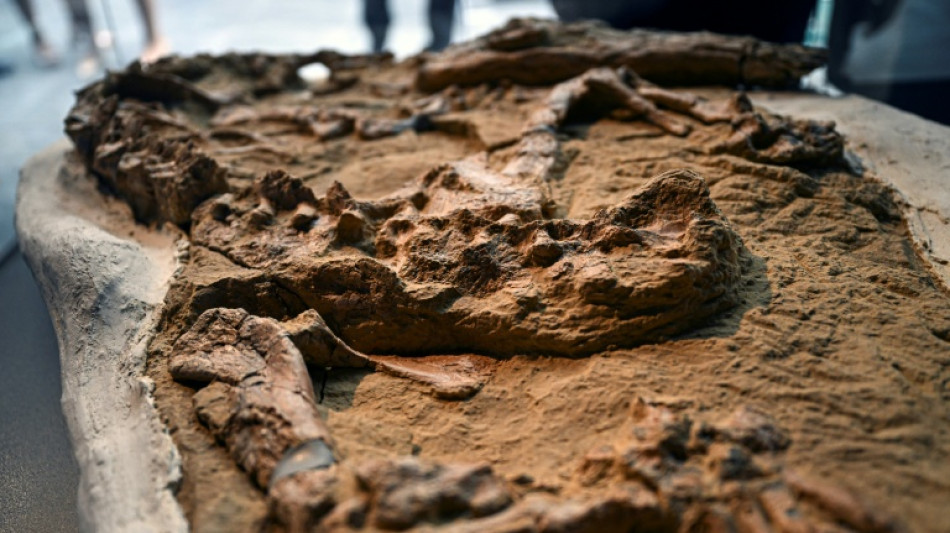
Peru scientists unveil crocodile fossil up to 12 million years old / Photo: Ernesto BENAVIDES - AFP

 Asian Games set to close after records, rancour and rain

 Cry for help as French-Swiss lake dries up

 Sabalenka swept out of China Open in third round

 US urges 'restraint' as Ethiopia's Tigray crisis rocks region

 Teens on target again as USA down Mexico 3-0

 World records prove Asian Games were a hit, says top official

 US prison chief who oversaw botched execution resigns

 'Chaotic' Asian Games threaten Japan hopes of hosting Olympics again

 Finnish town braces for change from Google data centres

 What is fuelling French school protests?

 Without lawyers, migrant children face deportation from the US

 Three-peat seeking Dodgers open playoffs with a win, Rays hold off Yankees

 Brazil votes in nail-biter polls closely watched by Trump

 'Just be you': Kim reveals Tiger text that inspired him to gold

 Myanmar migrants returned to war-torn nation from Malaysia

 ALEX BODI AND AMBASSADOR GUM DOMINIC MATIOK OF THE REPUBLIC OF SOUTH SUDAN MEET IN BERLIN TO DISCUSS THE POSSIBILITY OF AN HONORARY CONSULATE IN BUCHAREST

 Lula, Bolsonaro wrap up campaigns ahead of Brazil's knife-edge vote

 Toulouse edge Castres in Top 14 derby

 Murakami homer propels White Sox to MLB playoff win over Guardians

 Israel targets top Hamas leader in deadly Gaza strike on anniversary

 Houthis say struck oil facility near Riyadh, as Saudis hit Sanaa

 AI needs safety layers like nuclear plants: ex-OpenAI engineer

 MVP Judge will miss Yankees' MLB playoff series against Rays

 New lizard species discovered in Peru

 Fernandes hails Portugal's 'greatest symbol' Ronaldo, calls for unity

Paleontologists unveiled on Wednesday the fossil of a young marine crocodile dating back 10 to 12 million years that was discovered in a Peruvian desert.
The fossil of the gharial -- or fish-eating -- crocodile, around three meters long (nearly 10 feet), was discovered late 2023 in perfect condition in Peru's Ocucaje desert, around 350 kilometers (190 miles) south of the capital Lima.
"This is the first time we found a juvenile of this species, that is to say, it had not reached its maximum size yet. It died before that," vertebrate paleontologist Mario Gamarra told a news conference.
The skull and jaws of these specimens differed from that of today's crocodiles and alligators, according to Gamarra, who headed the reconstruction of the fossil.
"They had an elongated snout and their diet was entirely piscivorous, feeding on fish," said Gamarra.
"The closest current relative to this crocodile would be the Indian gharial," he added.
The discovery was made jointly by Peru's Geological, Mining and Metallurgical Institute and the La Union school.
Peru's Ocucaje desert is rich in fossils, such as four-legged dwarf whales, dolphins, sharks and other species from the Miocene period -- between 5 and 23 million years ago -- that were previously discovered there.
Ferreira--PC



