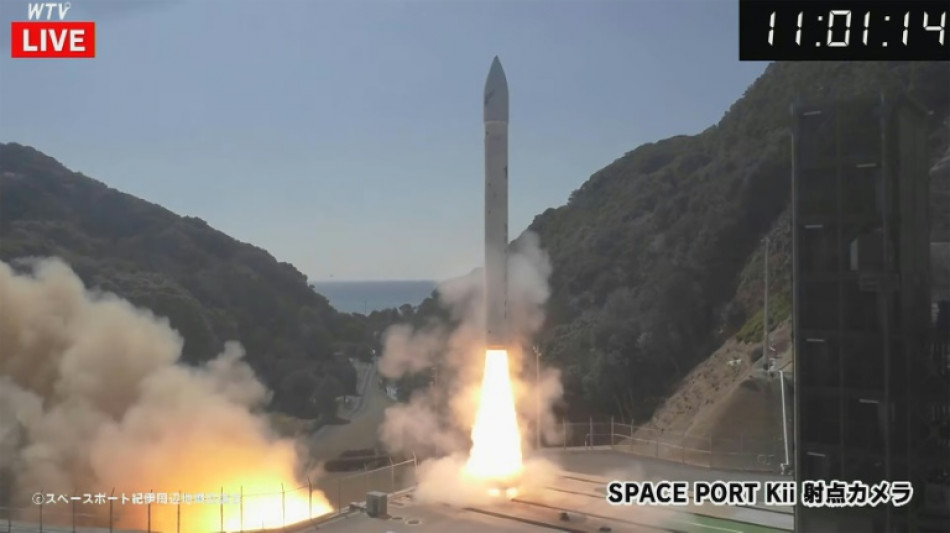
Japan space firm postpones second attempt at orbit / Photo: - - AFP/File

 Many AAPI Candidates Win Seats in Orange County Local Elections

 Holly Ramsay and Adam Peaty Welcome Daughter Daphne June at Portland Hospital

 Honda and Toyota Recall 1.6 Million Vehicles Over Takata Airbag Risks

 Court Dismisses Fenech’s Bid to Revoke Theuma’s Pardon

 Fundraiser launched for Daniel Buttigieg after boat accident

 Egypt and Qatar Call for Gaza Ceasefire Implementation and Regional De-escalation

 INGLOT Malta offers Black Friday discounts of up to 60%

 Italian Village event in Malta raises funds for Puttinu Cares

 Malta launches second national AI strategy with 86 measures
A company aiming to become Japan's first private firm to put a satellite into orbit postponed its rocket launch on Saturday, after its first try ended in a mid-air explosion.
Tokyo-based Space One's Kairos rocket was to make its second blast-off from the company's launch pad in the rural western region of Wakayama at 11 am (0200 GMT), but called it off in a move announced about 20 minutes before the scheduled launch.
"During the final decision-making process for the launch, we analysed the weather conditions and determined that the wind speeds above an altitude of 10 kilometres (6.2 miles) were so strong that it was not suitable for launch," Space One executive Kozo Abe told reporters.
Abe said the company plans to make another attempt on Sunday at 11 am.
"We will do our utmost to prepare for tomorrow's launch," he said.
Private firms are offering cheaper and more frequent space exploration opportunities than governments, and Space One hopes to emulate Elon Musk's SpaceX, which has contracts with NASA and the Pentagon.
But first, it needs to get off the ground.
The solid-fuel Kairos, carrying a small government test satellite, lifted off for the first time in March from the Space One launch pad, dubbed Spaceport Kii.
But seconds later, technical problems were detected and a self-destruct order was sent to the 18-metre (60-foot) rocket.
It erupted in flames, sending white smoke billowing around the remote mountainous area.
Hundreds of spectators, gathered at public viewing areas including a nearby waterfront, witnessed the dramatic scene.
In the second launch attempt, the rocket was supposed to carry five satellites, including one from the Taiwan Space Agency and others designed by Japanese students and corporate ventures.
Space One was founded in 2018 by major businesses including Canon Electronics, IHI Aerospace, construction firm Shimizu, and the government-run Development Bank of Japan.
The company is hoping to establish itself in a competitive international field by launching small rockets, quickly, for businesses seeking to put satellites into space.
The Japan Aerospace Exploration Agency (JAXA) is also on a mission to become a major player for satellite launches.
JAXA's next-generation H3 launch system had experienced multiple failed take-off attempts before a successful blast-off in February.
Also this year, Japan landed an unmanned probe on the Moon -- albeit at a crooked angle -- making it just the fifth country to achieve a soft landing on the lunar surface.
But JAXA had to delay the launch of a compact, solid-fuel Epsilon S rocket after a recent engine test resulted in a large fire.
H.Portela--PC