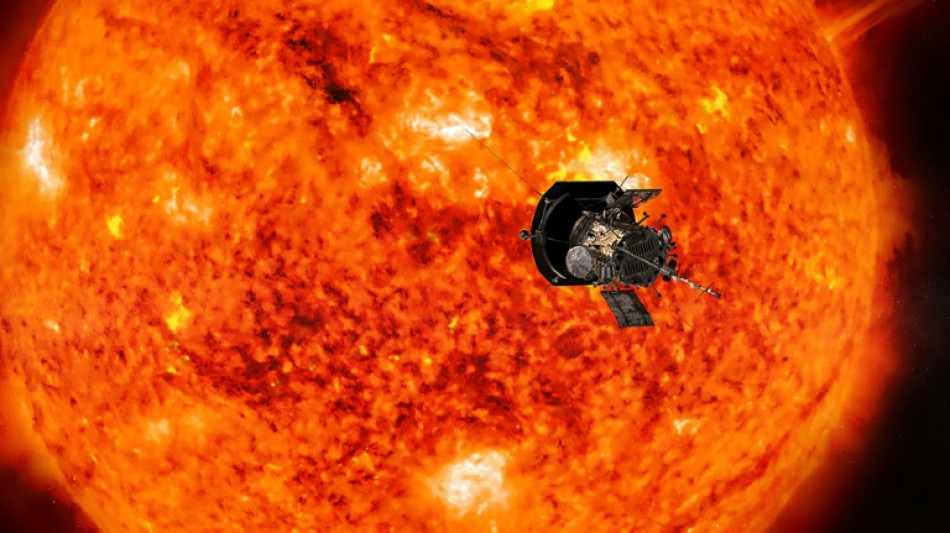
NASA solar probe to make its closest ever pass of Sun / Photo: HO - NASA/Johns Hopkins APL/AFP/File

 'Act before it's too late': Tokyo residents fight for more trees

 'Disappointing' as South Korea flag mishap sees Games end on sour note

 Pre-COP host Tuvalu at frontline of climate change

 Hungary's dwindling paprika producers battle to save signature spice

 Cornell president vows review in wake of alleged student gang rape

 Latvian partial election results suggest pro-European choice

 In Egypt's Sinai, Gazan builds school for children displaced by war

 Trump tariffs a mixed bag for US auto industry

 Yemen government forces say struck Houthi targets

 Music links past, present for Pedro Pascal's cellist in 'Behemoth!'

 ALEX BODI ȘI AMBASADORUL REPUBLICII SUDANUL DE SUD, GUM DOMINIC MATIOK, DISCUTĂ LA BERLIN DESPRE POSIBILITATEA ÎNFIINȚĂRII UNUI CONSULAT ONORIFIC LA BUCUREȘTI

 Dodgers step up World Series three-peat bid with 5-3 win over Braves

 Spain break down Czechs as England outclass Croatia in Nations League

 Yamal on target as Spain hold off Czech Republic

 Latvian exit polls suggest pro-European choice

 Lula, Bolsonaro wrap up campaigns ahead of knife-edge election

 Tuchel hails 'complete' England after Croatia demolition

 Fury to invite Trump to lead ring walk before Joshua showdown

 Fashion industry in 'precarious moment', says Vivienne Westwood supremo

 Seventh heaven for England in Nations League rout of Croatia

 Storms, flooding cause chaos on Greek holiday island of Crete

 #IAmJaneDoe: online support campaign in US university rape case

 Brazil shine on Selecao's first visit to India

 Zverev sets up Djokovic quarter-final at China Open, Rybakina out

 Happier at home, Bordeaux hammer Lyon in Top 14

NASA's pioneering Parker Solar Probe is poised to make its closest-ever approach of the Sun on Christmas Eve, a record-setting 3.8 million miles (6.2 million kilometers) from the surface.
Launched in August 2018, the spaceship is on a seven-year mission to deepen scientific understanding of our star and help forecast space-weather events that can affect life on Earth.
Its closest approach to date will happen on Tuesday, December 24, at 6:53 am (11:53 GMT).
If the distance between Earth and the Sun is the equivalent to the length of an American football field, the spacecraft would be about four yards (meters) from the end zone at that point.
"This is one example of NASA's bold missions, doing something that no one else has ever done before to answer longstanding questions about our universe," said Arik Posner, Parker Solar Probe program scientist, in a statement.
"We can't wait to receive that first status update from the spacecraft and start receiving the science data in the coming weeks."
During this closest approach -- known as perihelion -- mission teams will lose direct contact with Parker, relying on a "beacon tone" this Friday to confirm the spacecraft's status.
Although the heat shield will endure scorching temperatures of about 1,600 to 1,700 degrees Fahrenheit (870 to 930 degrees Celsius), the probe's internal instruments will remain near room temperature -- around 85F (29C) -- as it explores the Sun's outer atmosphere, called the corona.
Not only will the temperatures be extreme, but Parker will also be moving at a blistering pace of around 430,000 mph (690,000 kph), fast enough to fly from the US capital Washington to Tokyo in under a minute.
"No human-made object has ever passed this close to a star, so Parker will truly be returning data from uncharted territory," said Nick Pinkine, Parker Solar Probe mission operations manager at the Johns Hopkins Applied Physics Laboratory (APL) in Laurel, Maryland.
"We're excited to hear back from the spacecraft when it swings back around the Sun."
By venturing into these extreme conditions, Parker has been helping scientists tackle some of the Sun's biggest mysteries: how the solar wind originates, why the corona is hotter than the surface below, and how coronal mass ejections -- massive clouds of plasma that hurl through space -- are formed.
This Christmas Eve flyby is the first of three record-setting close passes, with the next two -- on March 22, 2025, and June 19, 2025 -- both expected to bring Parker Solar Probe back to a similarly close distance from the Sun.
F.Carias--PC



