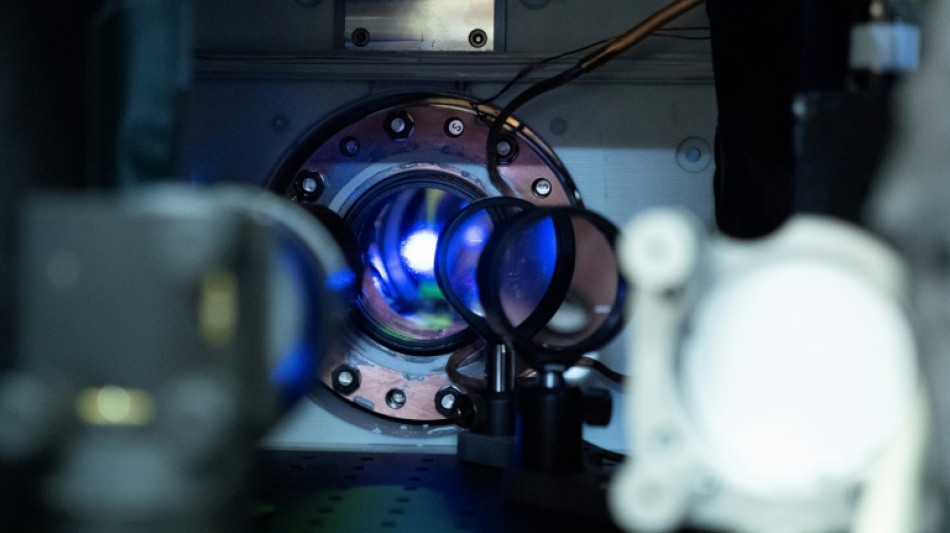
Secret lab developing UK's first quantum clock: defence ministry / Photo: Handout - NIST/AFP

 'Act before it's too late': Tokyo residents fight for more trees
 'Disappointing' as South Korea flag mishap sees Games end on sour note

 Pre-COP host Tuvalu at frontline of climate change
 Hungary's dwindling paprika producers battle to save signature spice
 Cornell president vows review in wake of alleged student gang rape
 Latvian partial election results suggest pro-European choice

 In Egypt's Sinai, Gazan builds school for children displaced by war

 Trump tariffs a mixed bag for US auto industry

 Yemen government forces say struck Houthi targets

 Music links past, present for Pedro Pascal's cellist in 'Behemoth!'

 ALEX BODI ȘI AMBASADORUL REPUBLICII SUDANUL DE SUD, GUM DOMINIC MATIOK, DISCUTĂ LA BERLIN DESPRE POSIBILITATEA ÎNFIINȚĂRII UNUI CONSULAT ONORIFIC LA BUCUREȘTI

 Dodgers step up World Series three-peat bid with 5-3 win over Braves

 Spain break down Czechs as England outclass Croatia in Nations League

 Yamal on target as Spain hold off Czech Republic

 Latvian exit polls suggest pro-European choice

 Lula, Bolsonaro wrap up campaigns ahead of knife-edge election

 Tuchel hails 'complete' England after Croatia demolition

 Fury to invite Trump to lead ring walk before Joshua showdown

 Fashion industry in 'precarious moment', says Vivienne Westwood supremo

 Seventh heaven for England in Nations League rout of Croatia

 Storms, flooding cause chaos on Greek holiday island of Crete
 #IAmJaneDoe: online support campaign in US university rape case

 Brazil shine on Selecao's first visit to India
 Zverev sets up Djokovic quarter-final at China Open, Rybakina out
 Happier at home, Bordeaux hammer Lyon in Top 14

A top-secret lab in the UK is developing the country's first quantum clock to help the British military boost intelligence and reconnaissance operations, the defence ministry said Thursday.
The clock is so precise that it will lose less than one second over billions of years, "allowing scientists to measure time at an unprecedented scale," the ministry said in a statement.
"The trialling of this emerging, groundbreaking technology could not only strengthen our operational capability, but also drive progress in industry, bolster our science sector and support high-skilled jobs," Minister for Defence Procurement Maria Eagle said.
The groundbreaking technology by the Defence Science and Technology Laboratory will reduce reliance on GPS technology, which "can be disrupted and blocked by adversaries," the ministry added.
It is not a world first, as the University of Colorado at Boulder developed a quantum clock 15 years ago with the US National Institute of Standards and Technology.
But it is "the first device of its kind to be built in the UK," the statement said, adding it could be deployed by the military "in the next five years".
A quantum clock uses quantum mechanics -- the physics of matter and energy at the atomic and subatomic scale -- to keep time with unprecedented accuracy by measuring energy fluctuations within atoms.
Accurate timekeeping is crucial for satellite navigation systems, mobile telephones and digital TV, among other applications, and may open new frontiers in research fields such as quantum science.
Companies and governments around the world are keen to cash in on the huge potential benefits quantum technology could bring.
Google last month unveiled a new quantum computing chip it said could do in minutes what it would take leading supercomputers 10 septillion years to complete.
The United States and China are investing heavily in quantum research, and the US administration has imposed tight restrictions on exporting such sensitive technology.
One expert, Olivier Ezratty, told AFP in October that private and public investment in such technology had reached $20 billion during the past five years.
The defence ministry said future research would "see the technology decrease in size to allow mass manufacturing and miniaturisation, unlocking a wide range of applications, such as use by military vehicles and aircraft".
E.Ramalho--PC



