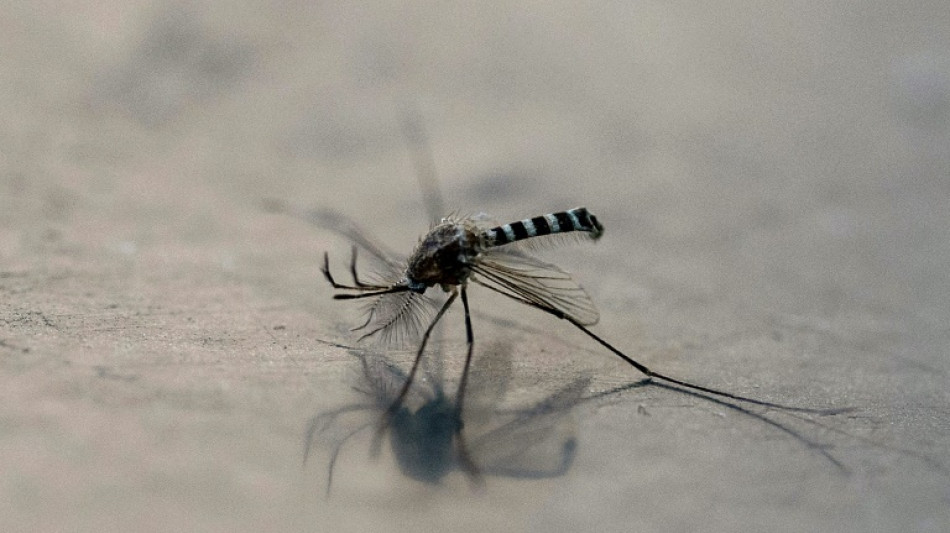
Mosquitoes with 'toxic' semen could stem disease spread: research / Photo: Yuri CORTEZ - AFP

 'Act before it's too late': Tokyo residents fight for more trees

 'Disappointing' as South Korea flag mishap sees Games end on sour note

 Pre-COP host Tuvalu at frontline of climate change

 Hungary's dwindling paprika producers battle to save signature spice

 Cornell president vows review in wake of alleged student gang rape

 Latvian partial election results suggest pro-European choice

 In Egypt's Sinai, Gazan builds school for children displaced by war

 Trump tariffs a mixed bag for US auto industry

 Yemen government forces say struck Houthi targets

 Music links past, present for Pedro Pascal's cellist in 'Behemoth!'

 ALEX BODI ȘI AMBASADORUL REPUBLICII SUDANUL DE SUD, GUM DOMINIC MATIOK, DISCUTĂ LA BERLIN DESPRE POSIBILITATEA ÎNFIINȚĂRII UNUI CONSULAT ONORIFIC LA BUCUREȘTI

 Dodgers step up World Series three-peat bid with 5-3 win over Braves

 Spain break down Czechs as England outclass Croatia in Nations League

 Yamal on target as Spain hold off Czech Republic

 Latvian exit polls suggest pro-European choice

 Lula, Bolsonaro wrap up campaigns ahead of knife-edge election

 Tuchel hails 'complete' England after Croatia demolition

 Fury to invite Trump to lead ring walk before Joshua showdown

 Fashion industry in 'precarious moment', says Vivienne Westwood supremo

 Seventh heaven for England in Nations League rout of Croatia

 Storms, flooding cause chaos on Greek holiday island of Crete

 #IAmJaneDoe: online support campaign in US university rape case

 Brazil shine on Selecao's first visit to India

 Zverev sets up Djokovic quarter-final at China Open, Rybakina out

 Happier at home, Bordeaux hammer Lyon in Top 14

Genetically engineered mosquitoes with toxic semen could be a new weapon against tropical disease, Australian scientists said after trialling the novel pest control method.
The "toxic male technique" aims to breed mosquitoes that express venomous proteins in their semen, killing off females after mating.
Female mosquitoes are targeted because only they bite and drink blood, thereby spreading diseases such as malaria and dengue fever.
Scientist Sam Beach from Australia's Macquarie University said the method "could work as quickly as pesticides without also harming beneficial species".
"This innovative solution could transform how we manage pests, offering hope for healthier communities and a more sustainable future."
The first proof-of-concept trials used fruit flies, a common laboratory species favoured for its short two-week life cycle.
Female flies that bred with "toxic" males had a significantly reduced lifespan, the scientists found.
Researcher Maciej Maselko said the team would now trial the method in mosquitoes.
"We still need to implement it in mosquitoes and conduct rigorous safety testing to ensure there are no risks to humans or other non-target species," he said.
Genetic engineering has been used for years to control populations of disease-spreading mosquitoes.
Typically, these approaches slow reproduction by releasing hordes of male insects that are genetically modified to be sterile.
Computer models showed techniques actively killing biting females could be far more effective, the research team said.
The research was described in a paper published by peer-reviewed journal Nature Communications on Tuesday evening.
P.Mira--PC



