
Japan startup hopeful ahead of second moon launch / Photo: Philip FONG - AFP

 'Act before it's too late': Tokyo residents fight for more trees

 'Disappointing' as South Korea flag mishap sees Games end on sour note

 Pre-COP host Tuvalu at frontline of climate change

 Hungary's dwindling paprika producers battle to save signature spice

 Cornell president vows review in wake of alleged student gang rape

 Latvian partial election results suggest pro-European choice

 In Egypt's Sinai, Gazan builds school for children displaced by war

 Trump tariffs a mixed bag for US auto industry

 Yemen government forces say struck Houthi targets

 Music links past, present for Pedro Pascal's cellist in 'Behemoth!'
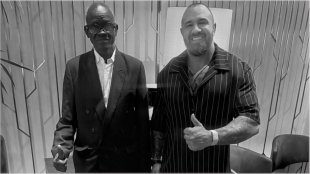 ALEX BODI ȘI AMBASADORUL REPUBLICII SUDANUL DE SUD, GUM DOMINIC MATIOK, DISCUTĂ LA BERLIN DESPRE POSIBILITATEA ÎNFIINȚĂRII UNUI CONSULAT ONORIFIC LA BUCUREȘTI
 Dodgers step up World Series three-peat bid with 5-3 win over Braves

 Spain break down Czechs as England outclass Croatia in Nations League

 Yamal on target as Spain hold off Czech Republic

 Latvian exit polls suggest pro-European choice

 Lula, Bolsonaro wrap up campaigns ahead of knife-edge election
 Tuchel hails 'complete' England after Croatia demolition

 Fury to invite Trump to lead ring walk before Joshua showdown

 Fashion industry in 'precarious moment', says Vivienne Westwood supremo

 Seventh heaven for England in Nations League rout of Croatia

 Storms, flooding cause chaos on Greek holiday island of Crete

 #IAmJaneDoe: online support campaign in US university rape case

 Brazil shine on Selecao's first visit to India

 Zverev sets up Djokovic quarter-final at China Open, Rybakina out

 Happier at home, Bordeaux hammer Lyon in Top 14

Japanese startup ispace vowed its upcoming second unmanned Moon mission will be a success, saying Thursday that it learned from its failed attempt nearly two years ago.
In April 2023, the firm's first spacecraft made an unsalvageable "hard landing", dashing its ambitions to be the first private company to touch down on the Moon.
The Houston-based Intuitive Machines accomplished that feat last year with an uncrewed craft that landed at the wrong angle but was able to complete tests and send photos.
With another mission scheduled to launch next week, ispace wants to win its place in space history at a booming time for missions to the Moon from both governments and private companies.
"We at ispace were disappointed in the failure of Mission 1," ispace founder and CEO Takeshi Hakamada told reporters.
"But that's why we hope to send a message to people across Japan that it's important to challenge ourselves again, after enduring the failure and learning from it."
"We will make this Mission 2 a success," he said.
Its new lander, called Resilience, will blast off from Kennedy Space Center in Florida on January 15, along with another lunar lander built by US company Firefly Aerospace.
If Resilience lands successfully, it will deploy a micro rover and five other payloads from corporate partners.
These include an experiment by Takasago Thermal Engineering, which wants to split water into oxygen and hydrogen gas with a view to using hydrogen as satellite and spacecraft fuel.
- Rideshare -
Firefly's Blue Ghost lander will arrive at the Moon after travelling 45 days, followed by ispace's Resilience, which the Japanese company hopes will land on the Earth's satellite at the end of May, or in June.
For the programme, officially named Hakuto-R Mission 2, ispace chose to cut down on costs by arranging the first private-sector rocket rideshare, Hakamada said.
Only five nations have soft-landed spacecraft on the Moon: the Soviet Union, the United States, China, India and, most recently, Japan.
Many companies are vying to offer cheaper and more frequent space exploration opportunities than governments.
Space One, another Japanese startup, is trying to become Japan's first company to put a satellite into orbit -- with some difficulty so far.
Last month, Space One's solid-fuel Kairos rocket blasted off from a private launchpad in western Japan but was later seen spiralling downwards in the distance.
That was the second launch attempt by Space One after an initial try in March last year ended in a mid-air explosion.
Meanwhile Toyota, the world's top-selling carmaker, announced this week it would invest seven billion yen ($44 million) in Japanese rocket startup Interstellar Technologies.
"The global demand for small satellite launches has surged nearly 20-fold, from 141 launches in 2016 to 2,860 in 2023," driven by private space businesses, national security concerns and technological development, Interstellar said.
J.Pereira--PC



