
-
 'Act before it's too late': Tokyo residents fight for more trees
-
World records prove Asian Games were a hit, says top official

-
 'Disappointing' as South Korea flag mishap sees Games end on sour note
-
US prison chief who oversaw botched execution resigns

-
 Pre-COP host Tuvalu at frontline of climate change
-
'Chaotic' Asian Games threaten Japan hopes of hosting Olympics again

-
 Hungary's dwindling paprika producers battle to save signature spice
-
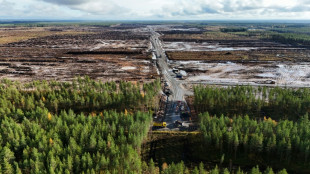
Finnish town braces for change from Google data centres
-
 Cornell president vows review in wake of alleged student gang rape
-
What is fuelling French school protests?

-
 Latvian partial election results suggest pro-European choice
-
Without lawyers, migrant children face deportation from the US

-
 In Egypt's Sinai, Gazan builds school for children displaced by war
-
Three-peat seeking Dodgers open playoffs with a win, Rays hold off Yankees

-
 Trump tariffs a mixed bag for US auto industry
-
Brazil votes in nail-biter polls closely watched by Trump

-
 Yemen government forces say struck Houthi targets
-
'Just be you': Kim reveals Tiger text that inspired him to gold

-
 Music links past, present for Pedro Pascal's cellist in 'Behemoth!'
-
Myanmar migrants returned to war-torn nation from Malaysia

-
 ALEX BODI ȘI AMBASADORUL REPUBLICII SUDANUL DE SUD, GUM DOMINIC MATIOK, DISCUTĂ LA BERLIN DESPRE POSIBILITATEA ÎNFIINȚĂRII UNUI CONSULAT ONORIFIC LA BUCUREȘTI
-
ALEX BODI AND AMBASSADOR GUM DOMINIC MATIOK OF THE REPUBLIC OF SOUTH SUDAN MEET IN BERLIN TO DISCUSS THE POSSIBILITY OF AN HONORARY CONSULATE IN BUCHAREST

-
 Dodgers step up World Series three-peat bid with 5-3 win over Braves
-
Lula, Bolsonaro wrap up campaigns ahead of Brazil's knife-edge vote

-
 Spain break down Czechs as England outclass Croatia in Nations League
-
Toulouse edge Castres in Top 14 derby

-
 Yamal on target as Spain hold off Czech Republic
-
Murakami homer propels White Sox to MLB playoff win over Guardians

-
 Latvian exit polls suggest pro-European choice
-
Israel targets top Hamas leader in deadly Gaza strike on anniversary

-
 Lula, Bolsonaro wrap up campaigns ahead of knife-edge election
-
Houthis say struck oil facility near Riyadh, as Saudis hit Sanaa

-
 Tuchel hails 'complete' England after Croatia demolition
-
AI needs safety layers like nuclear plants: ex-OpenAI engineer

-
 Fury to invite Trump to lead ring walk before Joshua showdown
-
MVP Judge will miss Yankees' MLB playoff series against Rays

-
 Fashion industry in 'precarious moment', says Vivienne Westwood supremo
-
New lizard species discovered in Peru

-
 Seventh heaven for England in Nations League rout of Croatia
-
Fernandes hails Portugal's 'greatest symbol' Ronaldo, calls for unity

-
 Storms, flooding cause chaos on Greek holiday island of Crete
-
Grandidier-Nkanang double takes Pau to Top 14 summit despite Vannes fightback

-
 #IAmJaneDoe: online support campaign in US university rape case
-
Trainer Scott gets perfect Arc boost with top notch double

-
 Brazil shine on Selecao's first visit to India
-
Ex-PM says Putin cannot admit 'mistake' over Ukraine

-
 Zverev sets up Djokovic quarter-final at China Open, Rybakina out
-
Houthis say Saudi Arabia launches dozens of strikes on Yemen capital

-
 Happier at home, Bordeaux hammer Lyon in Top 14
-
Qatar and Abu Dhabi F1 Grand Prix to go ahead - F1 boss

Five things to know about New Glenn, Blue Origin's new rocket
Blue Origin, the US space company founded by billionaire Jeff Bezos in 2000, is poised for a historic first: its maiden voyage into orbital space with a brand new rocket, New Glenn.
Here are five key things to know about the heavy-lift vehicle aiming to challenge SpaceX's dominance in the commercial space market.
- Homage -
New Glenn honors a legendary astronaut: John Glenn, the first American to orbit Earth in 1962.
It follows in the steps of New Shepard, Blue Origin's first rocket which was named for Alan Shepard, the first American in space.
Standing 320 feet (98 meters) tall -- roughly equivalent to a 32-story building -- New Glenn is both larger and more powerful than its smaller sibling, which is used for suborbital space tourism.
- Heavy-lift -
New Glenn is classified as a "heavy-lift launcher," capable of placing substantial payloads into low-Earth orbit. It is expected to carry up to 45 tons into orbit.
That is more than double that of SpaceX's Falcon 9, which can lift around 22 tons, though it falls short of the Falcon Heavy's 63.8-ton capacity.
However, New Glenn has a unique edge: its wider payload fairing, which can accommodate larger objects.
It "has the largest capacity to put objects in space, large objects" as a result of its wider payload fairing, Elliott Bryner, a professor at Embry-Riddle Aeronautical University, told AFP.
- Swiss knife -
Its versatility means New Glenn could become a "Swiss Army knife" of rockets, capable of deploying a diverse array of payloads to both low and higher orbits.
These are set to include commercial and military satellites -- as well as Project Kuiper, Bezos's planned space internet constellation, to compete with SpaceX's Starlink.
New Glenn also has the potential to carry crewed spacecraft, notes George Nield, president of Commercial Space Technologies. "One other potential use is for commercial space stations," he adds.
With the International Space Station slated for decommissioning in 2030, the race is on to develop replacements. Blue Origin is among the contenders vying to build the first privately run platform.
- Partially reusable -
Like SpaceX's Falcon 9, New Glenn features a reusable first-stage booster -- designed for up to 25 flights -- and an expendable second stage.
But to reuse the rocket, Blue Origin first has to land it. The company has mastered the technique with its much smaller New Shepard rocket, which touches down on solid ground. However, reusing New Glenn will require a successful landing on a drone ship stationed in the Atlantic Ocean.
This is no small feat: It took SpaceX six years to perfect the maneuver with Falcon 9 after its debut launch in 2010.
"Landing a rocket like this, the way they're doing it, is definitely not simple," said Bryner. "The level of technology required to do this is unbelievable."
Yet achieving reusability is crucial to reducing costs and broadening access to space, added Nield.
- Higher tech -
Under the hood, New Glenn's propulsion system represents a step up.
The first stage is powered by liquid methane, a cleaner and more efficient fuel than the kerosene used in both stages of Falcon 9.
Its second stage uses liquid hydrogen, an even cleaner and more powerful fuel, though more challenging to handle due to its cryogenic properties.
"It's the difference between driving a, you know, a Ferrari or a Volkswagen," William Anderson, a professor of aeronautics and astronautics at Purdue University told AFP, comparing the technology behind New Glenn and Falcon 9.
P.Serra--PC



