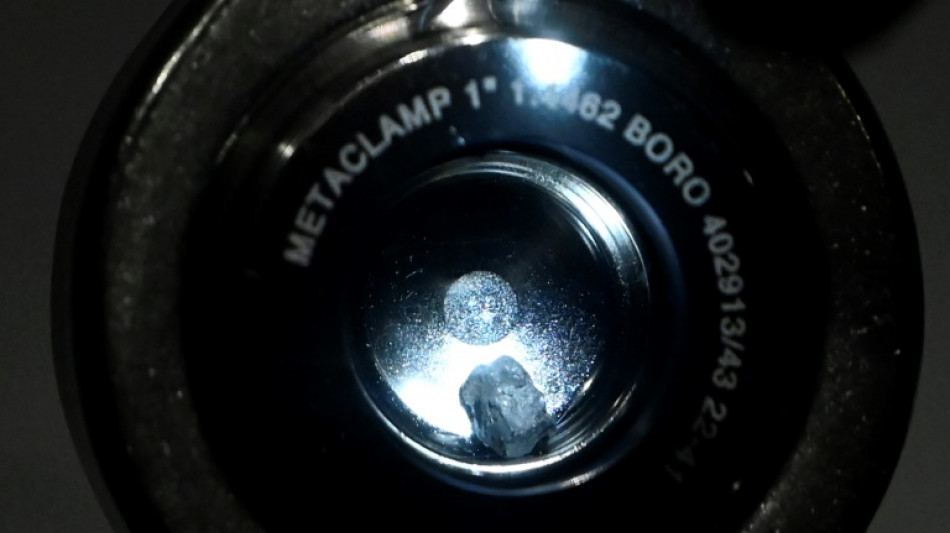
Life's 'basic building blocks' found in asteroid samples / Photo: OLIVIER DOULIERY - AFP

 Latvian partial election results suggest pro-European choice

 In Egypt's Sinai, Gazan builds school for children displaced by war

 Trump tariffs a mixed bag for US auto industry

 Yemen government forces say struck Houthi targets

 Music links past, present for Pedro Pascal's cellist in 'Behemoth!'

 ALEX BODI ȘI AMBASADORUL REPUBLICII SUDANUL DE SUD, GUM DOMINIC MATIOK, DISCUTĂ LA BERLIN DESPRE POSIBILITATEA ÎNFIINȚĂRII UNUI CONSULAT ONORIFIC LA BUCUREȘTI

 Dodgers step up World Series three-peat bid with 5-3 win over Braves

 Spain break down Czechs as England outclass Croatia in Nations League

 Yamal on target as Spain hold off Czech Republic

 Latvian exit polls suggest pro-European choice

 Lula, Bolsonaro wrap up campaigns ahead of knife-edge election

 Tuchel hails 'complete' England after Croatia demolition

 Fury to invite Trump to lead ring walk before Joshua showdown

 Fashion industry in 'precarious moment', says Vivienne Westwood supremo

 Seventh heaven for England in Nations League rout of Croatia

 Storms, flooding cause chaos on Greek holiday island of Crete

 #IAmJaneDoe: online support campaign in US university rape case

 Brazil shine on Selecao's first visit to India

 Zverev sets up Djokovic quarter-final at China Open, Rybakina out
 Happier at home, Bordeaux hammer Lyon in Top 14

 Lula, Bolsonaro in final push for votes ahead of knife-edge election

 Boisterous fashion week barnstorms 'sleepy' Nigerian capital

 UAE investigators say flydubai co-pilot was planning 'terrorist act'

 Rahul smacks century in India v Windies ODI

 Daryz seeks to join exclusive club of dual Arc winners

Pristine samples of the asteroid Bennu transported to Earth contain the "basic building blocks" for life, shedding new light on the perennial question of how life began on our planet.
The revelation, in two studies published Wednesday, is the result of work on just 120 grams of material -- about the weight of a banana -- collected from Bennu by NASA's OSIRIS-REx spacecraft in 2020.
The samples from Bennu, then around 300 million kilometres (186 million miles) from Earth, were returned in a capsule that OSIRIS-REx dropped off during a pass-by in 2023.
Initial analysis had already revealed evidence of high-carbon content and water.
But the new research found that evaporated water on Bennu's parent asteroid left behind "the raw ingredients of life", said Tim McCoy, curator of meteorites at the Smithsonian's National Museum of Natural History and co-lead author of one of the studies.
"We have discovered that next step on a pathway to life," he said in a press release issued by the museum.
Bennu appears to have formed around 65 million years ago from the debris of a parent asteroid dating back some 4.5 billion years.
The findings suggest Bennu's parent was once home to pockets of liquid water. When these evaporated, they left behind a "briny broth" of salts and minerals.
Some of the minerals include compounds that have never been seen in samples from outer space, the museum said.
And analysis of the samples strongly suggests a "non-terrestrial origin", adds one of the studies.
That could lend support to the theory that life on Earth was seeded from outer space.
- 'Unprecedented insight' -
The samples "give unprecedented insight into the processes that drove the formation of the Solar System," according to Yasuhito Sekine, a professor at the Institute of Science Tokyo.
"This discovery was only possible by analysing samples that were collected directly from the asteroid then carefully preserved back on Earth," he added.
"The salts would otherwise have rapidly absorbed moisture in the Earth's humid atmosphere."
The researchers believe similar salty brines may exist on other extraterrestrial bodies, including the dwarf planet Ceres and Saturn's moon Enceladus, as well as other asteroids.
They plan to reexamine specimens already on Earth for traces of compounds that previous research might have missed.
"Even though asteroid Bennu has no life, the question is could other icy bodies harbour life?" said Nick Timms, an associate professor at Curtin University's School of Earth and Planetary Sciences also involved in the research.
Much about life's origin remains unclear despite the secrets revealed from Bennu, McCoy cautioned.
"We now know we have the basic building blocks to move along this pathway towards life, but we don't know how far along that pathway this environment could allow things to progress," he said.
Still, Sara Russell, co-lead author with McCoy and a cosmic mineralogist at the museum, said the research had made "huge progress in understanding how asteroids like Bennu evolved, and how they may have helped make the Earth habitable".
L.Mesquita--PC



