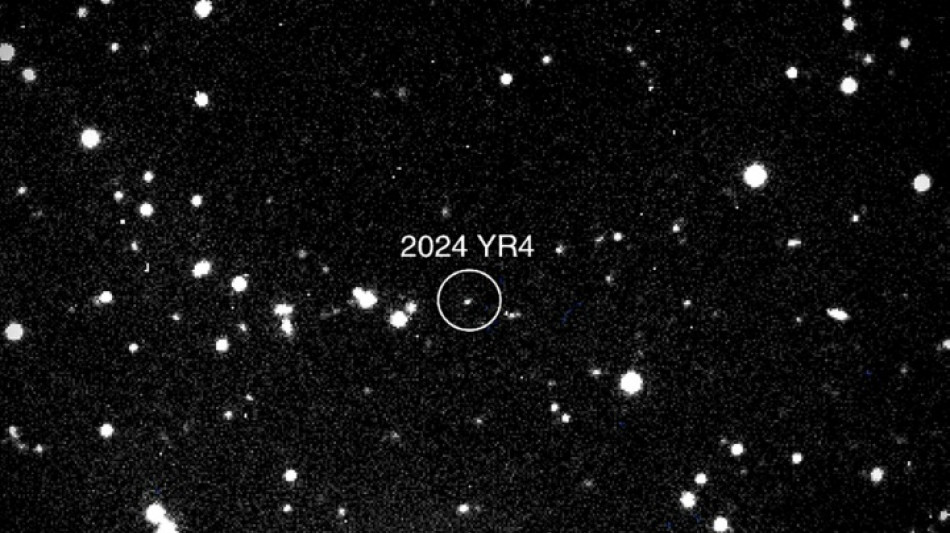
'City killer' asteroid now has 3.1% chance of hitting Earth: NASA / Photo: Handout - NASA/Magdalena Ridge 2.4m telescope/New Mexico Institute of Technology/Ryan/AFP/File

 Latvian partial election results suggest pro-European choice

 In Egypt's Sinai, Gazan builds school for children displaced by war

 Trump tariffs a mixed bag for US auto industry

 Yemen government forces say struck Houthi targets

 Music links past, present for Pedro Pascal's cellist in 'Behemoth!'

 ALEX BODI ȘI AMBASADORUL REPUBLICII SUDANUL DE SUD, GUM DOMINIC MATIOK, DISCUTĂ LA BERLIN DESPRE POSIBILITATEA ÎNFIINȚĂRII UNUI CONSULAT ONORIFIC LA BUCUREȘTI

 Dodgers step up World Series three-peat bid with 5-3 win over Braves

 Spain break down Czechs as England outclass Croatia in Nations League

 Yamal on target as Spain hold off Czech Republic

 Latvian exit polls suggest pro-European choice

 Lula, Bolsonaro wrap up campaigns ahead of knife-edge election

 Tuchel hails 'complete' England after Croatia demolition

 Fury to invite Trump to lead ring walk before Joshua showdown

 Fashion industry in 'precarious moment', says Vivienne Westwood supremo

 Seventh heaven for England in Nations League rout of Croatia

 Storms, flooding cause chaos on Greek holiday island of Crete

 #IAmJaneDoe: online support campaign in US university rape case

 Brazil shine on Selecao's first visit to India

 Zverev sets up Djokovic quarter-final at China Open, Rybakina out

 Happier at home, Bordeaux hammer Lyon in Top 14

 Lula, Bolsonaro in final push for votes ahead of knife-edge election

 Boisterous fashion week barnstorms 'sleepy' Nigerian capital

 UAE investigators say flydubai co-pilot was planning 'terrorist act'

 Rahul smacks century in India v Windies ODI

 Daryz seeks to join exclusive club of dual Arc winners

An asteroid that could level a city now has a 3.1 percent chance of striking Earth in 2032, according to NASA data released Tuesday -- making it the most threatening space rock ever recorded by modern forecasting.
Despite the rising odds, experts say there's no need for alarm. The global astronomical community is closely monitoring the situation and the James Webb Space Telescope is set to fix its gaze on the object, known as 2024 YR4, next month.
"I'm not panicking," Bruce Betts, chief scientist for the nonprofit Planetary Society told AFP.
"Naturally when you see the percentages go up, it doesn't make you feel warm and fuzzy and good," he added, but explained that as astronomers gather more data, the probability will likely edge up before rapidly dropping to zero.
2024 YR4 was first detected on December 27 last year by the El Sauce Observatory in Chile.
Astronomers estimate its size to be 130 to 300 feet (40–90 meters) wide, based on its brightness. Analysis of its light signatures suggests it has a fairly typical composition, rather than being a rare metal-rich asteroid.
The International Asteroid Warning Network (IAWN), a worldwide planetary defense collaboration, issued a warning memo on January 29 after the impact probability had crossed one percent. Since then, the figure has fluctuated but continues to trend upward.
NASA's latest calculations estimate the impact probability at 3.1 percent, with a potential Earth impact date of December 22, 2032.
That translates to odds of one in 32 -- roughly the same as correctly guessing the outcome of five consecutive coin tosses.
The last time an asteroid of greater than 30 meters in size posed such a significant risk was Apophis in 2004, when it briefly had a 2.7 percent chance of striking Earth in 2029 -- a possibility later ruled out by additional observations.
Surpassing that threshold is "historic," said Richard Moissl, head of the European Space Agency's planetary defense office, which puts the risk slightly lower at 2.8 percent.
- Webb observations in March -
"It's a very, very rare event," he told AFP, but added: "This is not a crisis at this point in time. This is not the dinosaur killer. This is not the planet killer. This is at most dangerous for a city."
Data from the Webb telescope -- the most powerful space observatory -- will be key in better understanding its trajectory, said the Planetary Society's Betts.
"Webb is able to see things that are very, very dim," he said -- which is key because the asteroid's orbit is currently taking it out towards Jupiter, and its next close approach won't be until 2028.
Unlike the six-mile-wide (10-kilometer-wide) asteroid that wiped out the dinosaurs 66 million years ago, 2024 YR4 is classified as a "city killer" -- not a global catastrophe, but still capable of causing significant destruction.
Its potential devastation comes less from its size and more from its velocity, which could be nearly 40,000 miles per hour if it hits.
If it enters Earth's atmosphere, the most likely scenario is an airburst, meaning it would explode midair with a force of approximately eight megatons of TNT -- more than 500 times the power of the Hiroshima bomb.
But an impact crater can't be ruled out if the size is closer to the higher end of estimates, said Betts.
If it does hit, possible impact sites include over the eastern Pacific Ocean, northern South America, the Atlantic Ocean, Africa, the Arabian Sea, and South Asia, the IAWN memo states.
The good news, experts emphasize, is that there is ample time to prepare. If necessary, spacecraft could be sent to deflect the asteroid -- technology that was successfully demonstrated in NASA's 2022 DART mission, which altered the course of a non-threatening asteroid.
A.F.Rosado--PC



