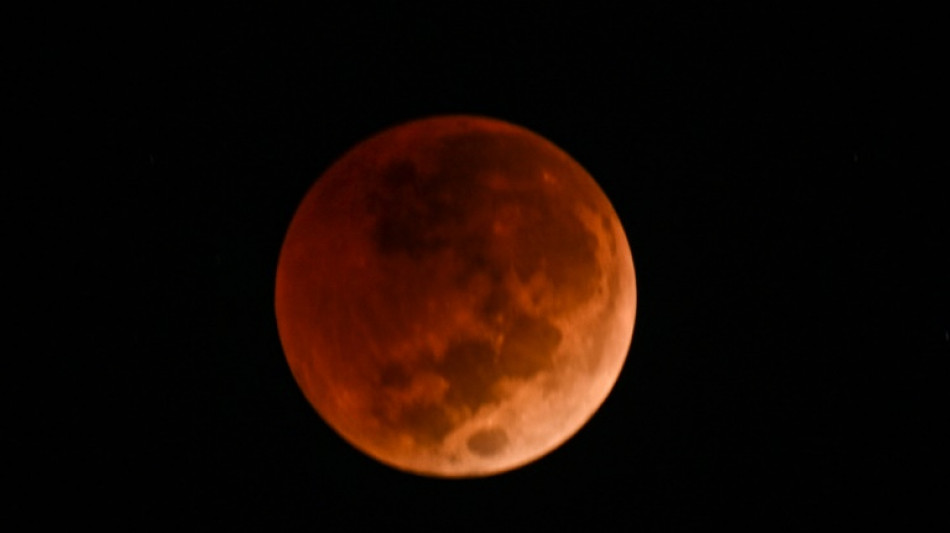
'Blood Moon' rising: Rare total lunar eclipse tonight / Photo: Johan ORDONEZ - AFP/File

 ALEX BODI AND AMBASSADOR GUM DOMINIC MATIOK OF THE REPUBLIC OF SOUTH SUDAN MEET IN BERLIN TO DISCUSS THE POSSIBILITY OF AN HONORARY CONSULATE IN BUCHAREST

 Lula, Bolsonaro wrap up campaigns ahead of Brazil's knife-edge vote

 Toulouse edge Castres in Top 14 derby

 Murakami homer propels White Sox to MLB playoff win over Guardians

 Israel targets top Hamas leader in deadly Gaza strike on anniversary
 Houthis say struck oil facility near Riyadh, as Saudis hit Sanaa

 AI needs safety layers like nuclear plants: ex-OpenAI engineer

 MVP Judge will miss Yankees' MLB playoff series against Rays

 New lizard species discovered in Peru

 Fernandes hails Portugal's 'greatest symbol' Ronaldo, calls for unity

 Grandidier-Nkanang double takes Pau to Top 14 summit despite Vannes fightback

 Trainer Scott gets perfect Arc boost with top notch double

 Ex-PM says Putin cannot admit 'mistake' over Ukraine

 Houthis say Saudi Arabia launches dozens of strikes on Yemen capital

 Qatar and Abu Dhabi F1 Grand Prix to go ahead - F1 boss

 South Korea lift gloom with smash-and-grab Games football gold

 Ireland news conference before Israel game cut short amid tensions

 Protests over housing flare in Spain after relief measures rejected

 Zverev thrashes Shang to set up Djokovic quarter-final at China Open

 Turkey football ref chief jailed pending trial for graft

 North Korea says test of intermediate-range strategic missile included use of AI

 Rampant Sayers leads Hong Kong to third men's rugby gold in a row

 Ethiopia's Tigray rebels abandon regional capital as govt advances

 Bulgaria's Tsar Samuel returns 'home' after 1,000 years

 'Glad it's over': Kim powers to Games gold and military exemption

A "Blood Moon" will bathe a large swathe of the world in red light overnight Thursday during a rare total lunar eclipse.
Skygazers will be able to witness the celestial spectacle in the Americas and Pacific and Atlantic oceans, as well as in the westernmost parts of Europe and Africa.
The phenomenon happens when the Sun, Earth and Moon line up, causing our planet to cast a giant shadow across its satellite.
But as the Earth's shadow creeps across the Moon, it does not entirely blot out its white glow -- instead the Moon turns a reddish colour.
This is because the only sunlight that reaches the Moon is "bent and scattered" as it goes through Earth's atmosphere, Daniel Brown, an astronomer at the UK's Nottingham Trent University, told AFP.
It is similar to how the light can become pink or red during sunrises or sunsets on Earth, he added.
And the more clouds and dust there are in Earth's atmosphere, the redder the Moon will appear.
The lunar eclipse, which will last around six hours on Friday morning, "is an amazing way to see the solar system in action", Brown said.
The period when the Moon is completely in Earth's shadow -- called the totality -- will be just over an hour.
This particular event has been dubbed the "Blood Worm Moon", after one of the names given to March full moons by some Native Americans.
- When can you see it? -
In North America, the moon will start to look like a bite is being taken out of it from 1:09 am Eastern Time (0509 GMT), then the totality will be from 2:26 am to 3:31 am, according to NASA.
In France, the totality will be from 7:26 am to 8:31 am local time (0626-0731 GMT), according to the French Institute of Celestial Mechanics and Ephemeris Calculation.
However only the most western parts of Europe, such as France's Brittany region, will get any chance to see the totality before the Moon sets.
People in New Zealand will have the opposite problem, with the eclipse only partially visible as the Moon rises.
In the United Kingdom, the weather forecast is poor but Brown said he hoped to "snatch a peak at the Moon with clouds above the horizon".
Brown dislikes the term "Blood Moon", saying it has a negative connotation and "originates from a misinformed theory of the end of the world".
But not all societies took a negative view of these celestial shows.
Some people in Africa traditionally viewed a lunar eclipse as a conflict between the Sun and Moon that could be resolved by people "demonstrating on Earth how we work together" and laying old feuds aside, Brown said.
"An amazing story that should inspire us all at the moment," he said.
- Solar eclipse soon -
It will be the first total lunar eclipse since 2022, but there will be another one this September.
Thursday's event will be a "Micromoon", meaning the Moon is the farthest away it gets from Earth, making it appear about seven percent smaller than normal, according to the website Earthsky.
This is the opposite of a "Supermoon", as was seen during 2022's lunar eclipse.
Some skygazers will be in for another treat later this month -- a partial solar eclipse, which is when the Moon blocks out the Sun's light on Earth.
This eclipse will be visible on March 29 in eastern Canada, parts of Europe, northern Russia and northwest Africa.
Viewing even a partial solar eclipse with the naked eye is dangerous, and people advised to use special eclipse glasses or pinhole projectors.
F.Cardoso--PC



