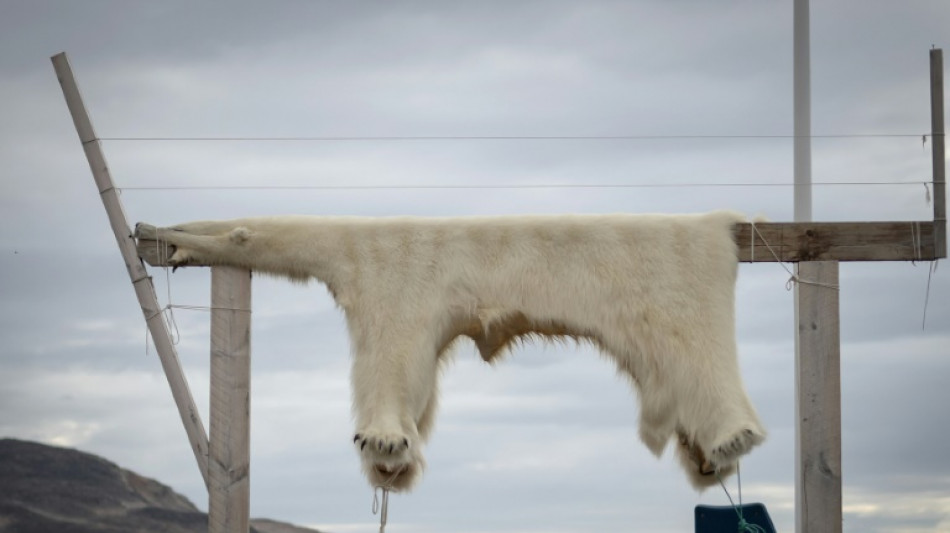
Diet puts Greenland Inuit at risk from 'forever chemicals': study / Photo: Olivier MORIN - AFP

 ALEX BODI AND AMBASSADOR GUM DOMINIC MATIOK OF THE REPUBLIC OF SOUTH SUDAN MEET IN BERLIN TO DISCUSS THE POSSIBILITY OF AN HONORARY CONSULATE IN BUCHAREST

 Lula, Bolsonaro wrap up campaigns ahead of Brazil's knife-edge vote

 Toulouse edge Castres in Top 14 derby

 Murakami homer propels White Sox to MLB playoff win over Guardians

 Israel targets top Hamas leader in deadly Gaza strike on anniversary

 Houthis say struck oil facility near Riyadh, as Saudis hit Sanaa

 AI needs safety layers like nuclear plants: ex-OpenAI engineer

 MVP Judge will miss Yankees' MLB playoff series against Rays

 New lizard species discovered in Peru

 Fernandes hails Portugal's 'greatest symbol' Ronaldo, calls for unity
 Grandidier-Nkanang double takes Pau to Top 14 summit despite Vannes fightback

 Trainer Scott gets perfect Arc boost with top notch double

 Ex-PM says Putin cannot admit 'mistake' over Ukraine

 Houthis say Saudi Arabia launches dozens of strikes on Yemen capital

 Qatar and Abu Dhabi F1 Grand Prix to go ahead - F1 boss

 South Korea lift gloom with smash-and-grab Games football gold

 Ireland news conference before Israel game cut short amid tensions

 Protests over housing flare in Spain after relief measures rejected

 Zverev thrashes Shang to set up Djokovic quarter-final at China Open

 Turkey football ref chief jailed pending trial for graft

 North Korea says test of intermediate-range strategic missile included use of AI

 Rampant Sayers leads Hong Kong to third men's rugby gold in a row

 Ethiopia's Tigray rebels abandon regional capital as govt advances

 Bulgaria's Tsar Samuel returns 'home' after 1,000 years

 'Glad it's over': Kim powers to Games gold and military exemption

Scientists warned on Thursday that the long-term health of Inuit hunters in eastern Greenland was under threat, due to so-called "forever chemicals" in the atmosphere and their diet of polar bear and seal meat.
Christian Sonne, from Denmark's Aarhus University, said the Ittoqqortoormiit fishing and hunting community had levels of the chemicals -- also known as PFAS -- in their blood 13 times higher than the risk threshold.
The remote zone is particularly affected by the contamination because the chemicals are carried there by nearby sea and air currents, said Sonne, author of a study of the issue published in the journal Cell.
"East Greenland is really a hotspot of human contamination because you can both eat polar bears, which you don't hunt in Russia or Svalbard, and ringed seals that accumulate PFAS and other harmful substances," he told AFP.
"These substances are so persistent in the environment and in the body that the concentrations will still be very high over the next 75 to 100 years."
The area, home to just 300 people, has the highest PFAS levels in the world, excluding those affecting firefighters, factory workers and that linked to groundwater contamination in Sweden and Italy, said Sonne.
He attributed that to the long-range transfer of the chemicals in the air and water, which end up in the bodies of animals, particularly those that are then eaten.
To lower their levels, he advised the Inuit community to diversify what they eat.
He also called for tighter regulations to force industry to manufacture fewer toxic compounds that are less likely to be spread widely.
- High mercury, PCB levels -
PFAS are synthetic chemicals first developed in the 1940s to withstand intense heat and repel water and grease.
They have since been used in a vast range of household and industrial products, including food packaging, make-up, stain-proof fabrics, non-stick cookware and flame retardants.
Studies have suggested that exposure to PFAS chemicals is associated with increased rates of cancer, obesity, thyroid, liver and kidney disease, higher cholesterol, low birthweight and even weaker response to vaccines.
Polychlorinated biphenyls -- banned by the United States in 1979 -- are industrial chemicals, which affect immune, reproductive, nervous and endocrine systems, and are likely to cause cancer.
They also bind to sediment, threatening fish and wildlife.
Depending on ocean currents and winds, the situation varies across the Arctic territories.
Sonne said Inuit hunters also had very high levels of mercury and probably the highest levels of toxic man-made PCB chemicals in the world.
M.A.Vaz--PC



