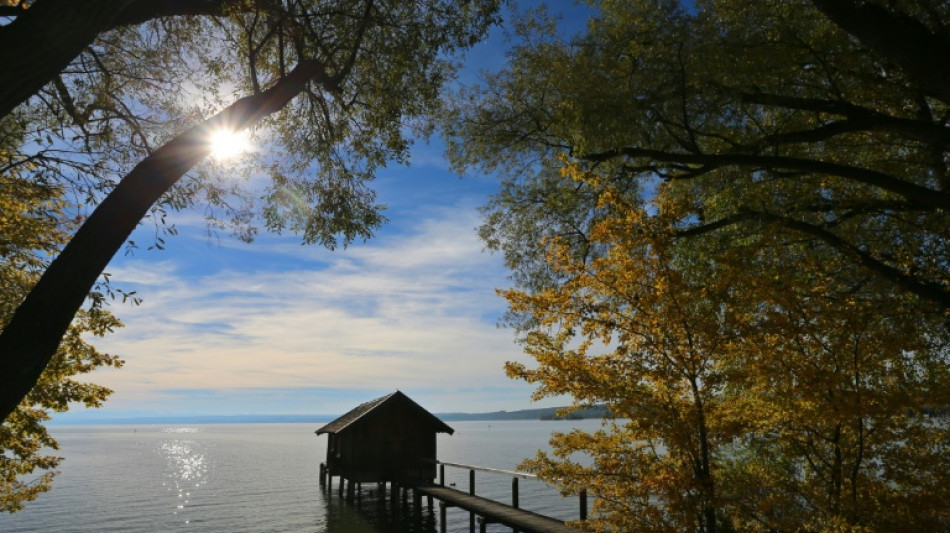
Just looking at images of nature can relieve pain, study finds / Photo: KARL-JOSEF HILDENBRAND - DPA/AFP/File

 ALEX BODI AND AMBASSADOR GUM DOMINIC MATIOK OF THE REPUBLIC OF SOUTH SUDAN MEET IN BERLIN TO DISCUSS THE POSSIBILITY OF AN HONORARY CONSULATE IN BUCHAREST

 Lula, Bolsonaro wrap up campaigns ahead of Brazil's knife-edge vote

 Toulouse edge Castres in Top 14 derby

 Murakami homer propels White Sox to MLB playoff win over Guardians

 Israel targets top Hamas leader in deadly Gaza strike on anniversary

 Houthis say struck oil facility near Riyadh, as Saudis hit Sanaa

 AI needs safety layers like nuclear plants: ex-OpenAI engineer

 MVP Judge will miss Yankees' MLB playoff series against Rays

 New lizard species discovered in Peru

 Fernandes hails Portugal's 'greatest symbol' Ronaldo, calls for unity

 Grandidier-Nkanang double takes Pau to Top 14 summit despite Vannes fightback
 Trainer Scott gets perfect Arc boost with top notch double

 Ex-PM says Putin cannot admit 'mistake' over Ukraine

 Houthis say Saudi Arabia launches dozens of strikes on Yemen capital

 Qatar and Abu Dhabi F1 Grand Prix to go ahead - F1 boss

 South Korea lift gloom with smash-and-grab Games football gold

 Ireland news conference before Israel game cut short amid tensions

 Protests over housing flare in Spain after relief measures rejected

 Zverev thrashes Shang to set up Djokovic quarter-final at China Open

 Turkey football ref chief jailed pending trial for graft
 North Korea says test of intermediate-range strategic missile included use of AI

 Rampant Sayers leads Hong Kong to third men's rugby gold in a row

 Ethiopia's Tigray rebels abandon regional capital as govt advances

 Bulgaria's Tsar Samuel returns 'home' after 1,000 years

 'Glad it's over': Kim powers to Games gold and military exemption

Simply looking at nature -- or even just digital pictures of it -- can relieve pain, according to new research which scanned the brains of people receiving electrical shocks.
Nature's many health benefits has been documented by decades of research.
More than 40 years ago, a pioneering study showed that hospitalised patients needed fewer painkillers and recovered quicker when they looked out of a window onto green space rather than a brick wall.
"Yet until now, the underlying reasons for this effect were unclear," said Maximilian Steininger, a neuroscientist at the University of Vienna and lead author of a study published in Nature Communications on Thursday.
The problem is that both nature and pain can be subjective.
Because people like nature, it could have a placebo effect. Or what if it is not nature that reduces pain, but city life that increases it?
To find out more, the researchers recorded the brain activity of 49 volunteers using functional magnetic resonance imaging (fRMI).
The subjects looked at different images while receiving a series of electric shocks -- some more painful than others -- on the back of their left hand.
The first scene depicted a lake surrounded by trees blowing in the wind, while the sounds of rustling leaves and birdsong played in the background.
In the second scene, some urban elements such as buildings, benches and alleyways were added, while city noise intruded.
The third scene was of an office, with the accompanying drab furniture and whir of work.
- 'Important practical implications' -
Not only did the participants report feeling less pain when they looking at the natural landscapes, the fMRI scans showed there was a difference in their brains.
"Our study is the first to provide evidence from brain scans that this isn't just a placebo effect," Steininger said in a statement.
The nature scenes provoked decreased activity in a part of the brain involved in perceiving pain, called nociception. However other areas linked to regulating pain were not significantly affected.
The researchers said the results could be because natural environments capture people's attention, diverting them away from the sensation of pain.
This is known in psychology as the "attention restoration theory".
"The fact that this pain-relieving effect can be achieved through a virtual nature exposure which is easy to administer has important practical implications," said study co-author Alex Smalley from the UK's Exeter University.
It also "opens new avenues for research to better understand how nature impacts our minds," he added.
J.Pereira--PC



