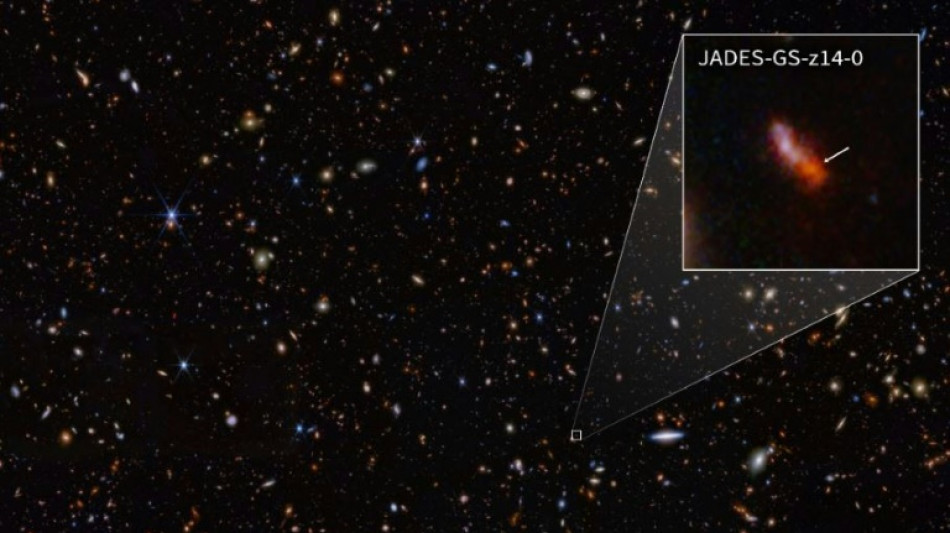
Oxygen detected in most distant galaxy: 'astonished' astronomers / Photo: HANDOUT - ESA, NASA, CSA, STScI/AFP/File

 ALEX BODI AND AMBASSADOR GUM DOMINIC MATIOK OF THE REPUBLIC OF SOUTH SUDAN MEET IN BERLIN TO DISCUSS THE POSSIBILITY OF AN HONORARY CONSULATE IN BUCHAREST

 Lula, Bolsonaro wrap up campaigns ahead of Brazil's knife-edge vote

 Toulouse edge Castres in Top 14 derby

 Murakami homer propels White Sox to MLB playoff win over Guardians

 Israel targets top Hamas leader in deadly Gaza strike on anniversary

 Houthis say struck oil facility near Riyadh, as Saudis hit Sanaa

 AI needs safety layers like nuclear plants: ex-OpenAI engineer

 MVP Judge will miss Yankees' MLB playoff series against Rays

 New lizard species discovered in Peru

 Fernandes hails Portugal's 'greatest symbol' Ronaldo, calls for unity

 Grandidier-Nkanang double takes Pau to Top 14 summit despite Vannes fightback

 Trainer Scott gets perfect Arc boost with top notch double

 Ex-PM says Putin cannot admit 'mistake' over Ukraine

 Houthis say Saudi Arabia launches dozens of strikes on Yemen capital

 Qatar and Abu Dhabi F1 Grand Prix to go ahead - F1 boss

 South Korea lift gloom with smash-and-grab Games football gold

 Ireland news conference before Israel game cut short amid tensions

 Protests over housing flare in Spain after relief measures rejected

 Zverev thrashes Shang to set up Djokovic quarter-final at China Open

 Turkey football ref chief jailed pending trial for graft

 North Korea says test of intermediate-range strategic missile included use of AI

 Rampant Sayers leads Hong Kong to third men's rugby gold in a row

 Ethiopia's Tigray rebels abandon regional capital as govt advances

 Bulgaria's Tsar Samuel returns 'home' after 1,000 years

 'Glad it's over': Kim powers to Games gold and military exemption

Oxygen has been detected in the most distant galaxy ever discovered, surprised astronomers said Thursday, offering further evidence that stars in the early universe matured far quicker than had been thought possible.
The galaxy JADES-GS-z14-0, which was discovered by the James Webb Space Telescope last year, is so far away that its light took 13.4 billion years to reach Earth.
This means the galaxy can also reveal what the universe was like in its infancy, when it was just 300 million years old -- two percent of its current age.
Since coming online in 2022, the powerful Webb telescope has discovered that galaxies in the young universe were much brighter, more advanced and more numerous than scientists had expected.
These discoveries have been so startling they have raised doubts about whether something important is missing in our understanding of the universe.
For the latest research, two international teams led by Dutch and Italian astronomers probed the JADES-GS-z14-0 galaxy using the ALMA radio telescope in Chile's Atacama desert.
They detected traces of oxygen, according to the European Southern Observatory, confirming hints previously spotted by the Webb telescope.
During this period known as the cosmic dawn, newly born galaxies were thought to only have young stars, which mostly contain light elements like hydrogen and helium.
Only later were they supposed to get heavier stuff such as oxygen.
But the two new studies found that JADES-GS-z14-0 has around 10 times more heavy elements than had been anticipated.
"It is like finding an adolescent where you would only expect babies," said Sander Schouws of Leiden Observatory, the first author of a Dutch-led study to be published in The Astrophysical Journal.
"The results show the galaxy has formed very rapidly and is also maturing rapidly, adding to a growing body of evidence that the formation of galaxies happens much faster than was expected," he said in a statement.
Astrophysicist Stefano Carniani, lead author of the Italian-led paper to be published in Astronomy & Astrophysics, said he was "astonished by the unexpected results".
"The evidence that a galaxy is already mature in the infant universe raises questions about when and how galaxies formed."
L.Carrico--PC



