Infants remember more than you think, new study reveals / Photo: Ina FASSBENDER - AFP/File

 ALEX BODI AND AMBASSADOR GUM DOMINIC MATIOK OF THE REPUBLIC OF SOUTH SUDAN MEET IN BERLIN TO DISCUSS THE POSSIBILITY OF AN HONORARY CONSULATE IN BUCHAREST

 Lula, Bolsonaro wrap up campaigns ahead of Brazil's knife-edge vote

 Toulouse edge Castres in Top 14 derby

 Murakami homer propels White Sox to MLB playoff win over Guardians

 Israel targets top Hamas leader in deadly Gaza strike on anniversary

 Houthis say struck oil facility near Riyadh, as Saudis hit Sanaa

 AI needs safety layers like nuclear plants: ex-OpenAI engineer

 MVP Judge will miss Yankees' MLB playoff series against Rays

 New lizard species discovered in Peru

 Fernandes hails Portugal's 'greatest symbol' Ronaldo, calls for unity

 Grandidier-Nkanang double takes Pau to Top 14 summit despite Vannes fightback
 Trainer Scott gets perfect Arc boost with top notch double

 Ex-PM says Putin cannot admit 'mistake' over Ukraine

 Houthis say Saudi Arabia launches dozens of strikes on Yemen capital

 Qatar and Abu Dhabi F1 Grand Prix to go ahead - F1 boss

 South Korea lift gloom with smash-and-grab Games football gold

 Ireland news conference before Israel game cut short amid tensions

 Protests over housing flare in Spain after relief measures rejected

 Zverev thrashes Shang to set up Djokovic quarter-final at China Open

 Turkey football ref chief jailed pending trial for graft

 North Korea says test of intermediate-range strategic missile included use of AI

 Rampant Sayers leads Hong Kong to third men's rugby gold in a row

 Ethiopia's Tigray rebels abandon regional capital as govt advances

 Bulgaria's Tsar Samuel returns 'home' after 1,000 years

 'Glad it's over': Kim powers to Games gold and military exemption

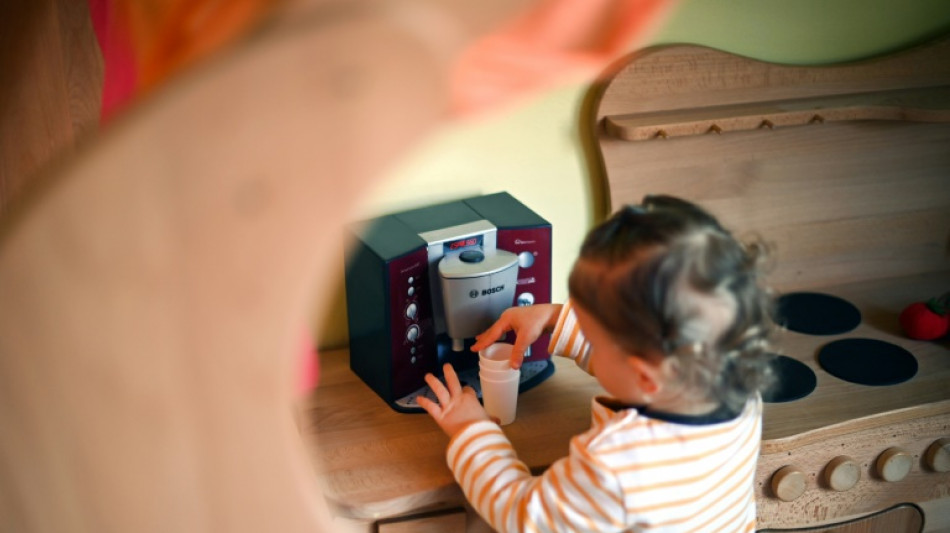
Our earliest years are a time of rapid learning, yet we typically cannot recall specific experiences from that period -- a phenomenon known as infantile amnesia.
A new study published in Science on Thursday challenges assumptions about infant memory, showing that young minds do indeed form memories. The question remains, however, why these memories become difficult to retrieve later in life.
"I've always been fascinated by this mysterious blank spot we have in our personal history," Nick Turk-Browne, professor of psychology at Yale and the study's senior author, told AFP.
Around the age of one, children become extraordinary learners -- acquiring language, walking, recognizing objects, understanding social bonds, and more. "Yet we remember none of those experiences -- so there's a sort of mismatch between this incredible plasticity and learning ability that we have," he said.
Sigmund Freud, the founder of psychoanalysis, hypothesized that early memories are repressed, though science has since largely dismissed the idea of an active suppression process. Instead, modern theories focus on the hippocampus, a part of the brain critical for episodic memory, which is not fully developed in infancy.
Turk-Browne, however, was intrigued by clues from previous behavioral research. Since babies cannot verbally report memories before acquiring language, their tendency to gaze longer at familiar things provides important hints.
Recent rodent studies monitoring brain activity have also shown that engrams -- patterns of cells that store memories -- form in the infant hippocampus but become inaccessible over time -- though they can be artificially reawakened through a technique that uses light to stimulate neurons.
But until now, pairing observations of infants with brain imaging had been out of reach, as babies are famously uncooperative when it comes to sitting still inside a Functional Magnetic Resonance Imaging (fMRI) machine -- the device that tracks blood flow to "see" brain activity.
- Psychedelic patterns -
To overcome this challenge, Turk-Browne's team used methods his lab has refined over the years -- working with families to incorporate pacifiers, blankets, and stuffed animals; holding babies still with pillows; and using psychedelic background patterns to keep them engaged.
Still, inevitable wiggling led to blurry images that had to be discarded, but the team accounted for this by running hundreds of sessions.
In total, 26 infants participated -- half under a year old, half over -- while their brains were scanned during a memory task adapted from adult studies.
First, they were shown images of faces, scenes, or objects. Later, after viewing other images, they were presented with a previously seen image alongside a new one.
"We quantify how much time they spend looking at the old thing they've seen before, and that's a measure of their memory for that image," said Turk-Browne.
By comparing brain activity during successful memory formation versus forgotten images, the researchers confirmed that the hippocampus is active in memory encoding from a young age.
This was true for 11 of 13 infants over a year old but not for those under one. They also found that babies who performed best on memory tasks showed greater hippocampal activity.
"What we can conclude accurately from our study is that infants have the capacity to encode episodic memories in the hippocampus starting around one year of age," said Turk-Browne.
- Forgotten Memories -
"The ingenuity of their experimental approach should not be understated," researchers Adam Ramsaran and Paul Frankland wrote in an accompanying Science editorial.
But what remains unresolved is what happens to these early memories. Perhaps they are never fully consolidated into long-term storage -- or perhaps they persist but become inaccessible.
Turk-Browne suspects the latter and is now leading a new study testing whether infants, toddlers, and children can recognize video clips recorded from their own perspective as younger babies.
Early, tentative results suggest these memories might persist until around age three before fading. Turk-Browne is particularly intrigued by the possibility that such fragments could one day be reactivated later in life.
A.Magalhes--PC



