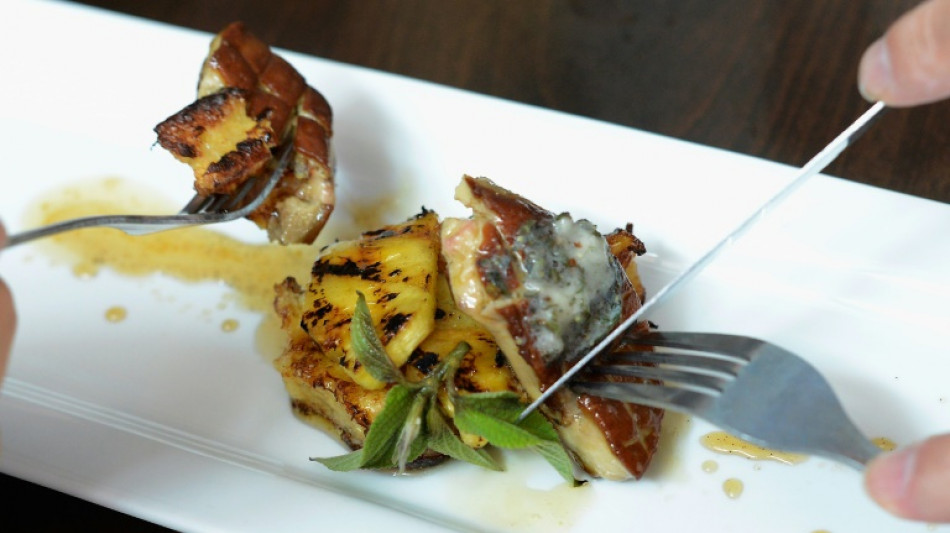
Faux gras? Scientists craft 'more ethical' version of French delicacy / Photo: KEVORK DJANSEZIAN - GETTY IMAGES NORTH AMERICA/AFP/File

 ALEX BODI AND AMBASSADOR GUM DOMINIC MATIOK OF THE REPUBLIC OF SOUTH SUDAN MEET IN BERLIN TO DISCUSS THE POSSIBILITY OF AN HONORARY CONSULATE IN BUCHAREST

 Lula, Bolsonaro wrap up campaigns ahead of Brazil's knife-edge vote

 Toulouse edge Castres in Top 14 derby

 Murakami homer propels White Sox to MLB playoff win over Guardians

 Israel targets top Hamas leader in deadly Gaza strike on anniversary

 Houthis say struck oil facility near Riyadh, as Saudis hit Sanaa

 AI needs safety layers like nuclear plants: ex-OpenAI engineer

 MVP Judge will miss Yankees' MLB playoff series against Rays

 New lizard species discovered in Peru

 Fernandes hails Portugal's 'greatest symbol' Ronaldo, calls for unity

 Grandidier-Nkanang double takes Pau to Top 14 summit despite Vannes fightback
 Trainer Scott gets perfect Arc boost with top notch double

 Ex-PM says Putin cannot admit 'mistake' over Ukraine
 Houthis say Saudi Arabia launches dozens of strikes on Yemen capital

 Qatar and Abu Dhabi F1 Grand Prix to go ahead - F1 boss

 South Korea lift gloom with smash-and-grab Games football gold
 Ireland news conference before Israel game cut short amid tensions

 Protests over housing flare in Spain after relief measures rejected

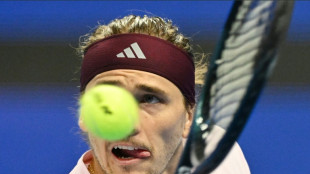 Zverev thrashes Shang to set up Djokovic quarter-final at China Open

 Turkey football ref chief jailed pending trial for graft

 North Korea says test of intermediate-range strategic missile included use of AI

 Rampant Sayers leads Hong Kong to third men's rugby gold in a row

 Ethiopia's Tigray rebels abandon regional capital as govt advances

 Bulgaria's Tsar Samuel returns 'home' after 1,000 years

 'Glad it's over': Kim powers to Games gold and military exemption

Foie gras — the fattened liver of ducks or geese — is a French delicacy prized for its rich, buttery flavor. But its production, which involves force-feeding the animals, has led to bans in several countries.
Now, a team of scientists says they've developed a more ethical alternative: one that mimics the taste and texture of the dish, minus the controversy.
The results were published Tuesday in the journal Physics of Fluids.
"It was always a dream to make foie gras more accessible and better for animal welfare," said lead author Thomas Vilgis, a professor of food science at the Max Planck Institute for Polymer Research in Mainz, Germany. "It's good to stop these force-feeding practices —- or at least reduce them."
Vilgis and his colleagues from his own institute and the University of Southern Denmark were adamant about one thing: no outside additives.
They initially tried cooking collagen from the birds' skin and bones into the liver-fat emulsion, but the result lacked the signature silky texture.
Then came the breakthrough: treating the fat with the bird's own lipases: enzymes the body naturally uses to break down fats. This tweak replicated a key part of the foie gras formation process, without resorting to force-feeding.
"At the end of the process, it allows the fat to recrystallize into the large crystals which form aggregates like the ones we see in the original foie gras," Vilgis said.
According to the authors, the elegance of the method lies in its simplicity: harvest the liver and fat, treat the fat with lipases, mix, sterilize — and voila.
Laser microscopy gave the new product a thumbs-up: the emulsion structure, fat droplet size, and shape closely matched traditional foie gras. Even the aroma passed the test.
To test texture, the team turned to industrial compression devices -— machines that gently press on food samples to measure firmness. The new foie gras held up well, offering a mouthfeel strikingly close to the original.
"We could really see the influence of these large fat particles, which we call in the paper 'percolating clusters,'" Vilgis said.
"At the beginning of the 'bite,' these large clusters have a high resistance, creating a similar mouthfeel of elasticity -— without being too rubbery like after the collagen or gelatin addition."
Vilgis has filed a patent for the process and now hopes to partner with companies to bring this kinder foie gras to market.
P.Queiroz--PC