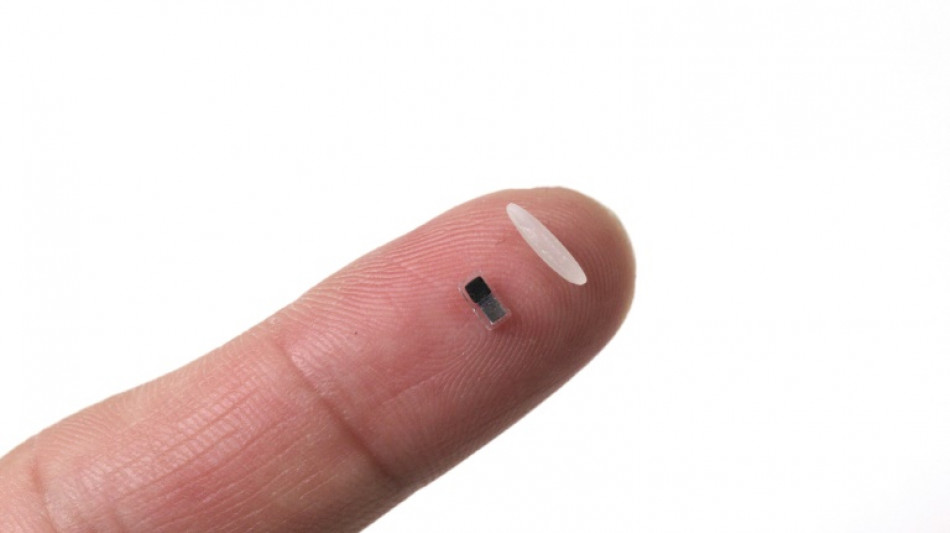
World's tiniest pacemaker is smaller than grain of rice / Photo: John A. Rogers - Northwestern University/AFP

 ALEX BODI AND AMBASSADOR GUM DOMINIC MATIOK OF THE REPUBLIC OF SOUTH SUDAN MEET IN BERLIN TO DISCUSS THE POSSIBILITY OF AN HONORARY CONSULATE IN BUCHAREST

 Lula, Bolsonaro wrap up campaigns ahead of Brazil's knife-edge vote

 Toulouse edge Castres in Top 14 derby

 Murakami homer propels White Sox to MLB playoff win over Guardians

 Israel targets top Hamas leader in deadly Gaza strike on anniversary

 Houthis say struck oil facility near Riyadh, as Saudis hit Sanaa

 AI needs safety layers like nuclear plants: ex-OpenAI engineer

 MVP Judge will miss Yankees' MLB playoff series against Rays

 New lizard species discovered in Peru

 Fernandes hails Portugal's 'greatest symbol' Ronaldo, calls for unity

 Grandidier-Nkanang double takes Pau to Top 14 summit despite Vannes fightback

 Trainer Scott gets perfect Arc boost with top notch double

 Ex-PM says Putin cannot admit 'mistake' over Ukraine

 Houthis say Saudi Arabia launches dozens of strikes on Yemen capital

 Qatar and Abu Dhabi F1 Grand Prix to go ahead - F1 boss

 South Korea lift gloom with smash-and-grab Games football gold

 Ireland news conference before Israel game cut short amid tensions

 Protests over housing flare in Spain after relief measures rejected

 Zverev thrashes Shang to set up Djokovic quarter-final at China Open

 Turkey football ref chief jailed pending trial for graft

 North Korea says test of intermediate-range strategic missile included use of AI

 Rampant Sayers leads Hong Kong to third men's rugby gold in a row

 Ethiopia's Tigray rebels abandon regional capital as govt advances

 Bulgaria's Tsar Samuel returns 'home' after 1,000 years

 'Glad it's over': Kim powers to Games gold and military exemption

Scientists said Wednesday they have developed the world's tiniest pacemaker, a temporary heartbeat regulator smaller than a grain of rice that can be injected and controlled by light before dissolving.
While still years away from being tested in humans, the wireless pacemaker was hailed as a "transformative breakthrough" that could spur advances in other areas of medicine.
Millions of people across the world have permanent pacemakers, which stimulate hearts with electrical pulses to ensure they beat normally.
The US-led team of researchers behind the new device said they were motivated to help the one percent of children born with congenital heart defects who need a temporary pacemaker in the week after surgery.
The pacemaker could also help adults restore a normal heartbeat as they recover from heart surgery.
Currently, temporary pacemakers require surgery to sew electrodes onto heart muscles, with wires connecting to a powered device on the patient's chest.
When the pacemaker is no longer needed, doctors or nurses pull out the wires, which can sometimes cause damage.
Neil Armstrong, the first person to walk on the Moon, died from internal bleeding after his temporary pacemaker was removed in 2012.
But the newly developed pacemaker is wireless. And at just one millimetre thick and 3.5 millimetres long, it can fit into the tip of a syringe.
It has also been designed to dissolve into the body when no longer needed, sparing patients invasive surgery.
- 'Significant leap forward' -
The pacemaker is paired to a soft patch worn on the patient's chest, according to a study describing the device in the journal Nature.
When the patch detects irregular heartbeats, it automatically flashes light that tells the pacemaker what heartbeat it should stimulate.
The pacemaker is powered by what is called a galvanic cell, which uses the body's fluids to convert chemical energy into electrical pulses that stimulate the heart.
So far, the pacemaker has worked effectively in tests on mice, rats, pigs, dogs and human heart tissue in the lab, according to the study.
Senior study author John Rogers of Northwestern University in the United States told AFP he estimated the pacemaker could be tested in humans in two to three years.
His lab has launched a start-up to pursue this goal, he added.
In the future, the underlying technology could also "create unique and powerful strategies to address societal challenges in human health," Rogers said.
Bozhi Tian, whose lab at the University of Chicago has also developed light-activated pacemakers but was not involved in the latest research, called it a "significant leap forward".
"This new pacemaker is a transformative breakthrough in medical technology," he told AFP.
"It's a paradigm shift in temporary pacing and bioelectronic medicine, opening up possibilities far beyond cardiology -- including nerve regeneration, wound healing and integrated smart implants."
Heart disease is the world's leading cause of death, according to the World Health Organization.
M.Carneiro--PC



