
'I don't have a voice in my head': Life with no inner monologue / Photo: Eric BARADAT - AFP/File

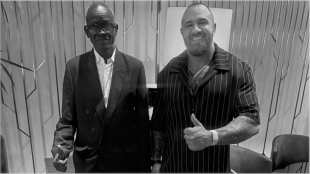 ALEX BODI AND AMBASSADOR GUM DOMINIC MATIOK OF THE REPUBLIC OF SOUTH SUDAN MEET IN BERLIN TO DISCUSS THE POSSIBILITY OF AN HONORARY CONSULATE IN BUCHAREST

 Lula, Bolsonaro wrap up campaigns ahead of Brazil's knife-edge vote

 Toulouse edge Castres in Top 14 derby

 Murakami homer propels White Sox to MLB playoff win over Guardians

 Israel targets top Hamas leader in deadly Gaza strike on anniversary

 Houthis say struck oil facility near Riyadh, as Saudis hit Sanaa

 AI needs safety layers like nuclear plants: ex-OpenAI engineer

 MVP Judge will miss Yankees' MLB playoff series against Rays

 New lizard species discovered in Peru

 Fernandes hails Portugal's 'greatest symbol' Ronaldo, calls for unity

 Grandidier-Nkanang double takes Pau to Top 14 summit despite Vannes fightback

 Trainer Scott gets perfect Arc boost with top notch double

 Ex-PM says Putin cannot admit 'mistake' over Ukraine

 Houthis say Saudi Arabia launches dozens of strikes on Yemen capital

 Qatar and Abu Dhabi F1 Grand Prix to go ahead - F1 boss

 South Korea lift gloom with smash-and-grab Games football gold

 Ireland news conference before Israel game cut short amid tensions

 Protests over housing flare in Spain after relief measures rejected

 Zverev thrashes Shang to set up Djokovic quarter-final at China Open

 Turkey football ref chief jailed pending trial for graft

 North Korea says test of intermediate-range strategic missile included use of AI

 Rampant Sayers leads Hong Kong to third men's rugby gold in a row

 Ethiopia's Tigray rebels abandon regional capital as govt advances

 Bulgaria's Tsar Samuel returns 'home' after 1,000 years

 'Glad it's over': Kim powers to Games gold and military exemption

Mel May only realised she was different while reading a news article one day.
"Wait, what? Some people hear a voice in their head?" she thought at the time.
She was stunned to discover that this was not just a figure of speech -- her friends were actually chatting to themselves in their minds.
May, a 30-year-old Australian video producer who lives in New York, remembers trying to explain to her family: "I don't have a voice in my head."
"My dad was like, 'You are lying'," she told AFP.
But her father came around once May started working with psychologists who agreed -- she is one of the very rare people who lack inner speech.
The idea that some people might not experience this phenomenon is so new that a clinical name, anendophasia, was only proposed for it in a paper last year.
The inner monologue has proven extremely difficult to study because it relies on people being able to describe how they think -- and it turns out we are unreliable narrators.
"People are ignorant about the characteristics of their own inner experience," Russell Hurlburt, a psychology professor at the University of Nevada, Las Vegas, told AFP.
"And it doesn't matter how confident you are," added Hurlburt, a pioneer in the field who has studied people with a range of inner experiences, including May.
Most people assume their inner voice is speaking all the time but it is actually just one of several phenomena of our inner experience, Hurlburt said.
Others include visual imagery, "unsymbolised thinking", feelings and sensory awareness.
- Only a quarter of the time? -
To study these phenomena, Hurlburt conducted research that would have a beeper go off at random while study participants were reading Franz Kafka's "The Metamorphosis" and describe what was in their head.
Rather than speaking the words in their inner voice, they were actually creating visual images -- "their own video" -- of the book, he said.
People also have different kinds of inner speech. Some have multiple voices, while bilingual people can switch languages.
Giordon Stark, a California-based particle physicist who was born deaf, has a mix of inner speech and visual images.
"I don't think of the word 'bed' in my head but I rather visualise the idea of my head hitting the pillow," which is similar to the sign language gesture for the word, the 34-year-old told AFP.
Pressed to estimate how often people are hearing an inner voice, Hurlburt emphasised that much more research is needed on the subject.
But a ballpark figure could be that people are "inner speaking" 20 to 25 percent of the time, he said.
That average includes people who have far more frequent speech and those with none, such as May.
"Her inner experience is close to being nothing but she's the exception rather than the rule," Hurlburt said.
Helene Loevenbruck, a leading inner voice researcher at France's Universite Grenoble Alpes, has had to change her mind on whether people like May could even exist.
"I thought everyone had an inner voice until very recently," she told AFP.
The idea ran counter to her previous work, which suggested inner speech was an important part of speaking out loud, serving as an "internal simulation".
But the work of Hurlburt -- and the discovery that some people cannot create mental images, a condition called aphantasia -- changed her mind.
- 'Pros and cons' -
May believes her lack of an inner voice is why she has never been an anxious person -- and why meditation is very easy for her.
Daniel Gregory, a philosopher specialising in inner speech at the University of Barcelona, said a potential disadvantage of having more inner speech is "a vulnerability to negative thought patterns, to rumination".
But we can also "use inner speech to encourage ourselves, to give ourselves positive messages", he told AFP.
May said a common response to hearing that she has no inner monologue is: "Wow, that must be amazing."
"I'm really quick to push back on that because I think certainly there are pros and cons," she said.
"I reflect a lot about what aspects of the lived experience I'm missing out on."
As well as not stressing about the future, May has a hard time remembering the past.
Loevenbruck said the people she had studied with aphantasia reported having "weird" autobiographical memories "because they have no sensory way of reliving a memory".
May emphasised that lacking an inner voice did not mean she was incapable of thought.
"I'm not dead inside. I know stuff and I feel stuff," said May, who plans to make a documentary about her experience.
Asked what was running through her head, she responded simply.
"Well, I'm sitting here, I'm listening to you and then I just automatically respond. And that's it.
"Isn't that how this happens for everyone?"
E.Raimundo--PC



