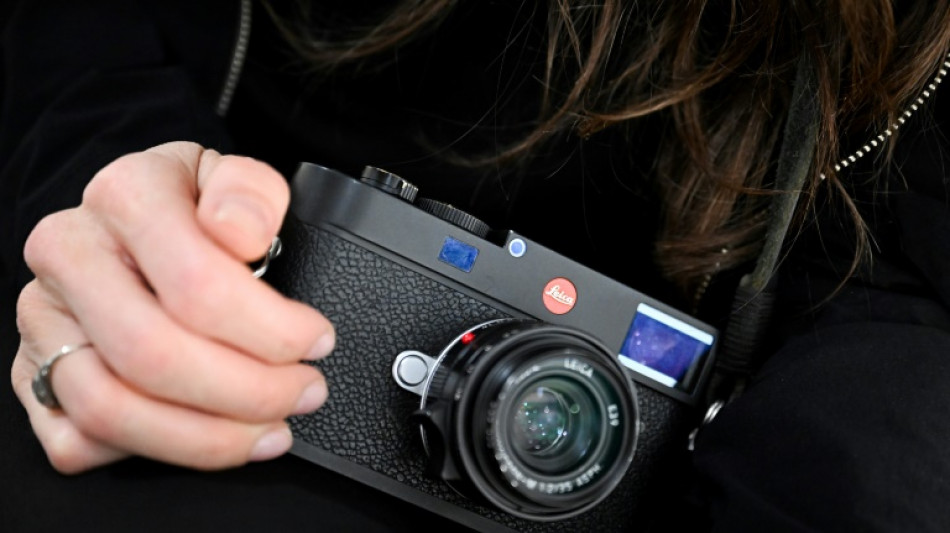
Snappy birthday: Germany's Leica camera turns 100 / Photo: Kirill KUDRYAVTSEV - AFP

 ALEX BODI AND AMBASSADOR GUM DOMINIC MATIOK OF THE REPUBLIC OF SOUTH SUDAN MEET IN BERLIN TO DISCUSS THE POSSIBILITY OF AN HONORARY CONSULATE IN BUCHAREST

 Lula, Bolsonaro wrap up campaigns ahead of Brazil's knife-edge vote
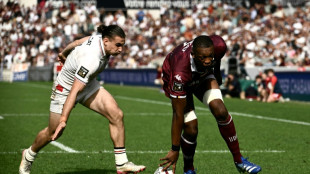
 Toulouse edge Castres in Top 14 derby
 Murakami homer propels White Sox to MLB playoff win over Guardians

 Israel targets top Hamas leader in deadly Gaza strike on anniversary
 Houthis say struck oil facility near Riyadh, as Saudis hit Sanaa

 AI needs safety layers like nuclear plants: ex-OpenAI engineer

 MVP Judge will miss Yankees' MLB playoff series against Rays

 New lizard species discovered in Peru

 Fernandes hails Portugal's 'greatest symbol' Ronaldo, calls for unity

 Grandidier-Nkanang double takes Pau to Top 14 summit despite Vannes fightback

 Trainer Scott gets perfect Arc boost with top notch double

 Ex-PM says Putin cannot admit 'mistake' over Ukraine

 Houthis say Saudi Arabia launches dozens of strikes on Yemen capital
 Qatar and Abu Dhabi F1 Grand Prix to go ahead - F1 boss

 South Korea lift gloom with smash-and-grab Games football gold

 Ireland news conference before Israel game cut short amid tensions

 Protests over housing flare in Spain after relief measures rejected

 Zverev thrashes Shang to set up Djokovic quarter-final at China Open

 Turkey football ref chief jailed pending trial for graft

 North Korea says test of intermediate-range strategic missile included use of AI

 Rampant Sayers leads Hong Kong to third men's rugby gold in a row

 Ethiopia's Tigray rebels abandon regional capital as govt advances

 Bulgaria's Tsar Samuel returns 'home' after 1,000 years

 'Glad it's over': Kim powers to Games gold and military exemption

Photographer Franziska Stuenkel likes to take spontaneous urban shots, so she needs a nimble camera that is ready to go when inspiration strikes: her German-made Leica M11.
"I have to be very quick and discreet," said the Berlin-based artist who captures reflections of people walking past windows, their contours merging with the shapes behind the glass.
Stuenkel's compact Leica is the perfect camera for the job, the 51-year-old told AFP.
Famous for its pocket-sized and retro-style devices, the Leica brand is celebrating a milestone as it marks 100 years since its first commercial camera was presented to the public.
The Leica company was founded in 1869 by the entrepreneur Ernst Leitz in the city of Wetzlar in western Germany, originally manufacturing optical lenses and microscopes.
But it was not until 1925 that the Leica 1 camera was introduced at the Leipzig Spring Fair.
Leica cameras went on to become the tool of choice for prominent photographers for years to come, including legendary photojournalists Robert Capa and Henri Cartier-Bresson.
Even today, the nifty camera with a red dot still holds its own in a market dominated by Japanese giants such as Sony, Canon and Nikon.
- 'Better photographer' -
Working with a Leica "makes you a better photographer", said British artist Alan Schaller, who uses a monochrome version of the M11 -- a digital camera with manual controls.
Schaller has got so used to adjusting the aperture, shutter speed and light sensitivity manually that he said he can now do it "faster than any automatic device".
One hundred years on, Leica cameras are still assembled by hand in a factory in Wetzlar, north of Frankfurt.
In the dust-free assembly room, 70 workers equipped with precision screwdrivers and anti-static tweezers build the devices by hand from more than 600 parts.
It's a painstaking job "that requires a lot of experience", said Peter Schreiner, head of camera assembly.
In another room nearby, lenses are polished to within 0.1 millionth of a metre before they are glued and lacquered.
After a difficult decade in the 2000s, Leica has turned its fortunes around by fully embracing digital cameras, which now account for the vast majority of sales.
The company still makes a handful of analogue devices -- including the M6, a cousin of the M11.
Leica's chief executive Matthias Harsch said sales are projected to have reached a record 600 million euros ($660 million) in 2024/25, with annual growth close to 10 percent.
- Leitz Phone -
Total global sales of digital cameras grew by only four percent last year, to 6.8 billion euros, according to Germany's GfK consumer institute.
Innovation remains at the heart of the brand, with a research budget of "more than 10 percent of sales", according to Harsch.
Beyond cameras, Leica has diversified into watches and laser projectors for home cinema, as well as cameras for smartphones.
Leica lenses can now be found in smartphones made by the Chinese company Xiaomi as well as in the Leitz Phone, designed by Leica with Sharp for the Japanese market.
But new technology can never replace the romance of the Leica camera, according to Harsch.
"With a phone, you take snapshots. Everything else is photography," he said, insisting that the two strands of the company's work enjoy a "peaceful coexistence".
Leica's phone cameras and its traditional models are also worlds apart when it comes to price -- the M11 costs upwards of 9,000 euros, plus a few thousand euros extra for a lens.
North America represents around 20 percent of Leica's total sales and the company is "assessing the impact" of tariffs announced by US President Donald Trump, Harsch said.
Leica operates more than 120 of its own stores worldwide, including in the United States, with more openings planned this year.
A.Motta--PC



