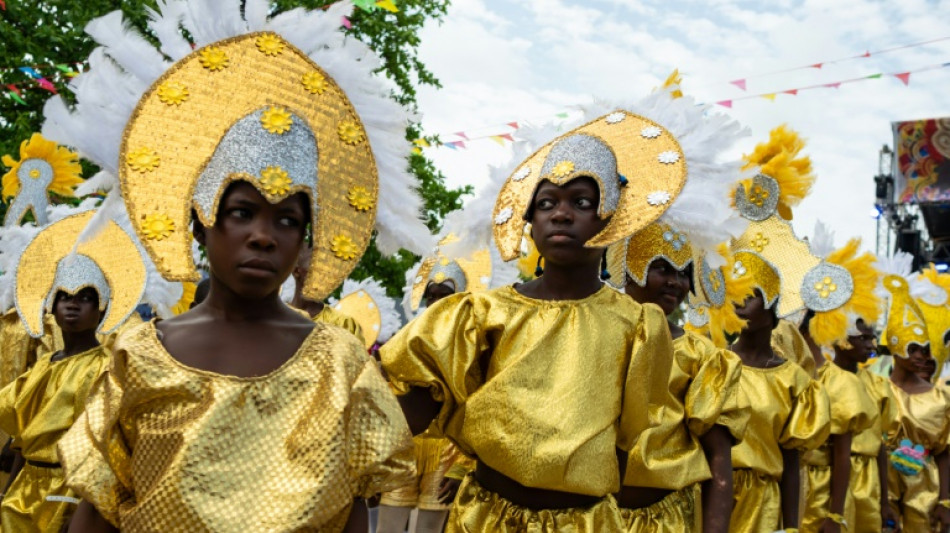
Afro-Brazilian carnival celebrates cultural kinship in Lagos / Photo: TOYIN ADEDOKUN - AFP

 Lula, Bolsonaro wrap up campaigns ahead of Brazil's knife-edge vote

 Toulouse edge Castres in Top 14 derby

 Murakami homer propels White Sox to MLB playoff win over Guardians

 Israel targets top Hamas leader in deadly Gaza strike on anniversary

 Houthis say struck oil facility near Riyadh, as Saudis hit Sanaa

 AI needs safety layers like nuclear plants: ex-OpenAI engineer

 MVP Judge will miss Yankees' MLB playoff series against Rays

 New lizard species discovered in Peru

 Fernandes hails Portugal's 'greatest symbol' Ronaldo, calls for unity

 Grandidier-Nkanang double takes Pau to Top 14 summit despite Vannes fightback
 Trainer Scott gets perfect Arc boost with top notch double

 Ex-PM says Putin cannot admit 'mistake' over Ukraine

 Houthis say Saudi Arabia launches dozens of strikes on Yemen capital

 Qatar and Abu Dhabi F1 Grand Prix to go ahead - F1 boss

 South Korea lift gloom with smash-and-grab Games football gold

 Ireland news conference before Israel game cut short amid tensions
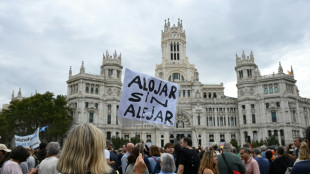 Protests over housing flare in Spain after relief measures rejected

 Zverev thrashes Shang to set up Djokovic quarter-final at China Open

 Turkey football ref chief jailed pending trial for graft

 North Korea says test of intermediate-range strategic missile included use of AI

 Rampant Sayers leads Hong Kong to third men's rugby gold in a row

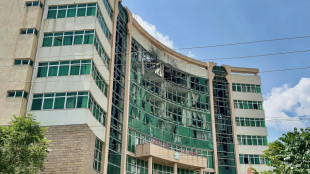 Ethiopia's Tigray rebels abandon regional capital as govt advances

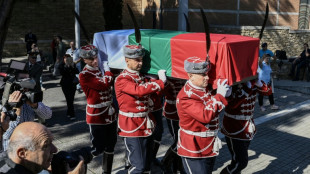 Bulgaria's Tsar Samuel returns 'home' after 1,000 years

 'Glad it's over': Kim powers to Games gold and military exemption

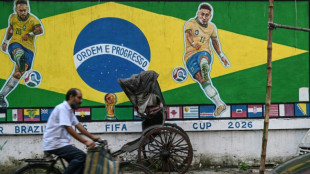 After 11 World Cups, football finally comes home for one Indian fan
Thousands of young and old descendants of formerly enslaved people donned elaborate costumes Sunday to bring the rhythm, vibrancy and colours of Brazil's Rio Carnival to the streets of Lagos in Nigeria.
The festival, albeit on a smaller scale than that of its Brazilian model, helps to keep their heritage alive and celebrate the city's Afro-Brazilian history.
After Brazil abolished slavery, some of those who had been enslaved returned to west Africa, settling in several countries including Nigeria and Sierra Leone.
They brought with them Latin American culture -- dance, food, religion and colours -- that lives on today in pockets of the megacity of Lagos.
At Sunday's Fanti Carnival, a stilt-walking woman in a green-and-yellow dress with a yellow fascinator on her head danced rhythmically to sounds of loud drums and trumpets, sometimes stealing a hug from a man also performing on stilts.
Just behind them, a group of young men in striking face masks were preparing for a "dragon dance" using long rubber dragons similar to those that feature in Chinese New Year celebrations.
"We want to keep (our heritage) alive, very colourful... we love colours," said retired fine art teacher Onabolu Abiola, 67, dressed in the green and yellow of the Brazilian flag.
"During this period, we don't bother ourselves with the economic situation or whatever... everybody comes together to have fun," said he added, breaking into an impromptu dance to traditional Nigerian Yoruba music.
- 'Story of hope' -
"We are here to show culture, we are here to make history -- the celebration of culture is important," said 50-year-old Mayegun Musiliu as he walked with fellow performers. "This is how we sustain it."
Brazil was the last place in the Americas to abolish slavery when it formally ended the practice in 1888.
Many slaves were forced to adopt Portuguese names, and today in Nigeria, it is common to find people with Yoruba first names and Portuguese surnames.
One of them is Aduke Gomez, a 62-year-old lawyer and historian.
"The story of Afro-Brazilians is a story of tragedy... but it's a story of hope, it's a story of resilience," she said. Loud music blaring from speakers almost drowned out her words.
"Personally, I'm very proud to be an Afro-Brazilian descendent because when you think of the chances of how many people came back and when they came back -- they came back with nothing... and many of them worked and lived to become educated and were contributing positively."
The carnival, she added, "is not just a day, it's a tangible legacy of what my ancestors went through".
- A little-known legacy -
Another participant, renowned filmmaker and actress Joke Silva, 64, recalled how her parents always used to bring her to the Fanti festival as a child.
She said she now continued the tradition, bringing her children to the celebrations.
"There needs to be more interrogation on how the trauma of (slavery)... has been part of what we are today. But that is not to claim victimhood," she said.
The carnival represents a part of Nigeria's history that is not always well known -- though some are trying to change that.
Kelenchi Anabaraonye, 27, curated a history exhibition at the festival.
"I had friends who were named Pionero, Pereira, Da Silva, Gomez," said Anabaraonye.
"Back then I thought they were jesting with the names, because you have a Yoruba first name and why are your surnames foreign? I didn't know that there was some historical connection."
A.F.Rosado--PC



