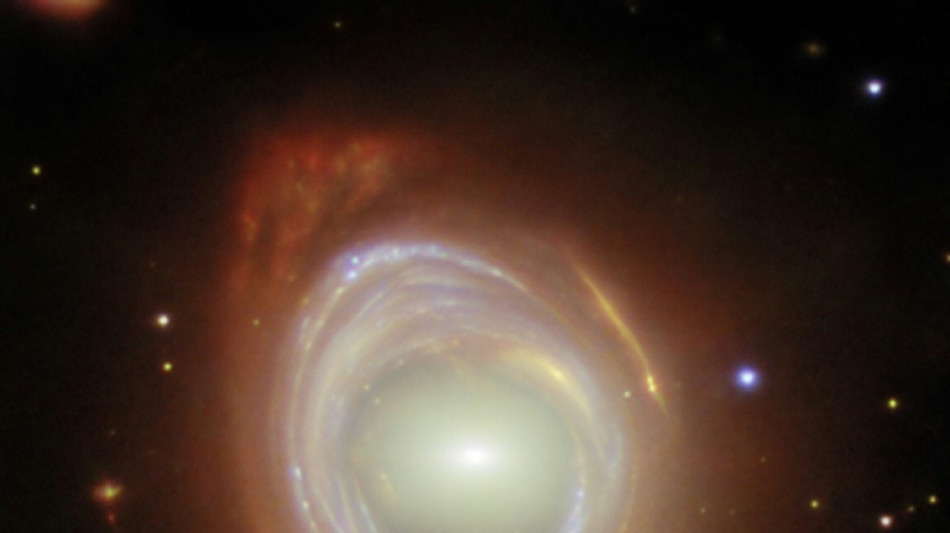
Universe dying quicker than thought, says new research / Photo: Handout - ESA/Webb, NASA & CSA, G. Mahler/AFP

 Yamal on target as Spain hold off Czech Republic

 Latvian exit polls suggest pro-European choice

 Lula, Bolsonaro wrap up campaigns ahead of knife-edge election

 Tuchel hails 'complete' England after Croatia demolition

 Fury to invite Trump to lead ring walk before Joshua showdown

 Fashion industry in 'precarious moment', says Vivienne Westwood supremo

 Seventh heaven for England in Nations League rout of Croatia

 Storms, flooding cause chaos on Greek holiday island of Crete

 #IAmJaneDoe: online support campaign in US university rape case

 Brazil shine on Selecao's first visit to India

 Zverev sets up Djokovic quarter-final at China Open, Rybakina out

 Happier at home, Bordeaux hammer Lyon in Top 14

 Lula, Bolsonaro in final push for votes ahead of knife-edge election

 Boisterous fashion week barnstorms 'sleepy' Nigerian capital

 UAE investigators say flydubai co-pilot was planning 'terrorist act'

 Rahul smacks century in India v Windies ODI

 Daryz seeks to join exclusive club of dual Arc winners

 Russia warns diplomats to leave Kyiv over new strikes threat

 Olympic champ Zheng rebukes rowdy home crowd at China Open

 World No.1 Sinner pulls out of Shanghai Masters to delay return

 Red Bull's Verstappen grabs pole position for Bahrain GP

 India beat Pakistan in blockbuster as golfer Kim wins 'crazy' gold

 India beat arch-rivals Pakistan to win Asian Games cricket gold

 Ethiopia's Tigray rebels abandon regional capital as govt advances: journalist

 Tom Kim powers to Games gold and exemption from military service

The universe is poised to die much faster than previously thought, according to new research by Dutch scientists.
But there's no great need to panic. We still have 10 to the power of 78 years before it happens -- that's a one with 78 zeroes.
However, that is a major revision from the previous estimate of 10 to the power of 1,100 years, notes the research paper from Radboud University, published in the Journal of Cosmology and Astroparticle Physics.
"The final end of the universe is coming much sooner than expected but fortunately it still takes a very long time," said lead author Heino Falcke.
A trio of scientists at Radboud set out to calculate when the most "durable" celestial bodies -- white dwarf stars -- would eventually die out.
They based their calculations on Hawking radiation, named after celebrated British physicist Stephen Hawking.
Hawking postulated in the mid-1970s that black holes leak radiation, slowly dissolving like aspirin in a glass of water -- giving them a finite lifetime.
The Radboud scientists extended this to other objects in the universe, calculating that the "evaporation time" depends on density.
This enabled them to calculate the theoretical dissolution of the longest-lasting body, the white dwarf.
"By asking these kinds of questions and looking at extreme cases, we want to better understand the theory, and perhaps one day, we can unravel the mystery of Hawking radiation," said co-author Walter van Suijlekom.
Humankind needn't worry too much about the end of the universe. Unless we escape planet Earth, we'll be long gone.
Scientists think that our Sun will be too hot for life in about a billion years, boiling our oceans.
In about eight billion years, our star will eventually expand towards the Earth, finally gobbling up our by-then barren and lifeless planet and condemning it to a fiery death.
J.Oliveira--PC



