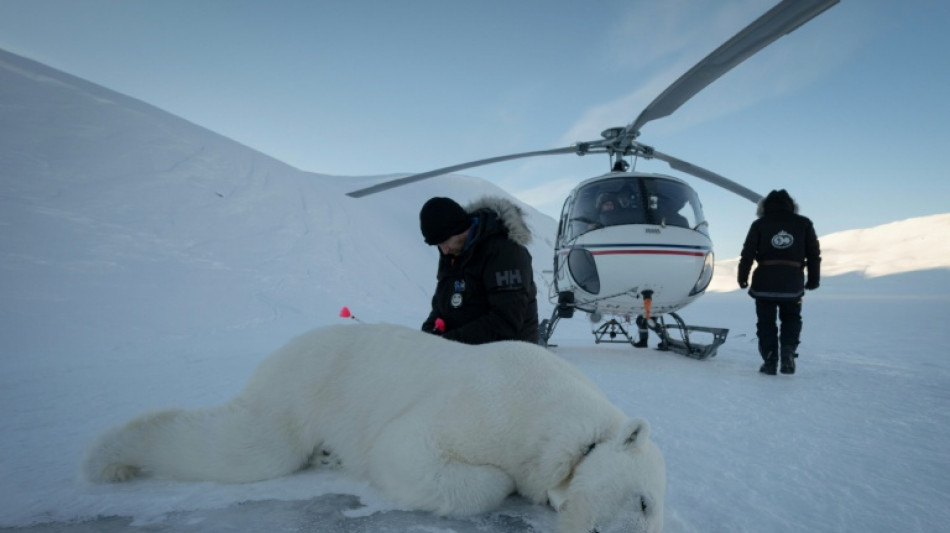
Polar bear biopsies to shed light on Arctic pollutants / Photo: Olivier MORIN - AFP

 Yamal on target as Spain hold off Czech Republic

 Latvian exit polls suggest pro-European choice

 Lula, Bolsonaro wrap up campaigns ahead of knife-edge election

 Tuchel hails 'complete' England after Croatia demolition

 Fury to invite Trump to lead ring walk before Joshua showdown

 Fashion industry in 'precarious moment', says Vivienne Westwood supremo

 Seventh heaven for England in Nations League rout of Croatia

 Storms, flooding cause chaos on Greek holiday island of Crete

 #IAmJaneDoe: online support campaign in US university rape case

 Brazil shine on Selecao's first visit to India

 Zverev sets up Djokovic quarter-final at China Open, Rybakina out

 Happier at home, Bordeaux hammer Lyon in Top 14

 Lula, Bolsonaro in final push for votes ahead of knife-edge election

 Boisterous fashion week barnstorms 'sleepy' Nigerian capital

 UAE investigators say flydubai co-pilot was planning 'terrorist act'

 Rahul smacks century in India v Windies ODI

 Daryz seeks to join exclusive club of dual Arc winners

 Russia warns diplomats to leave Kyiv over new strikes threat

 Olympic champ Zheng rebukes rowdy home crowd at China Open

 World No.1 Sinner pulls out of Shanghai Masters to delay return

 Red Bull's Verstappen grabs pole position for Bahrain GP

 India beat Pakistan in blockbuster as golfer Kim wins 'crazy' gold

 India beat arch-rivals Pakistan to win Asian Games cricket gold

 Ethiopia's Tigray rebels abandon regional capital as govt advances: journalist

 Tom Kim powers to Games gold and exemption from military service

With one foot braced on the helicopter's landing skid, a veterinarian lifted his air rifle, took aim and fired a tranquiliser dart at a polar bear.
The predator bolted but soon slumped into the snowdrifts, its broad frame motionless beneath the Arctic sky.
The dramatic pursuit formed part of a pioneering research mission in Norway's Svalbard archipelago, where scientists, for the first time, took fat tissue biopsies from polar bears to study the impact of pollutants on their health.
The expedition came at a time when the Arctic region was warming at four times the global average, putting mounting pressure on the iconic predators as their sea-ice habitat shrank.
"The idea is to show as accurately as possible how the bears live in the wild -- but in a lab," Laura Pirard, a Belgian toxicologist, told AFP.
"To do this, we take their (fatty) tissue, cut it in very thin slices and expose it to the stresses they face, in other words pollutants and stress hormones," said Pirard, who developed the method.
Moments after the bear collapsed, the chopper circled back and landed. Researchers spilled out, boots crunching on the snow.
One knelt by the bear's flank, cutting thin strips of fatty tissue. Another drew blood.
Each sample was sealed and labelled before the bear was fitted with a satellite collar.
Scientists said that while the study monitors all the bears, only females were tracked with GPS collars as their necks are smaller than their heads -- unlike males, who cannot keep a collar on for more than a few minutes.
- Arctic lab -
For the scientists aboard the Norwegian Polar Institute's research vessel Kronprins Haakon, these fleeting encounters were the culmination of months of planning and decades of Arctic fieldwork.
In a makeshift lab on the icebreaker, samples remained usable for several days, subjected to controlled doses of pollutants and hormones before being frozen for further analysis back on land.
Each tissue fragment gave Pirard and her colleagues insight into the health of an animal that spent much of its life on sea ice.
Analysis of the fat samples showed that the main pollutants present were per- and polyfluoroalkyl substances (PFAS) -- synthetic chemicals used in industry and consumer goods that linger in the environment for decades.
Despite years of exposure, Svalbard's polar bears showed no signs of emaciation or ill health, according to the team.
The local population has remained stable or even increased slightly, unlike parts of Canada, where the Western Hudson Bay group declined by 27 percent between 2016 and 2021, from 842 to 618 bears, according to a government aerial survey.
Other populations in the Canadian Arctic, including the Southern Beaufort Sea, have also shown long-term declines linked to reduced prey access and longer ice-free seasons.
Scientists estimate there are around 300 polar bears in the Svalbard archipelago and roughly 2,000 in the broader region stretching from the North Pole to the Barents Sea.
The team found no direct link between sea ice loss and higher concentrations of pollutants in Svalbard's bears. Instead, differences in pollutant levels came down to the bears' diet.
Two types of bears -- sedentary and pelagic -- feed on different prey, leading to different chemicals building up in their bodies.
- Changing diet -
With reduced sea ice, the bears' diets have already started shifting, researchers said. These behavioural adaptations appeared to help maintain the population’s health.
"They still hunt seals but they also take reindeer (and) eggs. They even eat grass (seaweed), even though that has no energy for them," Jon Aars, the head of the Svalbard polar bear programme, told AFP.
"If they have very little sea ice, they necessarily need to be on land," he said, adding that they spend "much more time on land than they used to... 20 or 30 years ago".
This season alone, Aars and his team of marine toxicologists and spatial behaviour experts captured 53 bears, fitted 17 satellite collars, and tracked 10 mothers with cubs or yearlings.
"We had a good season," Aars said.
The team's innovations go beyond biopsies. Last year, they attached small "health log" cylinders to five females, recording their pulse and temperature.
Combined with GPS data, the devices offer a detailed record of how the bears roam, how they rest and what they endure.
Polar bears were once hunted freely across Svalbard but since an international protection agreement in 1976, the population here has slowly recovered.
The team's findings may help explain how the bears' world is changing, and at an alarming rate.
As the light faded and the icebreaker's engines hummed against the vast silence, the team packed away their tools, leaving the Arctic wilderness to its inhabitants.
L.Carrico--PC



