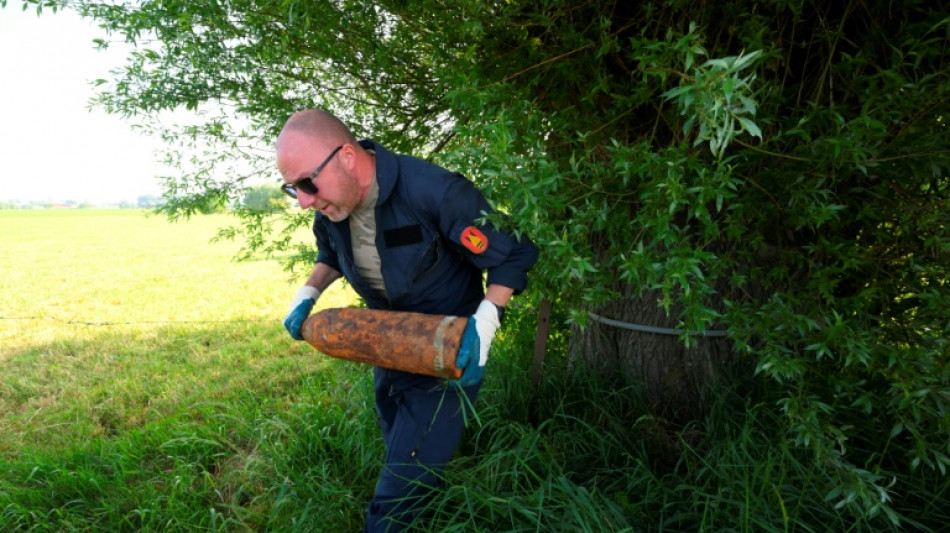
Deminers comb Belgian countryside for remnants of Great War / Photo: Nicolas TUCAT - AFP

 Yamal on target as Spain hold off Czech Republic

 Latvian exit polls suggest pro-European choice

 Lula, Bolsonaro wrap up campaigns ahead of knife-edge election

 Tuchel hails 'complete' England after Croatia demolition

 Fury to invite Trump to lead ring walk before Joshua showdown

 Fashion industry in 'precarious moment', says Vivienne Westwood supremo

 Seventh heaven for England in Nations League rout of Croatia

 Storms, flooding cause chaos on Greek holiday island of Crete

 #IAmJaneDoe: online support campaign in US university rape case

 Brazil shine on Selecao's first visit to India

 Zverev sets up Djokovic quarter-final at China Open, Rybakina out
 Happier at home, Bordeaux hammer Lyon in Top 14

 Lula, Bolsonaro in final push for votes ahead of knife-edge election

 Boisterous fashion week barnstorms 'sleepy' Nigerian capital

 UAE investigators say flydubai co-pilot was planning 'terrorist act'

 Rahul smacks century in India v Windies ODI

 Daryz seeks to join exclusive club of dual Arc winners

 Russia warns diplomats to leave Kyiv over new strikes threat

 Olympic champ Zheng rebukes rowdy home crowd at China Open

 World No.1 Sinner pulls out of Shanghai Masters to delay return
 Red Bull's Verstappen grabs pole position for Bahrain GP

 India beat Pakistan in blockbuster as golfer Kim wins 'crazy' gold

 India beat arch-rivals Pakistan to win Asian Games cricket gold

 Ethiopia's Tigray rebels abandon regional capital as govt advances: journalist

 Tom Kim powers to Games gold and exemption from military service

Working with the utmost care, a Belgian deminer wiggled a century-old artillery shell from the soil and deposited it safely in a sandbox in the back of his truck.
"This one's an 18-pounder -- there might be a bit of explosive left inside," said Franjo, one of a team of army specialists whose job is to comb the countryside for remnants of the Great War.
In the flat fields of northwestern Belgium, where hundreds of thousands of soldiers fell between 1914 and 1918, traces of the conflict are everywhere.
Beyond the military cemeteries -- their neat rows of tombstones stretching sometimes beyond the line of sight -- British, German and French shells and munitions are constantly turning up at the surface.
The task of tracking and removing them keeps the demining service of the Belgian army -- known as SEDEE in French, DOVO in Flemish -- busy on a daily basis.
Founded in the wake of World War I, the service concentrates its activities around the town of Langemark-Poelkapelle, north of Ypres, where it has set up base.
Each year its teams respond to more than 2,000 requests from farmers or construction crews to remove munitions -- some spent, but others still live -- after turning the soil to sow crops or lay foundations for a new home.
Once removed, the team determines how dangerous the munitions are -- and based on that how to dispose of them, either detonating them outside, or burning them in an oven.
"We destroy 200 to 250 tonnes every year," Jacques Callebaut, head of public relations for the deminer service, told AFP.
On this morning near Ypres, it took the team under an hour to scoop up a dozen shells and grenades -- snaking along little country roads with their small truck.
Franjo -- who asked to be identified by first name only -- and his two teammates navigate with the help of a small pile of printed police emails, mapping all the spots where potential explosives have been flagged.
- 'An added danger' -
Sometimes landowners try to make their work easier by setting out the shells to be collected from the roadside.
The deminers themselves wear thick gloves to handle the rusted relics, which can potentially contain white phosphorus, arsenic or mustard gas -- a chemical weapon causing skin blistering also known as yperite because of its use near Ypres in World War I.
"Around 60 percent of the munitions we find contain an explosive load, and around 10 to 30 can also be toxic, which brings an added danger," Callebaut said.
When in doubt, they rely on technology -- peering inside the shell with X-rays to spot a smoke cartridge, or using a neuron spectrometer to analyse its various materials.
Belgium's deminers have built up a degree of expertise that other countries have come to rely on.
"We handle the toxic munitions found in The Netherlands, and a few weeks ago we were called to neutralise a bomb in Norway as they didn't have the equipment to do so," Callebaut said.
At the crossroads of the Germanic, French and British empires, Belgium has been a key battlefield since the European Middle Ages -- and famously saw Napoleon's French army defeated by the British at Waterloo, in 1815.
It was heavily hit by the two world wars of the 20th century -- but it was the first that left by far the most traces in the land.
"World War II shells only turn up from time in time, in cities that came under bombardment," said Corentin Rousman, a Belgian historian.
Near Ypres, by contrast, "there was a static front line for four years, with millions of shells on either side," he said.
F.Ferraz--PC



