Earth's satellites at risk if asteroid smashes into Moon: study / Photo: Handout - European Southern Observatory/AFP/File

 Tuchel hails 'complete' England after Croatia demolition

 Fury to invite Trump to lead ring walk before Joshua showdown

 Fashion industry in 'precarious moment', says Vivienne Westwood supremo

 Seventh heaven for England in Nations League rout of Croatia

 Storms, flooding cause chaos on Greek holiday island of Crete

 #IAmJaneDoe: online support campaign in US university rape case

 Brazil shine on Selecao's first visit to India

 Zverev sets up Djokovic quarter-final at China Open, Rybakina out

 Happier at home, Bordeaux hammer Lyon in Top 14

 Lula, Bolsonaro in final push for votes ahead of knife-edge election

 Boisterous fashion week barnstorms 'sleepy' Nigerian capital

 UAE investigators say flydubai co-pilot was planning 'terrorist act'

 Rahul smacks century in India v Windies ODI

 Daryz seeks to join exclusive club of dual Arc winners

 Russia warns diplomats to leave Kyiv over new strikes threat

 Olympic champ Zheng rebukes rowdy home crowd at China Open

 World No.1 Sinner pulls out of Shanghai Masters to delay return

 Red Bull's Verstappen grabs pole position for Bahrain GP

 India beat Pakistan in blockbuster as golfer Kim wins 'crazy' gold

 India beat arch-rivals Pakistan to win Asian Games cricket gold

 Ethiopia's Tigray rebels abandon regional capital as govt advances: journalist

 Tom Kim powers to Games gold and exemption from military service

 Split loyalties for Indian football fans at Brazil friendly

 India-Pakistan blockbuster brings cricket fever to Japan baseball field

 Wong waiting on Rafa after winning Asian Games tennis gold

If a huge asteroid smashes into the Moon in 2032, the gigantic explosion would send debris streaming towards Earth that would threaten satellites and create a spectacular meteor shower, according to researchers.
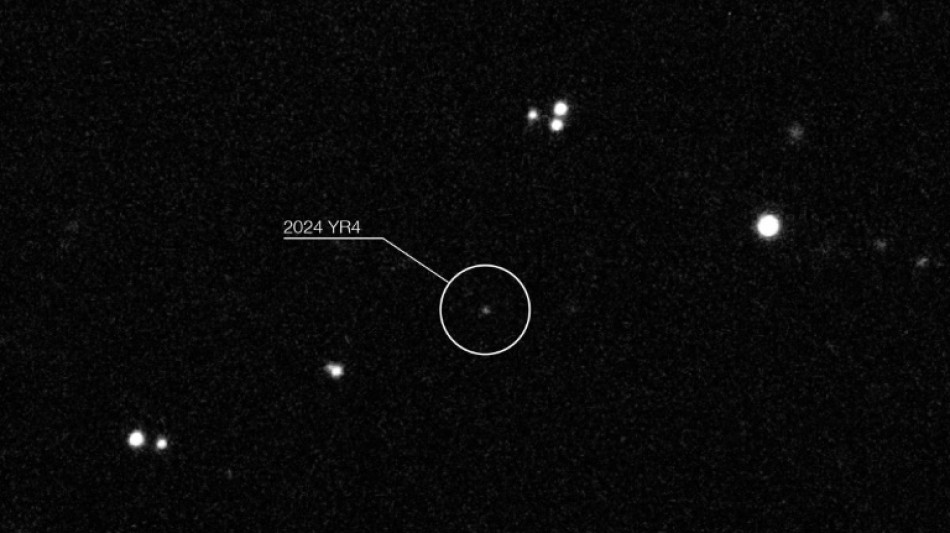
Earlier this year there were briefly fears that the 60-metre-wide (200-foot-wide) asteroid called 2024 YR4, which is big enough to level a city, would strike Earth on December 22, 2032.
It was given the highest chance -- 3.1 percent -- of hitting our home planet that scientists have ever measured for such a giant space rock.
Subsequent observations from telescopes definitively ruled out a direct hit on Earth.
However, the odds that it will crash into the Moon have risen to 4.3 percent, according to data from the James Webb space telescope in May.
A new preprint study, which has not been peer-reviewed, is the first to estimate how such a collision could affect Earth.
It would be the largest asteroid to hit the Moon in around 5,000 years, lead study author Paul Wiegert of Canada's University of Western Ontario told AFP.
The impact would be "comparable to a large nuclear explosion in terms of the amount of energy released", he added.
Up to 100 million kilograms (220 million pounds) of material would shoot out from the Moon's surface, according to a series of simulations run by the researchers.
If the asteroid hit the side of the Moon facing Earth -- which is roughly a 50-percent chance -- up to 10 percent of this debris could be pulled in by Earth's gravity over the following days, they said.
- 'Like a bullet' -
Earth's atmosphere would protect the surface from the millimetre- to centimetre-sized lunar rocks, Weigert said. 0.04-2.54
But these meteors could be capable of destroying some satellites -- and there are expected to be a lot more of those orbiting the planet by 2032.
"A centimetre-sized rock travelling at tens of thousands of metres per second is a lot like a bullet," Wiegert said.
In the days after the impact, there could be more than 1,000 times the normal number of meteors threatening Earth's satellites, he added.
Meanwhile, those of us on the ground would be treated to a "spectacular" meteor shower lighting up the night sky, the study said.
But the current odds of a direct hit on the near side of the Moon remain at just two percent, Wiegert emphasised.
The asteroid is not expected to be visible again until 2028, so the world will have to wait to find out more.
If a direct hit is eventually found to be likely, humanity probably has enough time to plan a mission to spare the Moon.
"I'm sure it will be considered," Wiegert said.
The asteroid is half as wide and has 10 percent of the mass of Dimorphos, which NASA's DART mission smashed into in 2022, successfully changing its trajectory.
If 2024 YR4 is on a collision course with the Moon, it would be "a good target" for another test of our planetary defences, Wiegert said.
But if not, trying to deflect something zooming so close to Earth could be a little "dangerous", he added.
The preprint study, which published on the arXiv database last week, has been submitted to the Astrophysical Journal Letters.
R.J.Fidalgo--PC



