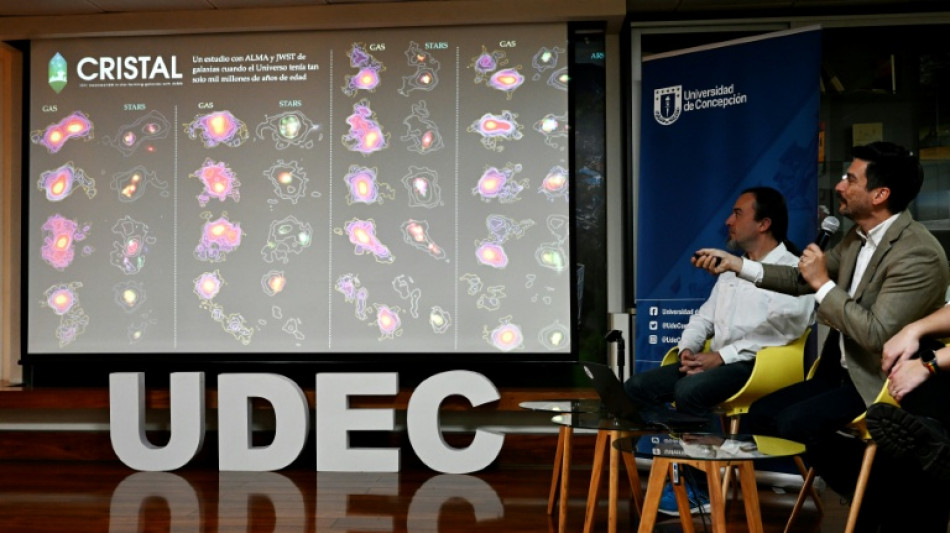
ALMA lets astronomers see building blocks of early galaxies / Photo: Rodrigo ARANGUA - AFP

 Tuchel hails 'complete' England after Croatia demolition

 Fury to invite Trump to lead ring walk before Joshua showdown

 Fashion industry in 'precarious moment', says Vivienne Westwood supremo

 Seventh heaven for England in Nations League rout of Croatia

 Storms, flooding cause chaos on Greek holiday island of Crete

 #IAmJaneDoe: online support campaign in US university rape case

 Brazil shine on Selecao's first visit to India

 Zverev sets up Djokovic quarter-final at China Open, Rybakina out
 Happier at home, Bordeaux hammer Lyon in Top 14

 Lula, Bolsonaro in final push for votes ahead of knife-edge election

 Boisterous fashion week barnstorms 'sleepy' Nigerian capital

 UAE investigators say flydubai co-pilot was planning 'terrorist act'

 Rahul smacks century in India v Windies ODI

 Daryz seeks to join exclusive club of dual Arc winners

 Russia warns diplomats to leave Kyiv over new strikes threat

 Olympic champ Zheng rebukes rowdy home crowd at China Open

 World No.1 Sinner pulls out of Shanghai Masters to delay return

 Red Bull's Verstappen grabs pole position for Bahrain GP

 India beat Pakistan in blockbuster as golfer Kim wins 'crazy' gold

 India beat arch-rivals Pakistan to win Asian Games cricket gold

 Ethiopia's Tigray rebels abandon regional capital as govt advances: journalist

 Tom Kim powers to Games gold and exemption from military service

 Split loyalties for Indian football fans at Brazil friendly

 India-Pakistan blockbuster brings cricket fever to Japan baseball field

 Wong waiting on Rafa after winning Asian Games tennis gold

Chile's ALMA observatory, which houses some of the world's most powerful telescopes, has captured its most detailed images to date of the building blocks of the early universe -- primarily cold gases, dust and stellar light in 39 galaxies.
"We've never achieved so much detail and depth in galaxies from the early universe," Sergio Martin, head of Scientific Operations at ALMA, told AFP during a presentation of the research at University of Concepcion in Santiago.
Due to its dark skies and clear air, Chile hosts the telescopes of more than 30 countries, including the Atacama Large Millimeter/submillimeter Array (ALMA) that was used in the findings.
The research was led by Rodrigo Herrera-Camus, director of the Millennium Nucleus of Galaxies (MINGAL) of Chile, who told AFP the new images provide "the opportunity to study how stars are born."
The survey also found that stars emerged in "giant clumps," Herrera-Camus said.
By combining ALMA's findings with images from the James Webb and Hubble telescopes, researchers were able to learn more about how galaxies evolve, interact, and form stars.
The ALMA telescope was developed by the European Southern Observatory, the US National Radio Astronomy Observatory and the National Astronomical Observatory of Japan.
S.Pimentel--PC



