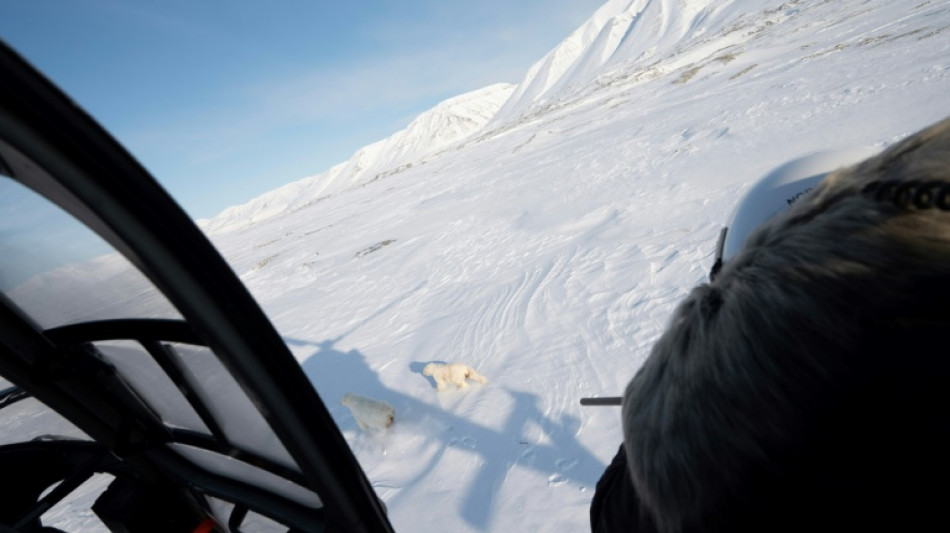
The eye-opening science of close encounters with polar bears / Photo: Olivier MORIN - AFP

 Tuchel hails 'complete' England after Croatia demolition

 Fury to invite Trump to lead ring walk before Joshua showdown

 Fashion industry in 'precarious moment', says Vivienne Westwood supremo
 Seventh heaven for England in Nations League rout of Croatia

 Storms, flooding cause chaos on Greek holiday island of Crete

 #IAmJaneDoe: online support campaign in US university rape case

 Brazil shine on Selecao's first visit to India

 Zverev sets up Djokovic quarter-final at China Open, Rybakina out
 Happier at home, Bordeaux hammer Lyon in Top 14

 Lula, Bolsonaro in final push for votes ahead of knife-edge election

 Boisterous fashion week barnstorms 'sleepy' Nigerian capital

 UAE investigators say flydubai co-pilot was planning 'terrorist act'

 Rahul smacks century in India v Windies ODI

 Daryz seeks to join exclusive club of dual Arc winners

 Russia warns diplomats to leave Kyiv over new strikes threat

 Olympic champ Zheng rebukes rowdy home crowd at China Open

 World No.1 Sinner pulls out of Shanghai Masters to delay return

 Red Bull's Verstappen grabs pole position for Bahrain GP

 India beat Pakistan in blockbuster as golfer Kim wins 'crazy' gold

 India beat arch-rivals Pakistan to win Asian Games cricket gold

 Ethiopia's Tigray rebels abandon regional capital as govt advances: journalist

 Tom Kim powers to Games gold and exemption from military service

 Split loyalties for Indian football fans at Brazil friendly

 India-Pakistan blockbuster brings cricket fever to Japan baseball field

 Wong waiting on Rafa after winning Asian Games tennis gold

It's a pretty risky business trying to take a blood sample from a polar bear -- one of the most dangerous predators on the planet -- on an Arctic ice floe.
First you have to find it and then shoot it with a sedative dart from a helicopter before a vet dares approach on foot to put a GPS collar around its neck.
Then the blood has to be taken and a delicate incision made into a layer of fat before it wakes.
All this with a wind chill of up to minus 30C.
For the last four decades experts from the Norwegian Polar Institute (NPI) have been keeping tabs on the health and movement of polar bears in the Svalbard archipelago, halfway between Norway and the North Pole.
Like the rest of the Arctic, global warming has been happening there three to four times faster than elsewhere.
But this year the eight scientists working from the Norwegian icebreaker Kronprins Haakon are experimenting with new methods to monitor the world's largest land carnivore, including for the first time tracking the PFAS "forever chemicals" from the other ends of the Earth that finish up in their bodies.
An AFP photographer joined them on this year's eye-opening expedition.
- Delicate surgery on the ice -
With one foot on the helicopter's landing skid, vet Rolf Arne Olberg put his rifle to his shoulder as a polar bear ran as the aircraft approached.
Hit by the dart, the animal slumped gently on its side into a snowdrift, with Olberg checking with his binoculars to make sure he had hit a muscle. If not, the bear could wake prematurely.
"We fly in quickly," Oldberg said, and "try to minimise the time we come in close to the bear... so we chase it as little as possible."
After a five- to 10-minute wait to make sure it is asleep, the team of scientists land and work quickly and precisely.
They place a GPS collar around the bear's neck and replace the battery if the animal already has one.
Only females are tracked with the collars because male polar bears -- who can grow to 2.6 metres (8.5 feet) -- have necks thicker than their heads, and would shake the collar straight off.
Olberg then made a precise cut in the bear's skin to insert a heart monitor between a layer of fat and the flesh.
"It allows us to record the bear's body temperature and heart rate all year," NPI researcher Marie-Anne Blanchet told AFP, "to see the energy the female bears (wearing the GPS) need to use up as their environment changes."
The first five were fitted last year, which means that for the first time experts can cross-reference their data to find out when and how far the bears have to walk and swim to reach their hunting grounds and how long they rest in their lairs.
The vet also takes a biopsy of a sliver of fat that allows researchers to test how the animal might stand up to stress and "forever chemicals", the main pollutants found in their bodies.
"The idea is to best represent what bears experience in the wild but in a laboratory," said Belgian toxicologist Laura Pirard, who is testing the biopsy method on the mammals.
- Eating seaweed -
It has already shown that the diet of Svalbard's 300 or so bears is changing as the polar ice retreats.
The first is that they are eating less seals and more food from the land, said Jon Aars, the lead scientist of the NPI's polar bear programme.
"They still hunt seals, but they also take eggs and reindeer -- they even eat (sea)grass and things like that, even though it provides them with no energy."
But seals remain their essential food source, he said. "Even if they only have three months to hunt, they can obtain about 70 percent of what they need for the entire year during that period. That's probably why we see they are doing okay and are in good condition" despite the huge melting of the ice.
But if warming reduces their seal hunting further, "perhaps they will struggle", he warned.
"There are notable changes in their behaviour... but they are doing better than we feared. However, there is a limit, and the future may not be as bright."
"The bears have another advantage," said Blanchet, "they live for a long time, learning from experience all their life. That gives a certain capacity to adapt."
- Success of anti-pollution laws -
Another encouraging discovery has been the tentative sign of a fall in pollution levels.
With some "bears that we have recaptured sometimes six or eight times over the years, we have observed a decrease in pollutant levels," said Finnish ecotoxicologist Heli Routti, who has been working on the programme for 15 years.
"This reflects the success of regulations over the past decades."
NPI's experts contribute to the Arctic Monitoring and Assessment Programme (AMAP) whose conclusions play a role in framing regulations or bans on pollutants.
"The concentration of many pollutants that have been regulated decreased over the past 40 years in Arctic waters," Routti said. "But the variety of pollutants has increased. We are now observing more types of chemical substances" in the bears' blood and fatty tissues.
These nearly indestructible PFAS or "forever chemicals" used in countless products like cosmetics and nonstick pans accumulate in the air, soil, water and food.
Experts warn that they ultimately end up in the human body, particularly in the blood and tissues of the kidney or liver, raising concerns over toxic effects and links to cancer.
G.Machado--PC



