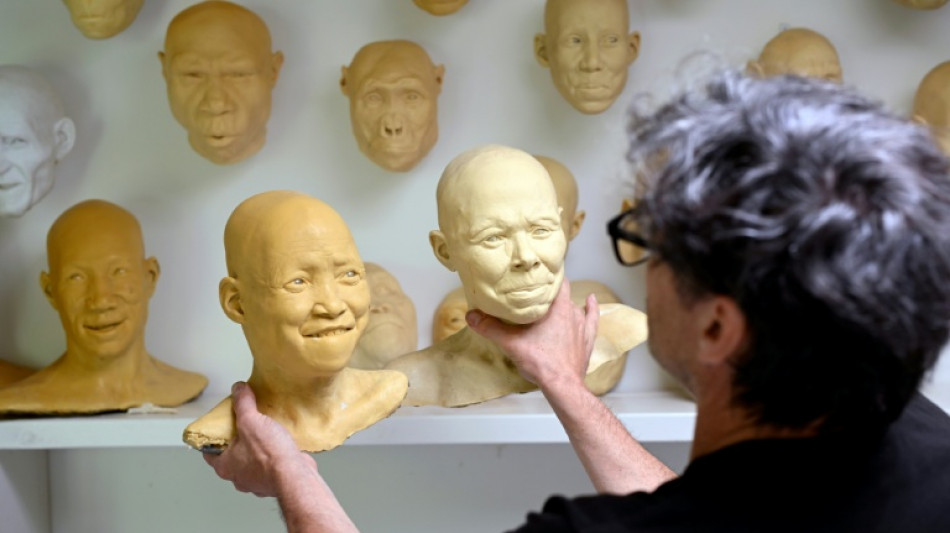
Artists, scientists breathe life into prehistoric woman / Photo: Nicolas TUCAT - AFP

 Tuchel hails 'complete' England after Croatia demolition

 Fury to invite Trump to lead ring walk before Joshua showdown

 Fashion industry in 'precarious moment', says Vivienne Westwood supremo

 Seventh heaven for England in Nations League rout of Croatia

 Storms, flooding cause chaos on Greek holiday island of Crete

 #IAmJaneDoe: online support campaign in US university rape case

 Brazil shine on Selecao's first visit to India

 Zverev sets up Djokovic quarter-final at China Open, Rybakina out
 Happier at home, Bordeaux hammer Lyon in Top 14

 Lula, Bolsonaro in final push for votes ahead of knife-edge election

 Boisterous fashion week barnstorms 'sleepy' Nigerian capital

 UAE investigators say flydubai co-pilot was planning 'terrorist act'

 Rahul smacks century in India v Windies ODI

 Daryz seeks to join exclusive club of dual Arc winners

 Russia warns diplomats to leave Kyiv over new strikes threat

 Olympic champ Zheng rebukes rowdy home crowd at China Open

 World No.1 Sinner pulls out of Shanghai Masters to delay return

 Red Bull's Verstappen grabs pole position for Bahrain GP

 India beat Pakistan in blockbuster as golfer Kim wins 'crazy' gold

 India beat arch-rivals Pakistan to win Asian Games cricket gold

 Ethiopia's Tigray rebels abandon regional capital as govt advances: journalist

 Tom Kim powers to Games gold and exemption from military service

 Split loyalties for Indian football fans at Brazil friendly

 India-Pakistan blockbuster brings cricket fever to Japan baseball field

 Wong waiting on Rafa after winning Asian Games tennis gold

With her clear blue eyes and slightly nervous gaze, the reconstructed bust of Mos'anne -- a woman who lived around 10,500 years ago -- is uncannily lifelike.
Reborn via a close partnership between science and art, Mos'anne's bust was created at Belgium's Ghent University as part of a project to explore how the region's last hunter-gatherers lived during the Mesolithic era.
"Part of the project is also understanding the genetics of these people, figuring out their kinship and so on, and to be able to really translate the science that we do to a wider audience," the project's lead researcher, Isabelle de Groote, told AFP.
Scientists chose the skull of Mos'anne -- named by public vote in reference to Belgium's Meuse Valley -- for reconstruction, as it was exceptionally well-preserved.
The bones held a large amount of preserved DNA, making it possible to reconstruct the woman -- aged between 35 and 60 at her death -- with remarkable realism.
"We also know that in the Mesolithic times, she is genetically part of the Western hunter-gatherer group," said de Groote.
Using genetic testing, researchers were able to determine the Mesolithic woman's skin and eye colour.
"This group is known for having very dark skin and blue eyes, a bit like Cheddar Man in Britain," she said, referring to the man who lived in Britain around 10,000 years ago, whose skeleton was discovered in 1903.
- 'Mixed emotions' -
Mos'anne's DNA revealed valuable clues about her appearance but it was the unique skills of Dutch "paleo-artists" Alfons and Adrie Kennis that brought her back to life.
After receiving guidance from the researchers -- including instructions to use ochre pigment on Mos'anne's headband -- the twins began their work, from moulding the skull to the final decorative feather, meticulously sculpting each facial muscle in clay.
"The biggest part of the reconstruction is forming a character," Alfons Kennis said from their Darwin-esque studio in Arnhem.
"You can make a forensic reconstruction... use the data, apply the muscles, apply the skin, but you get no character," Kennis said of their artistic process.
The Kennis brothers -- whose surname means "knowledge" in Dutch -- take about six months to complete a reconstruction.
They gained global recognition in the 2000s, their work exhibited in museums worldwide and featured in specialist publications.
The twins, fascinated by evolution and visual art since childhood, draw inspiration from archived anthropological images of early encounters between isolated populations and researchers.
"At the first meeting, there's nervousness, shyness. People are laughing, maybe out of nerves," said Kennis.
"When a prehistoric ancestor meets you for the first time, you see these mixed emotions... It's these emotions that we want to show."
Much about Mos'anne remains unknown. In Ghent, researchers are still analysing her to find out what she would eat.
With her headband dotted with duck feathers, golden skin, and pierced animal teeth adorning her ears and necklace, the prehistoric woman seems closer to us than ever.
"It was always my wish to be able to make it more tangible in a way," De Groote said.
B.Godinho--PC



