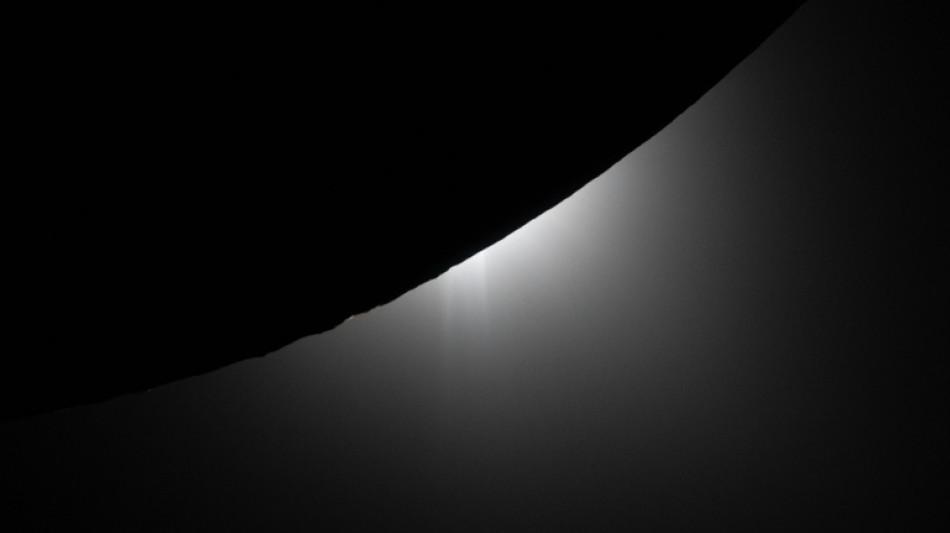
Artemis astronauts to shed light on space health risks / Photo: Handout - NASA/AFP

 Split loyalties for Indian football fans at Brazil friendly

 India-Pakistan blockbuster brings cricket fever to Japan baseball field

 Wong waiting on Rafa after winning Asian Games tennis gold

 With Russia next door and rising costs, Latvia goes to the polls

 Penalty hero rues empty seats as Games hosts Japan win football gold

 North Korea fires ballistic missile after Seoul's apology demand

 US regulator finds Boeing 737 MAX software bug 'not a safety concern'

 Ohtani 'managing' injuries as Dodgers launch MLB post-season

 Botched US execution leaves murderer unconscious on ventilator: lawyers

 Cornell rape case exposes sexual violence at US colleges

 France held by Italy in Zidane's homecoming after Olise stunner

 Ethiopian pro-government militia claims Tigray airport as regional tensions spike

 Ohtani shaking off injuries as Dodgers launch MLB post-season

 Sea levels to rise in California as coastal wave surges up west coast

 New rallies urged in France as protests disrupt over 730 schools

 Djokovic survives China Open scare, Sabalenka starts strong

 King Charles to evoke colonial 'darkest days' on Caribbean tour

 Tesla shares jump after global car sales top estimates

 DR Congo Ebola outbreak killed more than 4,000: official figures

 Djokovic survives China Open scare against wildcard world no. 104

 Lula, Bolsonaro trade blows in final scramble for votes in Brazil

 New clashes erupt as protests disrupt over 560 French schools

 NY governor vows to close loophole after alleged Cornell gang rape

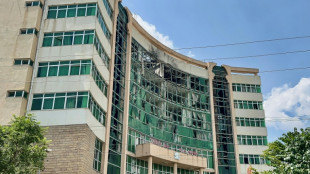 Ethiopia Tigray rebels pushed back as regional tensions spike

 Stocks rise, yields fall as US job numbers disappoint

While the Artemis II astronauts have been protected from the icy vacuum of space on their journey, their bodies have nonetheless been left exposed to possibly high levels of radiation -- a danger of space travel that NASA is anxiously waiting to study.
Their trip around the Moon has taken the four astronauts farther into space than any human before -- more than 1,000 times the distance from Earth to the International Space Station.
Earth's magnetosphere offers some protection against radioactive cosmic rays and solar particles to the orbiting ISS, but no such cover on the Moon.
Studying the impacts of radiation is essential as NASA hopes to eventually build a Moon base and send astronauts on the long trip to Mars.
The US space agency installed radiation sensors on the Orion capsule and took blood samples of the astronauts before takeoff to compare with samples post-trip. The crew's saliva samples are gathered throughout the journey and their health is monitored via smartwatches.
NASA has also placed state-of-the-art computer chips in the capsule that can replicate certain physiological functions, like that of an organ.
Mission planners chose to mimic bone marrow, which produces blood cells and is one of the tissues "most quickly affected by radiation and other stressors," NASA Human Research Program chief scientist Steven Platts told AFP.
With all of the data, Platts said his team hoped to better understand the variation between low earth orbit and deep space.
"It will be good research information for us to see the level of radiation, but also the type of radiation," he said.
"Our prediction is that we'll see a lot more galactic cosmic radiation... which is from supernovas and is everywhere," versus radiation coming from the Sun, he said.
- Mental health -
Platts said while most people associate radiation with cancer risk, it also can impact the central nervous system and blood circulation.
"It can lead to inflammation in the brain, and that's one of the things that can increase the risk of Parkinson's disease," he said.
With the Artemis II astronauts spending just 10 days in space, radiation is not a major concern, but the danger could rise dramatically with longer stays on the Moon.
Extensive health studies were conducted on the Apollo astronauts, but technology has advanced greatly in the 50 years since, said Bruce Betts, chief scientist at the Planetary Society, a space advocacy group.
"There will be a lot of information on the medical side of things," he said.
The other major focus is on psychological risks of spending long periods of time on the Moon or Mars.
With greater disconnection from home and tight living quarters, mental health could pose the greatest danger to astronauts on such missions, Platts said.
He compared the difference between the ISS and the tiny Orion capsule as like going from a "six-bedroom house, like a mansion... to a camper van."
F.Ferraz--PC



