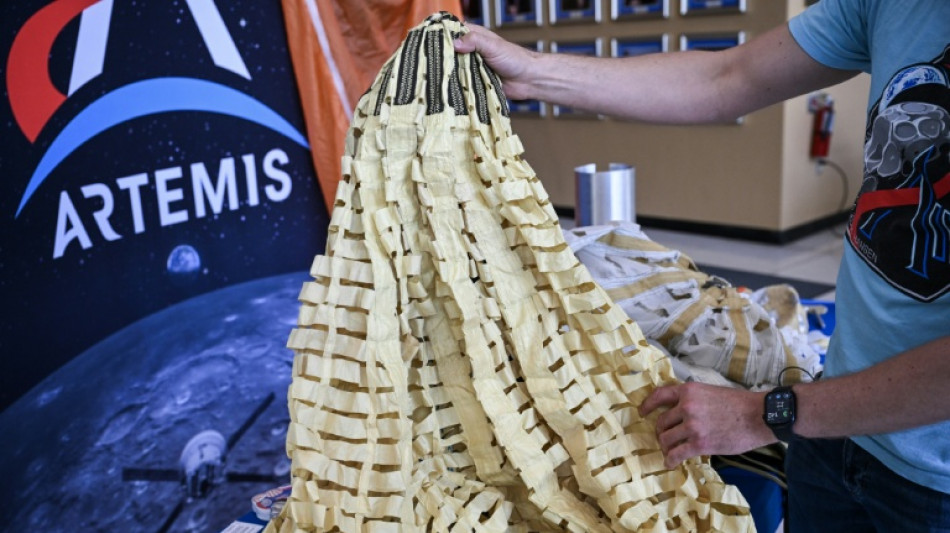
Parachutes: A vital part of Artemis II's trip home / Photo: RONALDO SCHEMIDT - AFP

 Split loyalties for Indian football fans at Brazil friendly
 India-Pakistan blockbuster brings cricket fever to Japan baseball field

 Wong waiting on Rafa after winning Asian Games tennis gold

 With Russia next door and rising costs, Latvia goes to the polls

 Penalty hero rues empty seats as Games hosts Japan win football gold
 North Korea fires ballistic missile after Seoul's apology demand

 US regulator finds Boeing 737 MAX software bug 'not a safety concern'

 Ohtani 'managing' injuries as Dodgers launch MLB post-season

 Botched US execution leaves murderer unconscious on ventilator: lawyers

 Cornell rape case exposes sexual violence at US colleges

 France held by Italy in Zidane's homecoming after Olise stunner

 Ethiopian pro-government militia claims Tigray airport as regional tensions spike

 Ohtani shaking off injuries as Dodgers launch MLB post-season
 Sea levels to rise in California as coastal wave surges up west coast

 New rallies urged in France as protests disrupt over 730 schools

 Djokovic survives China Open scare, Sabalenka starts strong
 King Charles to evoke colonial 'darkest days' on Caribbean tour

 Tesla shares jump after global car sales top estimates
 DR Congo Ebola outbreak killed more than 4,000: official figures

 Djokovic survives China Open scare against wildcard world no. 104

 Lula, Bolsonaro trade blows in final scramble for votes in Brazil

 New clashes erupt as protests disrupt over 560 French schools

 NY governor vows to close loophole after alleged Cornell gang rape
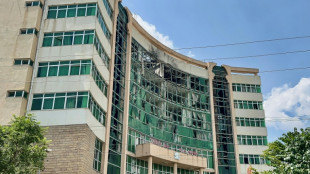 Ethiopia Tigray rebels pushed back as regional tensions spike

 Stocks rise, yields fall as US job numbers disappoint

As the Orion spacecraft hurtles home, friction caused by re-entry into Earth's atmosphere will drastically decrease its speed from a potential 25,000 miles per hour (40,000 kilometers per hour).
But for a gentle, 17-mile-per-hour (27-kph) impact in the Pacific Ocean, Orion and the humans onboard need parachutes.
Artemis II is scheduled to splash down off the southern California coast at 5:07 pm local time (0007 GMT) after the most dangerous part of its mission -- re-entry.
Jared Daum, the parachute system manager for Artemis II, explains how it will work in comments to AFP that have been lightly edited for clarity.
Q: What is the role of parachutes during re-entry?
A: The heat shield gets us down to 350 miles per hour (560 kph), but that's all the heat shield can do due to the mass of the vehicle. So at that point we need something more.
So at 24,000 feet (7,300 meters), we start the deployment sequence to get us down to the water. The parachute system, in my opinion, is one of the most important systems on the spacecraft.
It decelerates the vehicle from about 350 miles per hour to about 17 miles per hour for a nice soft landing for the crew in the Pacific Ocean.
Q: How does it work?
A: [It's] a series of four types of parachutes, 11 total, starting with what we call the forward bay cover parachute. It's all Kevlar, about seven feet (two meters) in diameter, and its job is to lift off the cover to expose the rest of our hardware.
[Next] we have two mortar-deployed drogue parachutes, each about 23 feet (7 meters) in diameter. Their job is to stabilize and decelerate the vehicle from that 350 down to about 150 miles per hour (240 kph).
The [three] pilot parachutes [deployed next] are about nine feet (2.7 meters) in diameter, and their only job is to lift up our three main parachutes. Each main parachute is about 300 pounds (136 kg) and 11,000 square feet (1,022 square meters).
As we get into our larger parachutes, like the drogues and the mains, we have a lighter-weight nylon ... not unlike what you might build a tent out of, or an old-school windbreaker. It's very light but strong enough to produce the drag that we need to decelerate.
As the capsule splashes down, the parachutes will instantaneously deflate when the risers are severed ... and we'll see the parachutes fall into the ocean.
The flight software deploys the first parachutes all the way down through the main parachutes. Of course the crew has the ability to manually command the chutes ... if for some reason we have low confidence in the flight software.
Q: Is there a plan B?
A: Redundancy is key with spaceflight. It's not like you can drive your car down the road, get a flat tire, pull over, fix it and keep going. With these parachutes you have one shot and it's got to work then.
So we have redundancy built into each of the four types of parachutes. We can lose one forward bay cover parachute, one drogue, one pilot and one main parachute, and the astronauts will still have a safe landing.
Without the parachutes, the crew would have no safe way to get back. This vehicle is designed to use parachutes, as are all of our crewed spacecraft from now all through previous history.
L.Torres--PC



