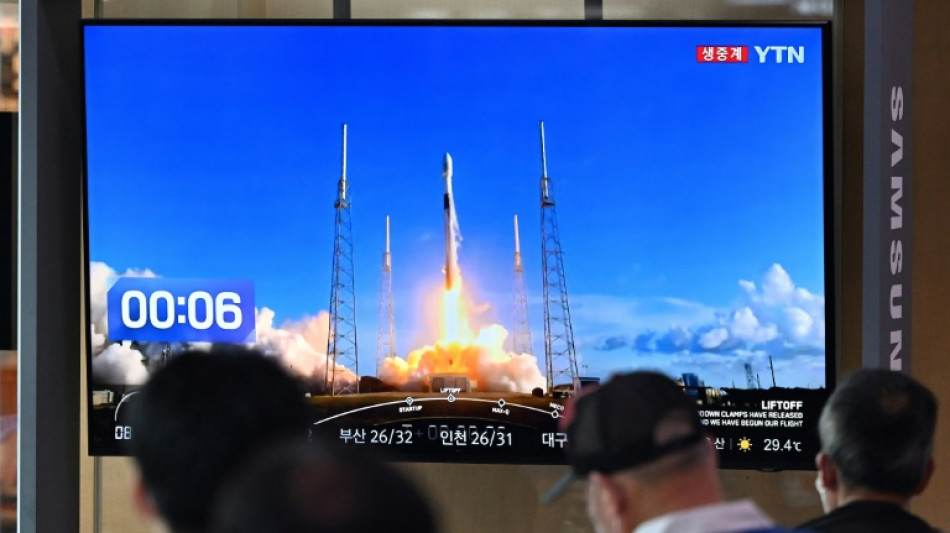
South Korea's first lunar orbiter launched by SpaceX / Photo: Jung Yeon-je - AFP

 'He's here with me': Japan cycle queen dedicates gold to late brother

 Japan Olympic chief says 'lot more' athletes at Games than expected

 Asian carmakers besting US rivals at home, China poised to strike

 Widgets & Web Offers All-Inclusive Investor Relations Websites for Public Companies, IPOs and SPACs

 Adams named new US captain to 2030 World Cup

 China a better influence in Latin America than US: poll

 Judge pauses construction of border project in Texas national park

 Belgium's De Bruyne fires double to sink Turkey, France held by Italy

 US jobs data boosts stocks as oil prices dip

 US Supreme Court to hear high-stakes climate case

 Trump expected to name intel chief Clayton as AI czar: reports

 Argentina unveils passports-for-investment scheme

 Brazil election debate chaos sparks censorship row

 England's Carse charged by cricket body over nightclub incident

 Amazon vows $1 bn for data center towns, decries 'myths'

 Oil prices drop on G7 fuel release, US jobs data boosts stocks

 G7 agrees deal to ease global energy supply concerns

 Spain's government dealt blow as lawmakers reject housing bills

 Food, medicine shortages deepen in Russian-occupied Oleshky

 Man City whistleblower Rui Pinto facing 'dire consequences' - lawyers

 Russia 'tearing Kyiv apart', mayor says, as strikes paralyse traffic

 Taiwan boxer Lin wins Games gold as Japan edge North Korea on penalties

 Japan tame North Korea to win Games gold after shootout drama

 US posts weak job growth data in September

 Ethiopia's conflict: the regional dimension

South Korea's first lunar orbiter successfully launched on a year-long mission to observe the Moon, Seoul said Friday, with the payload including a new disruption-tolerant network for sending data from space.
Danuri -- a portmanteau of the Korean words for "Moon" and "enjoy" -- was on a Falcon 9 rocket launched from Cape Canaveral in Florida by Elon Musk's aerospace company SpaceX. It aims to reach the Moon by mid-December.
"South Korea's first lunar orbiter 'Danuri' left for space at 8:08 am on August 5, 2022," Seoul's science ministry said in a tweet, sharing a video of the rocket blasting off trailing a huge column of smoke and flames.
"Danuri will be the first step towards the Moon and the farther universe," it said, apparently referring to the country's ambitious space program, which includes plans for a Moon mission by 2030.
SpaceX tweeted that the launch had been a success.
"Deployment of KPLO confirmed," it said, referring to Danuri using an acronym of its official name, the Korea Pathfinder Lunar Orbiter.
During its mission, Danuri will use six different instruments, including a highly sensitive camera provided by NASA, to conduct research, including investigating the lunar surface to identify potential landing sites.
One of the instruments will evaluate disruption-tolerant, network-based space communications, which, according to South Korea's science ministry, is a world first.
- BTS in space -
Danuri will also try to develop a wireless Internet environment to link satellites or exploration spacecraft, they added.
The lunar orbiter will stream K-pop sensation BTS' song "Dynamite" to test this wireless network.
Another instrument, ShadowCam, will record images of the permanently shaded regions around the poles of the Moon where no sunlight can reach.
Scientists also hope that Danuri will find hidden sources of water and ice in areas of the Moon, including the permanently dark and cold regions near the poles.
"This is a very significant milestone in the history of Korean space exploration," said Lee Sang-ryool, head of the Korea Aerospace Research Institute, in a video shown before the launch.
"Danuri is just the beginning, and if we are more determined and committed to technology development for space travel, we will be able to reach Mars, asteroids, and so on in the near future."
South Korean scientists say Danuri -- which took seven years to build -- will pave the way for the nation's more ambitious goal of landing on the Moon by 2030.
"South Korea will become the seventh country in the world to have launched an unmanned probe to the Moon," an official at the Korea Aerospace Research Institute told AFP.
"We hope to continue contributing to the global understanding of the Moon with what Danuri is set to find out."
- Lunar ambitions -
Danuri was launched by a private company -- SpaceX -- but South Korea recently became one of a handful of countries to successfully launch a one-tonne payload using their own rockets.
In June, the country's homegrown three-stage rocket nicknamed Nuri -- a decade in development at a cost of 2 trillion won ($1.5 billion) -- launched successfully and put a satellite into orbit, on its second attempt after a failure last October.
That launch -- coupled with Danuri's launch Friday -- helps bring South Korea ever closer to achieving its space ambitions.
In Asia, China, Japan and India all have advanced space programmes -- and the South's nuclear-armed neighbour North Korea has also demonstrated satellite launch capability.
Ballistic missiles and space rockets use similar technology and Pyongyang put a 300-kilogram (660-pound) satellite into orbit in 2012 in what Washington condemned as a disguised missile test.
A.S.Diogo--PC



