NASA unveils new space telescope to give 'atlas of the universe' / Photo: SAUL LOEB - AFP

 'He's here with me': Japan cycle queen dedicates gold to late brother

 Japan Olympic chief says 'lot more' athletes at Games than expected
 Asian carmakers besting US rivals at home, China poised to strike

 Widgets & Web Offers All-Inclusive Investor Relations Websites for Public Companies, IPOs and SPACs

 Adams named new US captain to 2030 World Cup

 China a better influence in Latin America than US: poll

 Judge pauses construction of border project in Texas national park

 Belgium's De Bruyne fires double to sink Turkey, France held by Italy

 US jobs data boosts stocks as oil prices dip

 US Supreme Court to hear high-stakes climate case

 Trump expected to name intel chief Clayton as AI czar: reports

 Argentina unveils passports-for-investment scheme

 Brazil election debate chaos sparks censorship row

 England's Carse charged by cricket body over nightclub incident

 Amazon vows $1 bn for data center towns, decries 'myths'

 Oil prices drop on G7 fuel release, US jobs data boosts stocks

 G7 agrees deal to ease global energy supply concerns

 Spain's government dealt blow as lawmakers reject housing bills

 Food, medicine shortages deepen in Russian-occupied Oleshky

 Man City whistleblower Rui Pinto facing 'dire consequences' - lawyers
 Russia 'tearing Kyiv apart', mayor says, as strikes paralyse traffic

 Taiwan boxer Lin wins Games gold as Japan edge North Korea on penalties

 Japan tame North Korea to win Games gold after shootout drama

 US posts weak job growth data in September

 Ethiopia's conflict: the regional dimension

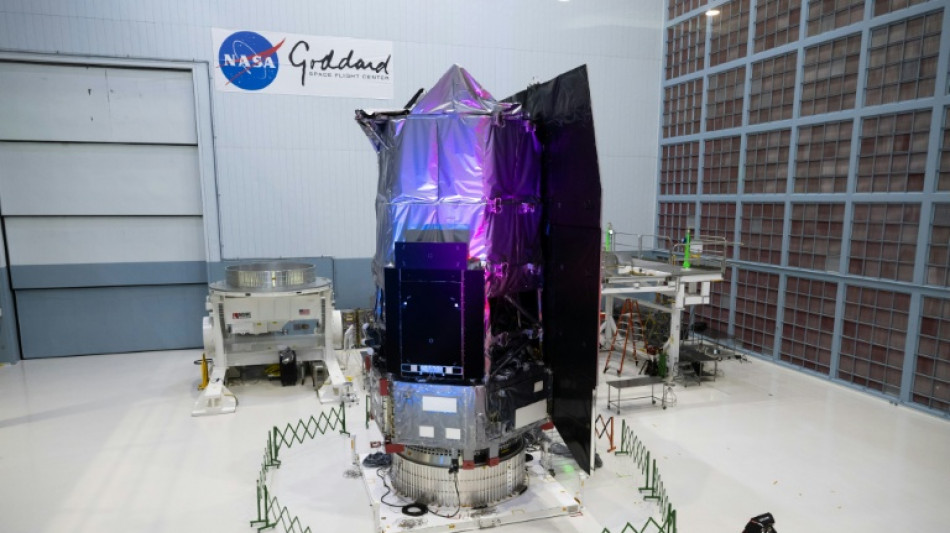
NASA unveiled a new telescope on Tuesday to scan vast swathes of the universe for planets outside our solar system and probe the mysteries of dark matter and dark energy.
The Roman space telescope is expected to discover tens of thousands of planets, possibly offering clarity abut how many could be out there.
"Roman will give the Earth a new atlas of the universe," NASA administrator Jared Isaacman told a news conference at the Goddard Space Flight Center in Maryland, where the telescope went on display.
The 12-metre (39-feet), silvery contraption with massive solar panels will be transported to Florida ahead of a launch into space aboard a SpaceX rocket planned for September at the earliest.
Roman, which took more than $4 billion and over a decade to build, is named after astronomer Nancy Grace Roman, nicknamed the "Mother of Hubble" for her role in developing the landmark space telescope.
Thirty-six years after Hubble launched into space, revolutionizing astronomical observations, NASA hopes Roman will help to shed light on questions that remain unresolved.
Boasting a field of view at least 100 times larger than Hubble's, the telescope will sweep across vast regions of space from its position 1.5 million kilometres (930,000 miles) from Earth.
The telescope will send 11 terabytes of data a day down to Earth, said Mark Melton, a systems engineer at Goddard Space Flight Center.
"In the first year, we'll have sent down more data than Hubble will have for its entire life," he told AFP.
The telescope's wide-angle lens will allow NASA to conduct a census of the objects that make up our universe, said Nicky Fox, associate administrator for NASA's Science Mission Directorate.
"Roman will discover tens of thousands of new planets outside our solar system. It will reveal billions of galaxies, thousands of supernovae and tens of billions of stars," she said.
This wealth of information will enable NASA to tease out areas of interest that can then be investigated by complementary telescopes, such as the James Webb Space Telescope.
- Study the invisible -
But Roman will also study the invisible -- dark matter and dark energy, whose origins remain unknown but which are thought to constitute 95 percent of our universe.
Dark matter is believed to be the glue that holds galaxies together, while dark energy pulls them apart by making the universe expand faster and faster over time.
Thanks to its infrared vision, the telescope will be able to observe light emitted by celestial bodies billions of years ago, effectively looking back in time to hopefully discover more about the two phenomena.
Complementing the work of Europe's Euclid space telescope and the Vera Rubin Observatory in Chile, Roman will probe "how the dark matter structures itself throughout cosmic time" and "calculate how fast galaxies are moving away from us," Darryl Seligman, an assistant professor of physics and astronomy at Michigan State University, told AFP.
These discoveries could fundamentally change our understanding of the structure of our universe, said astrophysicist Julie McEnery, who led the Roman project.
"If Roman wins a Nobel Prize at some point, it's probably for something we haven't even thought about or questioned yet," said Melton.
G.Teles--PC



