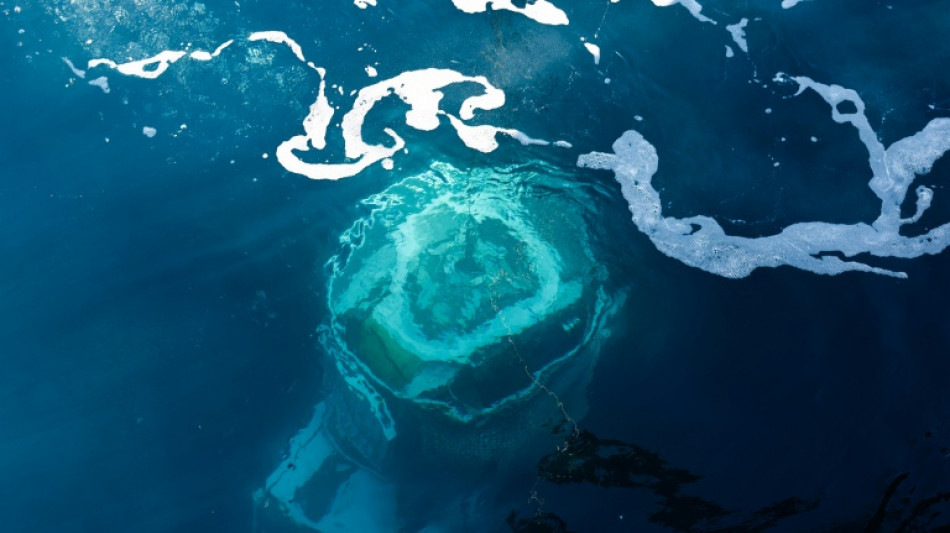
Diving robot explores mystery of France's deepest shipwreck / Photo: Thibaud MORITZ - AFP

 'He's here with me': Japan cycle queen dedicates gold to late brother

 Japan Olympic chief says 'lot more' athletes at Games than expected

 Asian carmakers besting US rivals at home, China poised to strike

 Widgets & Web Offers All-Inclusive Investor Relations Websites for Public Companies, IPOs and SPACs

 Adams named new US captain to 2030 World Cup

 China a better influence in Latin America than US: poll

 Judge pauses construction of border project in Texas national park

 Belgium's De Bruyne fires double to sink Turkey, France held by Italy

 US jobs data boosts stocks as oil prices dip

 US Supreme Court to hear high-stakes climate case

 Trump expected to name intel chief Clayton as AI czar: reports

 Argentina unveils passports-for-investment scheme

 Brazil election debate chaos sparks censorship row

 England's Carse charged by cricket body over nightclub incident

 Amazon vows $1 bn for data center towns, decries 'myths'

 Oil prices drop on G7 fuel release, US jobs data boosts stocks

 G7 agrees deal to ease global energy supply concerns

 Spain's government dealt blow as lawmakers reject housing bills

 Food, medicine shortages deepen in Russian-occupied Oleshky

 Man City whistleblower Rui Pinto facing 'dire consequences' - lawyers
 Russia 'tearing Kyiv apart', mayor says, as strikes paralyse traffic

 Taiwan boxer Lin wins Games gold as Japan edge North Korea on penalties

 Japan tame North Korea to win Games gold after shootout drama

 US posts weak job growth data in September
 Ethiopia's conflict: the regional dimension

Deep below the surface of the Mediterranean off the French coast, the pincer of a remotely guided underwater robot delicately closes around a centuries-old jug lying near a 16th-century shipwreck.
"You have to be extremely precise so as not to damage the site, so as not to stir up sediment," says navy officer Sebastien, who cannot give his second name for security reasons.
A two-hour journey from the French Riviera, Sebastien is overseeing the first of several archaeological missions on the deepest shipwreck in French territorial waters.
A routine army survey of the seabed uncovered the 16th-century merchant ship by chance last year in waters off the coast of Ramatuelle, close to Saint-Tropez.
Archaeologists believe the ship was sailing from northern Italy loaded with ceramics and metal bars before it sank.
Now the French navy and the culture ministry's underwater archaeology department are back to inspect the surviving artefacts lost more than 2,500 metres (1.5 miles) below sea level.
- Cannon, piles of jugs -
The navy is keeping secret the location of the wreckage site, which they have dubbed "Camarat 4" -- even if most people would unlikely have the means to reach a site so deep.
The sun has barely risen when the mission's navy tugboat arrives on site, carrying an underwater robot and two large containers acting as makeshift offices for marine archaeologists.
Its crew lower the robot -- which is equipped with cameras as well as pincers -- into the water.
A navy officer guides the robot down, linked to the ship through a long cable, as experts monitor its slow descent on screens.
An hour later, the device -- which is designed to plunge as deep as 4,000 metres -- is gliding over piles of round pitchers on the sea floor.
Slowly, through its cameras, it reveals the wreck to the team sitting on deck.
It captures footage of a cannon, as well as hundreds of pitchers and plates, decorated with floral motifs, crosses and fish.
The robot shoots eight pictures per second for three hours, grabbing more than 86,000 images that will then be used to create a 3D model of the site.
Archaeologist Franca Cibecchini is delighted the water is so clear.
"The visibility is excellent. You almost can't tell it's so deep," she says.
"It is most likely a merchant ship carrying glazed pottery from Liguria," a region in the northwest of Italy, Cibecchini adds.
She says it could have been loaded on to the ship in the ports of Genoa or nearby Savona.
- 'Valuable information' -
Marine Sadania, the lead archaeologist on the underwater dig, says findings will be key to understanding trade routes at the time the ship sank.
"We don't have very detailed texts about merchant ships in the 16th century, so this is a valuable source of information on maritime history," she says.
The experts hold their breath as the robot lowers a pitcher into a case as gently as possible, so as not to break it.
A third of all ceramics extracted from sea digs end up breaking, Sadania says.
In total, the team hauls up several jugs and plates.
Back on land, in a laboratory in the southern port city of Marseille, Sadania runs water over one of the jugs.
Dark blue lines run across its rounded side, creating rectangles, some of which are coloured in with turquoise blue or decorated with saffron-yellow symbols.
"It's one of the deepest objects ever recovered from a wreck in France," she says.
A.Seabra--PC



