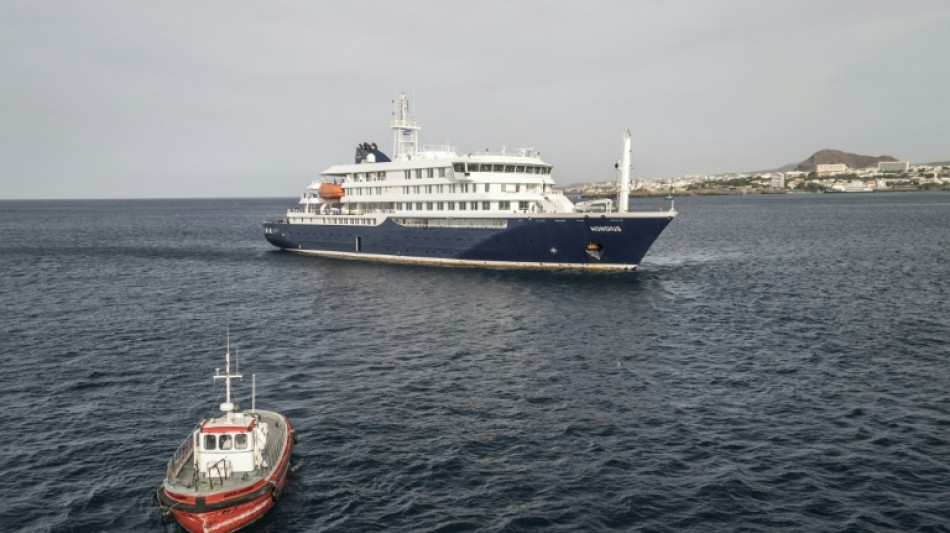
Past hantavirus outbreak shows how Andes virus spreads / Photo: - - AFP/File

 'He's here with me': Japan cycle queen dedicates gold to late brother

 Japan Olympic chief says 'lot more' athletes at Games than expected
 Asian carmakers besting US rivals at home, China poised to strike

 Widgets & Web Offers All-Inclusive Investor Relations Websites for Public Companies, IPOs and SPACs

 Adams named new US captain to 2030 World Cup

 China a better influence in Latin America than US: poll

 Judge pauses construction of border project in Texas national park

 Belgium's De Bruyne fires double to sink Turkey, France held by Italy
 US jobs data boosts stocks as oil prices dip

 US Supreme Court to hear high-stakes climate case

 Trump expected to name intel chief Clayton as AI czar: reports

 Argentina unveils passports-for-investment scheme

 Brazil election debate chaos sparks censorship row

 England's Carse charged by cricket body over nightclub incident

 Amazon vows $1 bn for data center towns, decries 'myths'

 Oil prices drop on G7 fuel release, US jobs data boosts stocks

 G7 agrees deal to ease global energy supply concerns

 Spain's government dealt blow as lawmakers reject housing bills

 Food, medicine shortages deepen in Russian-occupied Oleshky

 Man City whistleblower Rui Pinto facing 'dire consequences' - lawyers
 Russia 'tearing Kyiv apart', mayor says, as strikes paralyse traffic

 Taiwan boxer Lin wins Games gold as Japan edge North Korea on penalties

 Japan tame North Korea to win Games gold after shootout drama

 US posts weak job growth data in September
 Ethiopia's conflict: the regional dimension

An elderly man had just started running a fever when he walked into a birthday party in the small village of Epuyen in southwest Argentina in 2018.
That marked the start of the last time there was a "super-spreader" event of the Andes strain of hantavirus, before a recent deadly outbreak on a cruise ship turned the world's attention to this rare disease.
With the race on to track down anyone who was in contact with infected people on the ship, a thorough investigation into the 2018 outbreak has offered clues to how this illness can spread.
Argentine scientists analysed samples from most of the 33 infected people, which included 11 deaths, during the outbreak in Epuyen, and reconstructed how people crossed paths at that fateful birthday party.
They found that isolation measures helped stave off a wider outbreak -- and that the majority of human-to-human transmissions occurred on the very first day the infected person had a fever.
This could be pertinent for the 149 people still on board the MV Hondius cruise ship, after its operator said Thursday that there are no more symptomatic passengers on board.
Three people have died during the outbreak, including a Dutch couple who had travelled to Argentina, where hantavirus is endemic, before boarding the ship.
Two confirmed hantavirus patients are receiving care, one in Johannesburg and one in Zurich.
Three suspected cases have also been evacuated from the ship, with one of them testing positive for hantavirus, a Dutch hospital said on Thursday.
The World Health Organization has emphasised that the risk to the public is low and believes that the Andes hantavirus is not like Covid-19, which was an entirely new virus when it emerged and started a pandemic.
- 'Super-spreaders' -
The 2018 outbreak began when a 68-year-old Epuyen resident became infected with the Andes strain, likely while coming into contact with rodent urine, droppings or saliva near his home.
This is normally how humans catch hantavirus -- Andes being the only strain known to spread between humans.
On November 3, 2018, the man attended a birthday party for 90 minutes along with around 100 other people in the village in Argentina's Chubut Province, near the Chilean border.
Five people who came into contact with the man developed hantavirus symptoms in the weeks after the party, according to the 2020 study in the New England Journal of Medicine.
Three symptomatic people -- dubbed "super-spreaders" -- accounted for two-thirds of the infections.
One of them went on to infect six people "because of his active social life", the study said. He died 16 days after displaying symptoms.
His wife, the third super-spreader, was feeling ill when she attended his wake, where 10 more people were infected.
Back at the birthday party, a reconstruction of the scene determined that the first patient sat at a table within a metre (just over three feet) of several people he infected.
However, the man merely crossed paths with another on the way to the bathroom, saying "Hello" as he went, the study said.
During the outbreak, people appeared to be infected mostly "through inhalation of droplets", it added.
- Timing of symptoms 'critical' -
Exactly when hantavirus symptoms first emerged was "critical", the study emphasised.
In more than half of the cases, transmission "could be accurately established as the day of onset of fever in the primary case", it explained.
More than 80 health care workers were in close contact with symptomatic patients at hospitals, rarely taking many precautions, yet none became infected.
When the Argentine authorities put symptomatic patients in isolation and told contact cases to self-quarantine, it "likely curtailed further spread", the study said.
Isolation and quarantine measures have also now been put in place for those in contact with people on the cruise ship.
On Thursday, the WHO said it expects the cruise ship outbreak will be "limited" if countries follow public health measures.
But the UN agency added that more cases could yet emerge, because it can take as long as six weeks between being infected with hantavirus and developing symptoms.
F.Santana--PC



