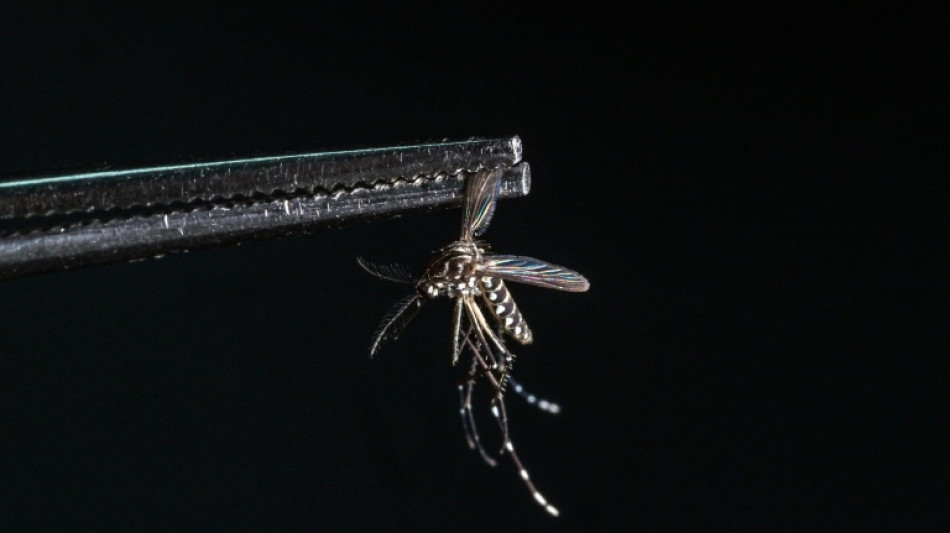
Scientist confronting the rising global threat of mosquitoes / Photo: Nelson ALMEIDA - AFP/File

 US regulator finds Boeing 737 MAX software bug 'not a safety concern'

 Ohtani 'managing' injuries as Dodgers launch MLB post-season

 Botched US execution leaves murderer unconscious on ventilator: lawyers

 Cornell rape case exposes sexual violence at US colleges

 France held by Italy in Zidane's homecoming after Olise stunner

 Ethiopian pro-government militia claims Tigray airport as regional tensions spike

 Ohtani shaking off injuries as Dodgers launch MLB post-season

 Sea levels to rise in California as coastal wave surges up west coast

 New rallies urged in France as protests disrupt over 730 schools

 Djokovic survives China Open scare, Sabalenka starts strong
 King Charles to evoke colonial 'darkest days' on Caribbean tour

 Tesla shares jump after global car sales top estimates

 DR Congo Ebola outbreak killed more than 4,000: official figures

 Djokovic survives China Open scare against wildcard world no. 104
 Lula, Bolsonaro trade blows in final scramble for votes in Brazil

 New clashes erupt as protests disrupt over 560 French schools

 NY governor vows to close loophole after alleged Cornell gang rape

 Ethiopia Tigray rebels pushed back as regional tensions spike

 Stocks rise, yields fall as US job numbers disappoint

 Man City verdict a 'big topic' for England players, says Tuchel

 NY attorney general tasked with investigating alleged Cornell gang rape

 China widens military footprint with Laos air base
 G7 talks as US pressures Europe over diesel stocks
 Man City launch appeal against explosive financial ruling
 Swiss president to quit government

Growing up in Tahiti, Anna-Bella Failloux saw first-hand the threat posed by mosquitoes: nearly a third of adults on the picturesque island once had swollen limbs from elephantiasis caused by their bites.
She has since dedicated her life to studying mosquitoes and the diseases they transmit -- a concern that looms ever larger as climate change expands the area where the insects roam.
"You have to accept being bitten by a mosquito from time to time," the 63-year-old entomologist at France's Pasteur Institute told AFP.
"But we have to avoid too many people getting sick and dying from the infections," Failloux said as she observed a mosquito trap being installed in the woods east of French capital Paris.
A keen seamstress, Failloux had sown the trap's netting herself.
Every few days over summer, these traps will be checked to see if the tiger mosquitoes inside could have spread yellow fever, dengue, chikungunya or Zika.
Once confined to the tropics, these mosquitoes have recently been detected in greater number across France and elsewhere, raising fears of outbreaks.
Failloux's life-long interest in mosquitoes goes back to a childhood spent in Papeete, Tahiti, where her shopkeeper parents arrived at the end of the 19th century.
While it seemed a tropical paradise, the island suffered from shockingly high rates of elephantiasis, which swells limbs to immense proportions. The condition is caused by a bacteria called Wuchereria bancrofti.
People become infected when mosquitoes inject "a small worm into their lymph nodes, which blocks circulation," Failloux explained.
At one point, around "30 percent of French Polynesia's population" was affected, she added.
- 'Increasingly vast playing field' -
Failloux would move to mainland France to study the Wuchereria bancrofti bacteria at university -- and dedicate herself to studying mosquito-borne diseases.
"Thirty years ago, climate change wasn't a major topic of discussion -- neither were mosquitoes," she said.
"Luckily, I persisted, then at some point, I was needed," said Failloux, who now heads the Pasteur Institute's arbovirus and insect vector unit.
While she had wanted to return to work in French Polynesia, life intervened.
"I met a husband in mainland France... so there you have it," Failloux said.
Rising temperatures caused by human-driven global warming have given mosquitoes -- and the many pathogens they spread -- "an increasingly vast playing field," she warned.
According to the World Health Organization, 80 percent of the world's population is now at risk of being exposed to one of more infectious diseases that were long considered tropical.
These diseases kill more than a million people a year, most of them children, according to the UN agency.
From 2028, Failloux will lead a team of around 15 researchers at a large new research centre in which the Pasteur Institute invested 30 million euros ($35 million).
The centre aims to develop strategies to control mosquitoes, particularly through their microbiota.
For now, Failloux's training for young entomologists includes courses in anthropology and sociology because she believes fighting mosquitoes also requires engaging the public.
One "long neglected" yet essential measure in the fight against mosquitoes is "cleaning your garden, unclogging your gutters," and eradicating any other stagnant water where mosquitoes could breed, Failloux added.
V.Dantas--PC



