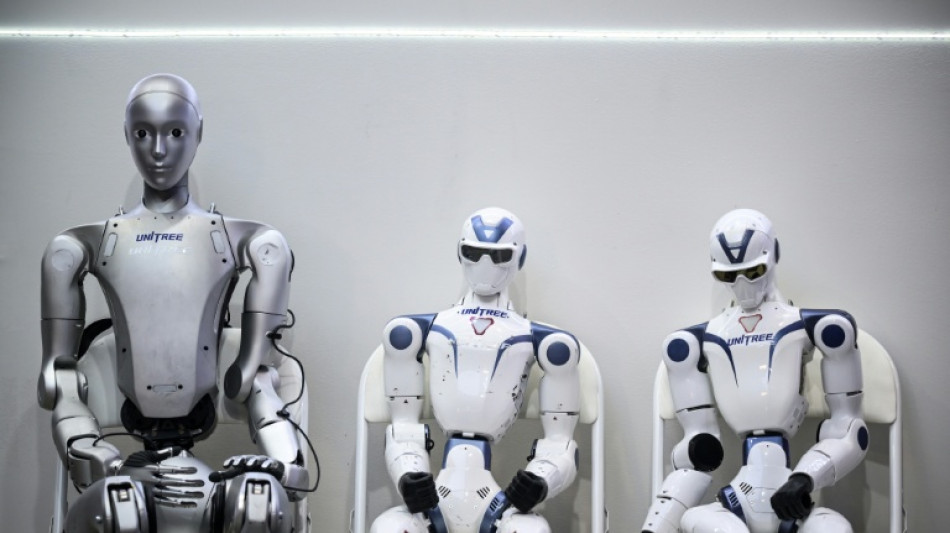
Robots pour cocktails and run marathons, but still can't multitask / Photo: JULIEN DE ROSA - AFP

 US regulator finds Boeing 737 MAX software bug 'not a safety concern'

 Ohtani 'managing' injuries as Dodgers launch MLB post-season

 Botched US execution leaves murderer unconscious on ventilator: lawyers

 Cornell rape case exposes sexual violence at US colleges

 France held by Italy in Zidane's homecoming after Olise stunner

 Ethiopian pro-government militia claims Tigray airport as regional tensions spike

 Ohtani shaking off injuries as Dodgers launch MLB post-season

 Sea levels to rise in California as coastal wave surges up west coast

 New rallies urged in France as protests disrupt over 730 schools

 Djokovic survives China Open scare, Sabalenka starts strong
 King Charles to evoke colonial 'darkest days' on Caribbean tour

 Tesla shares jump after global car sales top estimates

 DR Congo Ebola outbreak killed more than 4,000: official figures
 Djokovic survives China Open scare against wildcard world no. 104

 Lula, Bolsonaro trade blows in final scramble for votes in Brazil

 New clashes erupt as protests disrupt over 560 French schools

 NY governor vows to close loophole after alleged Cornell gang rape

 Ethiopia Tigray rebels pushed back as regional tensions spike
 Stocks rise, yields fall as US job numbers disappoint

 Man City verdict a 'big topic' for England players, says Tuchel

 NY attorney general tasked with investigating alleged Cornell gang rape

 China widens military footprint with Laos air base

 G7 talks as US pressures Europe over diesel stocks
 Man City launch appeal against explosive financial ruling

 Swiss president to quit government
They can mix cocktails, run marathons and fold laundry. But humanoid robots are still a long way from doing lots of different jobs on command, whatever the marketing says.
The gap was easy to spot at the Robotics Summit in Boston in late May. The glossy brochures promised one thing. The people who actually build the machines said another.
Elon Musk loves to show off his Optimus prototype, recently filmed jogging in short strides. Figure 03, a third-generation robot developed by Figure AI, can tidy and clean a living room by itself.
China's AgiBot and Matrix Robotics say their robots can greet visitors, serve coffee and give them a tour, a little like C-3PO from "Star Wars."
The reality is more modest.
"Most of the humanoids you see are being teleoperated, or they've got very specific paths and chores that they do," said Chris Matthieu of startup RealSense, which makes cameras for robots.
In other words, many are either run by a human with a remote control or stuck doing one narrow task.
Take Neo, the robot that 1X launched with great fanfare last October. It was billed as "the world's first consumer-ready humanoid robot designed to transform life at home" -- but was actually steered by a person off to the side.
Progress is real, though, and artificial intelligence is driving it. "I think AI has extremely accelerated that growth," said William Okazaki of sensor maker Renesas.
One big hurdle is the hands. Long the holy grail of robotics, they are getting close: robots can now grip with a delicate touch, and some sensors can even tell when they are touching human skin.
Much of this comes from a new kind of AI known as a VLA model, short for vision-language-action. It blends written instructions with what a camera sees in real time, so the robot can link what it is looking at to what it should do.
There is also the "world model" -- an AI that learns from vast amounts of images and video until it can predict what will happen next in the real world, such as how an object will shift when it is squeezed.
-- Hunt for data --
But an android that can do a bit of everything is still years off.
"For general purpose robots, it will take longer," said Daniel Fan of Innodisk, which makes parts for robots.
Plenty of humanoids are already out in the world -- Boston Dynamics' Atlas at Hyundai, Hexagon Robotics' AEON at a BMW site -- but these are trials, not final products.
"Until you actually get the robot actually trying to do the thing you think it can do, you don't really know," said Charlie Kemp of Hello Robot, which sells robots for people with limited mobility.
Running fully on their own, at scale, is not yet possible, "because there is not enough data," said Xinrui Bi of AgiBot.
To gather it, companies are setting up cameras everywhere to record human movement -- from people cooking at home to workers in a textile workshop in India.
The stakes are higher than for a chatbot like ChatGPT. A robot acts in the physical world, so its mistakes can hurt someone.
"If you want to move into a more social domain, it really has to be safe for the users around the robot," said Valentino Fagard of Japan's XELA Robotics, which works on giving robots a sense of touch.
Engineers can set limits -- telling the machines not to grip too hard, or not to get too close to a person. But there is a catch. Like chatbots, these AI systems don't always behave the same way twice, which makes them hard to predict.
"The issue with, call it the world model, or the end-to-end VLA, is they're non-deterministic, they're a black box," said John Black of Brain Corp, whose robots stick to a very specific task, like cleaning floors or checking store shelves.
"They're nowhere close to reaching the safety levels required," he said, because even the people who build these systems can not fully see why they do what they do.
A.F.Rosado--PC



