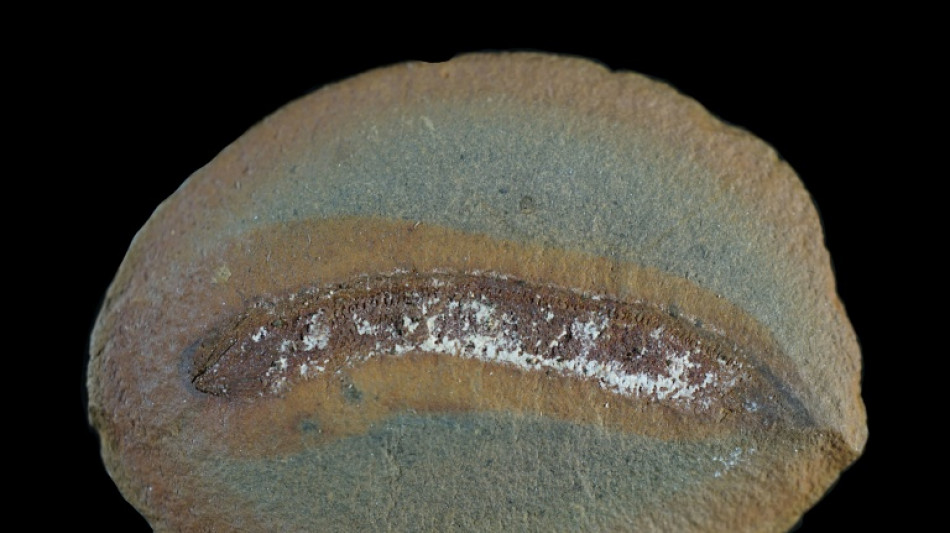
Fossils challenge assumptions on how animals adapted to land / Photo: Arjan MANN - Field Museum/AFP

 US regulator finds Boeing 737 MAX software bug 'not a safety concern'

 Ohtani 'managing' injuries as Dodgers launch MLB post-season

 Botched US execution leaves murderer unconscious on ventilator: lawyers

 Cornell rape case exposes sexual violence at US colleges

 France held by Italy in Zidane's homecoming after Olise stunner

 Ethiopian pro-government militia claims Tigray airport as regional tensions spike

 Ohtani shaking off injuries as Dodgers launch MLB post-season
 Sea levels to rise in California as coastal wave surges up west coast

 New rallies urged in France as protests disrupt over 730 schools

 Djokovic survives China Open scare, Sabalenka starts strong

 King Charles to evoke colonial 'darkest days' on Caribbean tour

 Tesla shares jump after global car sales top estimates

 DR Congo Ebola outbreak killed more than 4,000: official figures

 Djokovic survives China Open scare against wildcard world no. 104

 Lula, Bolsonaro trade blows in final scramble for votes in Brazil

 New clashes erupt as protests disrupt over 560 French schools

 NY governor vows to close loophole after alleged Cornell gang rape

 Ethiopia Tigray rebels pushed back as regional tensions spike

 Stocks rise, yields fall as US job numbers disappoint

 Man City verdict a 'big topic' for England players, says Tuchel

 NY attorney general tasked with investigating alleged Cornell gang rape

 China widens military footprint with Laos air base
 G7 talks as US pressures Europe over diesel stocks

 Man City launch appeal against explosive financial ruling

 Swiss president to quit government

Scientists have long posited the earliest water animals to transition to land had amphibious tadpole features, going through a metamorphosis akin to that of today's frogs.
But new research out Thursday in the journal Science challenges that conventional assumption. It presents analysis of rare fossils which scientists say fill knowledge gaps on the development of the creatures that gave rise to the first land-dwelling vertebrates.
The research centers on specimens excavated from the Mazon Creek fossil beds in northern Illinois, southwest of Chicago.
The world-renowned site features iron carbonate concretions that formed some 309 million years ago, fossilizing within them ancient creatures that had once thrived in the area's lush swamps, shallow seas and river deltas.
It's known for its exceptionally well-preserved specimens including soft tissue.
The new study analyzes dozens of fossils to examine the evolution between fish and tetrapods, or four-legged animals.
At the center was a specimen determined to likely be the baby of a crocodile-esque creature known as an embolomere, which lived mostly in the water but did develop little legs.
In its juvenile stage, popular thought would have anticipated it to show tadpole-like features like external gills, explained Jason Pardo, a research associate at Chicago's Field Museum and the study's co-lead author.
But it didn't, he said.
The body of the baby -- the specimen of which the researchers said are about the size of a short, narrow macaroni noodle -- instead showed evidence of direct development, meaning it was more or less put together the way they would be into adulthood.
That's not what we would expect to see in amphibians, whose metamorphosis from tadpoles into adults includes much more dramatic rearranging and development of organs and limbs.
"We now actually have some direct fossil record evidence," Pardo told AFP, "that this metamorphosis, this amphibian-like life cycle that we've for 150 years assumed was part of our history, turns out that it wasn't part of that at all."
- 'Glorious fossils' -
John Long, an Australian paleontologist who has also done extensive research in this field, called the study "quite outstanding."
"Not much was known about their early life stages," he explained to AFP of the animals that gave rise to the first tetrapods.
"This detailed work on a bunch of simply glorious fossils nails it that they went straight into a juvenile phase so didn't need to go through the tadpole stage."
Jason Anderson of the University of Calgary said the "impressive" paper highlights "the power of fossils to address questions we thought impossible given they take place in short periods of time, and in tissues not normally preserved over hundreds of millions of years."
Both he and Pardo also noted that the study underscores that amphibians are impressive evolutionary creatures in their own right.
"Our amphibians, instead of being relicts of earlier stages in the evolutionary history of tetrapods, are themselves highly evolved creatures," Anderson told AFP.
- 'Love letter' to citizen scientists -
The fossil serving as the focal point of the study had been in the collections at the Field Museum for a long time when the then-director showed it to paper co-author Arjan Mann, who became enthralled.
While both were doctoral students in Canada, Mann and Pardo puzzled over it for years.
Eventual analysis with scanning electron microscopy at the Canadian Museum of Nature allowed researchers to confirm it as a probable embolomere.
Throughout their research the duo analyzed that fossil's juvenile features along with another, smaller embolomere and other species of fossil baby tetrapod relatives.
Mann -- the Field Museum's Assistant Curator of Early Tetrapods -- noted that their research was made possible by the remarkable discoveries at the Mazon Creek site and the amateur scientists who for decades have combed it, a hobby that over the years turned up the specimens analyzed in the paper.
"This paper, in a way, is kind of a love letter to them, that shows the power of what we can do with working together with this community to synthesize really high-impactful new research," Mann told AFP.
C.Amaral--PC



