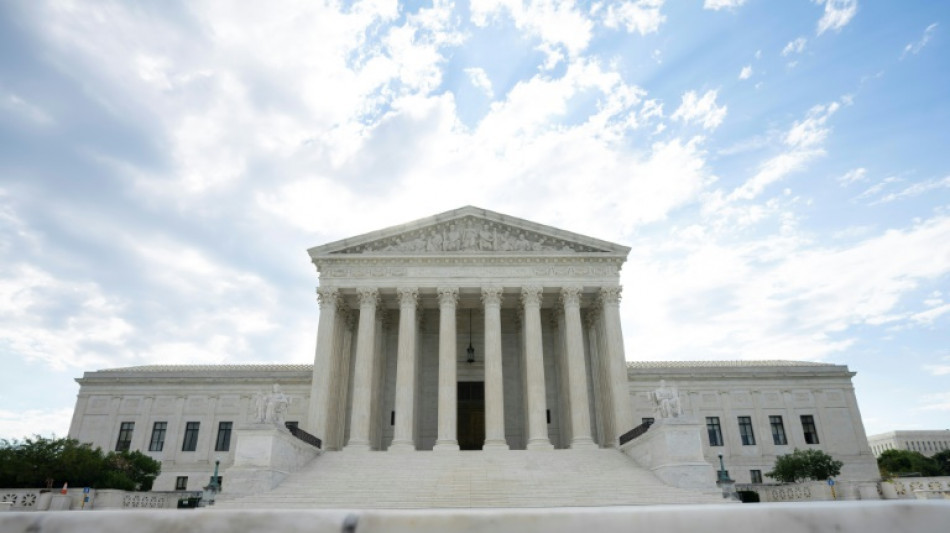
US Supreme Court rules on dragnet searches of cellphone location data / Photo: Stefani Reynolds - GETTY IMAGES/AFP/File

 US regulator finds Boeing 737 MAX software bug 'not a safety concern'

 Ohtani 'managing' injuries as Dodgers launch MLB post-season

 Botched US execution leaves murderer unconscious on ventilator: lawyers
 Cornell rape case exposes sexual violence at US colleges
 France held by Italy in Zidane's homecoming after Olise stunner

 Ethiopian pro-government militia claims Tigray airport as regional tensions spike
 Ohtani shaking off injuries as Dodgers launch MLB post-season
 Sea levels to rise in California as coastal wave surges up west coast
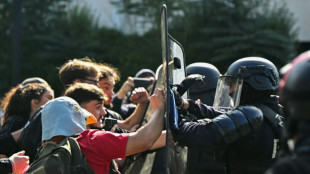 New rallies urged in France as protests disrupt over 730 schools
 Djokovic survives China Open scare, Sabalenka starts strong

 King Charles to evoke colonial 'darkest days' on Caribbean tour

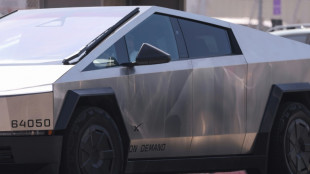 Tesla shares jump after global car sales top estimates

 DR Congo Ebola outbreak killed more than 4,000: official figures
 Djokovic survives China Open scare against wildcard world no. 104
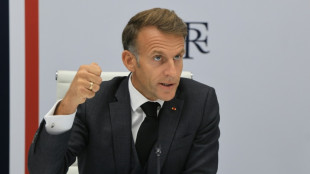
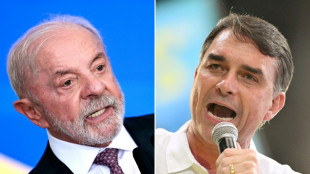 Lula, Bolsonaro trade blows in final scramble for votes in Brazil

 New clashes erupt as protests disrupt over 560 French schools
 NY governor vows to close loophole after alleged Cornell gang rape

 Ethiopia Tigray rebels pushed back as regional tensions spike
 Stocks rise, yields fall as US job numbers disappoint

 Man City verdict a 'big topic' for England players, says Tuchel

 NY attorney general tasked with investigating alleged Cornell gang rape

 China widens military footprint with Laos air base
 G7 talks as US pressures Europe over diesel stocks
 Man City launch appeal against explosive financial ruling

 Swiss president to quit government
The US Supreme Court on Monday ruled partially in favor of a man challenging the use of sweeping "geofence" searches of cellphone location data in his robbery conviction, sending the case back to a lower court for further consideration.
The court, in a 6-3 ruling, said that such searches -- which scan for every phone in a certain place at a specific time -- implicate the US Constitution's Fourth Amendment protections against "unreasonable searches and seizures."
However it said that a lower court would have to determine if the use of the search in the case at hand was in fact reasonable.
The case was brought by Okello Chatrie, identified as a suspect in a 2019 Virginia bank robbery after investigators obtained a warrant to search cellphone location data stored by Google.
Chatrie, who was armed with a gun and made off with $195,000, was eventually convicted and is serving a 12-year prison sentence.
His lawyer, Adam Unikowsky, argued that geofence warrants violate the Fourth Amendment by authorizing a search of every single person's account to find who was within a geofence perimeter.
Justice Elena Kagan, who was joined by the two other liberals on the court and three conservatives, wrote the majority opinion.
"An individual has a reasonable expectation of privacy in records about his cellphone's location, and police intrude on that constitutionally protected interest when they demand the information -- even though for only a limited time, and from a third-party tech company," Kagan wrote.
Eden Heilman, legal director of the American Civil Liberties Union of Virginia, welcomed the ruling.
"The Court's decision confirms that law enforcement does not have a blank check to use new technology to conduct warrantless surveillance of people's movements," Heilman said. "We do not lose our right to privacy simply because we use a cellphone."
Defending the use of geofence warrants, the government argued that a smartphone user can always choose to turn off location services.
Geofence warrants were notably used to identify supporters of President Donald Trump who stormed the US Capitol on January 6, 2021 in a bid to block congressional certification of Democrat Joe Biden's presidential election victory.
Google no longer stores location history data on its servers and has deleted all such data. Other technology companies continue to collect location data, however.
X.M.Francisco--PC



