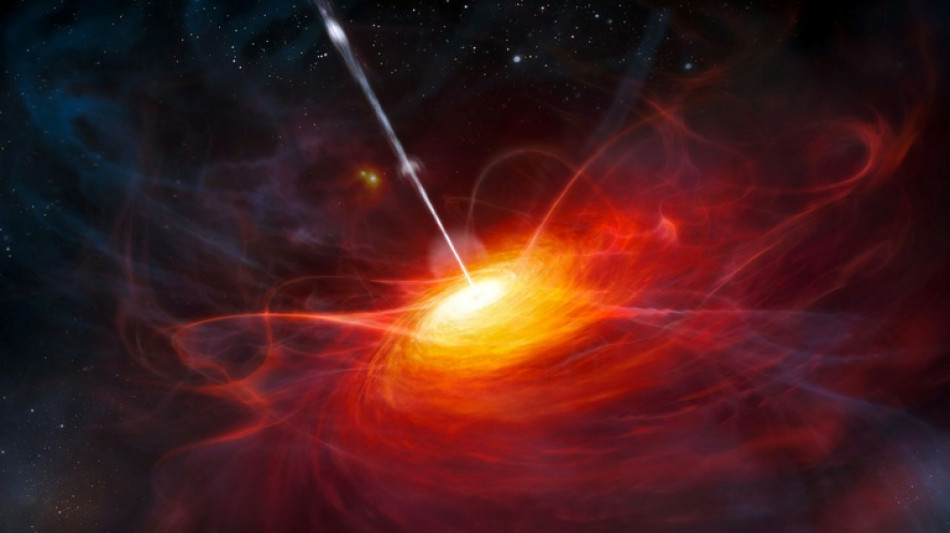
Oldest quasars ever discovered add to 'perplexing' space mystery / Photo: M. KORNMESSER - ESO/AFP/File

 US regulator finds Boeing 737 MAX software bug 'not a safety concern'

 Ohtani 'managing' injuries as Dodgers launch MLB post-season

 Botched US execution leaves murderer unconscious on ventilator: lawyers

 Cornell rape case exposes sexual violence at US colleges

 France held by Italy in Zidane's homecoming after Olise stunner

 Ethiopian pro-government militia claims Tigray airport as regional tensions spike

 Ohtani shaking off injuries as Dodgers launch MLB post-season

 Sea levels to rise in California as coastal wave surges up west coast

 New rallies urged in France as protests disrupt over 730 schools

 Djokovic survives China Open scare, Sabalenka starts strong

 King Charles to evoke colonial 'darkest days' on Caribbean tour

 Tesla shares jump after global car sales top estimates

 DR Congo Ebola outbreak killed more than 4,000: official figures

 Djokovic survives China Open scare against wildcard world no. 104

 Lula, Bolsonaro trade blows in final scramble for votes in Brazil

 New clashes erupt as protests disrupt over 560 French schools

 NY governor vows to close loophole after alleged Cornell gang rape

 Ethiopia Tigray rebels pushed back as regional tensions spike

 Stocks rise, yields fall as US job numbers disappoint

 Man City verdict a 'big topic' for England players, says Tuchel

 NY attorney general tasked with investigating alleged Cornell gang rape

 China widens military footprint with Laos air base

 G7 talks as US pressures Europe over diesel stocks

 Man City launch appeal against explosive financial ruling

 Swiss president to quit government

The Euclid space telescope has spotted the oldest quasars -- the brightest objects in the universe -- ever discovered, deepening a cosmic mystery that has been puzzling scientists.
Quasars are powered by supermassive black holes at the heart of early galaxies gobbling up surrounding matter in a colossal feeding frenzy that can shine trillions of times brighter than the Sun.
Because they are so incredibly bright -- and looking deep into space also means looking back in time -- scientists have been hunting for ancient quasars to learn more about the little-understood infancy of the universe.
In a study published on Monday, an international team of astronomers announced they had discovered 31 quasars, including the two oldest observed yet, using the European Space Agency's Euclid telescope, which is at a stable hovering spot around 1.5 million kilometres from Earth.
The light from the oldest pair comes from when the universe was roughly 670 million years old, just five percent of its current age of 13.8 billion years.
This beats the team's previous record for oldest -- and therefore most distant -- quasar announced in 2021 by around 20 million years.
Previous quasar hunts were mostly carried out with ground-based telescopes, but the launch of Euclid in 2023 "has transformed this field," Daming Yang, the lead author of the study in Astronomy & Astrophysics, told AFP.
In just two years, Euclid has doubled the number of ancient quasars known to science, added Yang, a PhD student at Leiden University in the Netherlands.
- Cosmic quandary -
The newly discovered quasars date back to what is known as the epoch of reionisation. This when the first stars and galaxies began to form, bringing an end to the cosmic dark ages.
"We can use quasars as a lighthouse to study the gas between us and them, so that we can trace how the universe was reionised through this cosmic history," Daming Yang said.
The quasars are also the latest example of a problem that has been increasingly baffling scientists.
As more powerful telescopes allow us to see further back in time, galaxies and other cosmic objects have turned out to be far bigger than had been thought possible at such an early age.
"Every step further back in time makes the puzzle more perplexing," study co-author Joseph Hennawi said in a statement about the newly discovered quasars.
"These monsters -- weighing billions of times the mass of our Sun -- somehow already existed when the universe was in its infancy," he said.
"We don't yet have a good understanding of how they grew so massive, so fast."
Hoping to find an answer, the scientists are searching for even older quasars.
The far-seeing James Webb space telescope also recently observed the newly announced quasars, Daming said, and the team will soon begin sifting through the data it collected.
The team eventually hope to stitch together "a quasar chronicle of the first billion years," Hennawi said.
B.Godinho--PC



