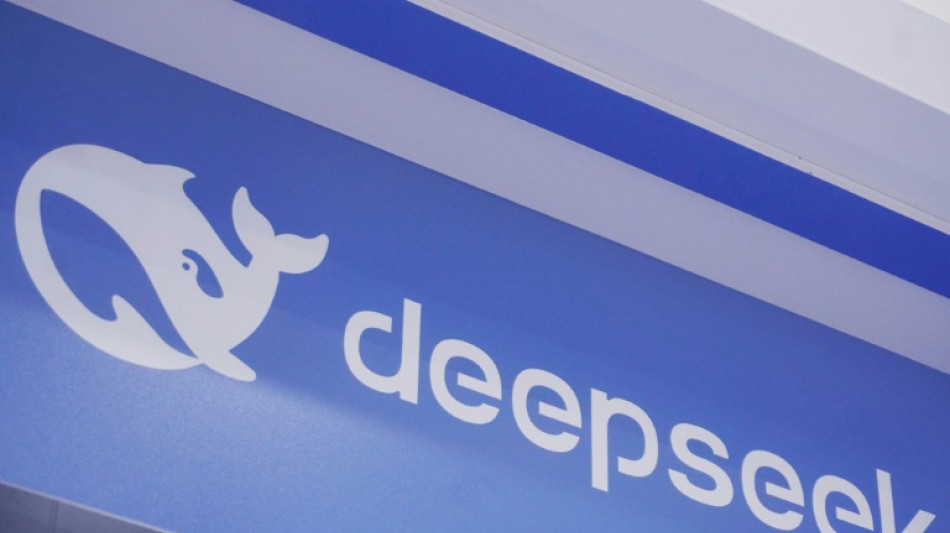
US crackdown on top AI fuels open-source surge / Photo: - - CN-STR/AFP

 US regulator finds Boeing 737 MAX software bug 'not a safety concern'

 Ohtani 'managing' injuries as Dodgers launch MLB post-season

 Botched US execution leaves murderer unconscious on ventilator: lawyers

 Cornell rape case exposes sexual violence at US colleges

 France held by Italy in Zidane's homecoming after Olise stunner

 Ethiopian pro-government militia claims Tigray airport as regional tensions spike

 Ohtani shaking off injuries as Dodgers launch MLB post-season

 Sea levels to rise in California as coastal wave surges up west coast
 New rallies urged in France as protests disrupt over 730 schools

 Djokovic survives China Open scare, Sabalenka starts strong

 King Charles to evoke colonial 'darkest days' on Caribbean tour

 Tesla shares jump after global car sales top estimates

 DR Congo Ebola outbreak killed more than 4,000: official figures
 Djokovic survives China Open scare against wildcard world no. 104

 Lula, Bolsonaro trade blows in final scramble for votes in Brazil

 New clashes erupt as protests disrupt over 560 French schools

 NY governor vows to close loophole after alleged Cornell gang rape

 Ethiopia Tigray rebels pushed back as regional tensions spike

 Stocks rise, yields fall as US job numbers disappoint

 Man City verdict a 'big topic' for England players, says Tuchel

 NY attorney general tasked with investigating alleged Cornell gang rape

 China widens military footprint with Laos air base

 G7 talks as US pressures Europe over diesel stocks

 Man City launch appeal against explosive financial ruling
 Swiss president to quit government

The US government's shock moves to restrict access to top artificial intelligence systems from Anthropic and OpenAI have sparked growing interest in open-source models -- especially ones from China.
The de facto bans from an anti-regulation White House blindsided the tech world, which had grown accustomed to AI labs releasing ever more powerful models with nary a worry of government intervention.
The episode has thrust a long-simmering debate to the fore: open versus closed AI.
Most of the best-known AI models -- like OpenAI's ChatGPT or Anthropic's Claude -- are "closed," meaning the company keeps the underlying code and data locked away.
Users can access the AI via an app or website, mainly through a subscription, but the company controls who gets in and can shut down access at any time.
"Open-source" or "open-weight" models work differently: the developers release the model's core files for anyone to download, modify and run on their own computers. Once released, no one -- not the company, not a government -- can take them back.
In early June, the Trump administration ordered Anthropic to block non-Americans from using its most powerful -- and closed -- models, Mythos 5 and Fable 5.
Faced with the complexity of screening users, the startup simply pulled the models offline entirely.
Shortly after, OpenAI agreed to let the government approve every customer for its newest model, GPT-5.6.
"If everything you need to do has to be on a specific frontier model, that makes whatever you're building a whole lot less reliable" when it is suddenly unavailable, said Oren Michels, co-founder and CEO of Barndoor AI.
Haitham Mengad, co-founder of Stems Labs, a startup focused on AI-powered music creation, felt the disruption firsthand.
"Fable has been a game-changing model for me. Honestly, when they took it off, it was the first time that I realized... it's almost like a drug," he recalled.
The Mythos episode "was a powerful moment" for seeing open source as an alternative, Mengad said.
- 'Being flexible' -
Open models were already gaining fans because using closed AI keeps getting more expensive.
Around the same time, China's Zhipu AI (also known as Z.ai) released GLM-5.2, an open model that performed nearly as well as top offerings from Anthropic and OpenAI on several benchmarks.
"GLM-5.2 is free to download, fine-tune, and run on an enterprise's own servers, putting pricing pressure on frontier labs at the same time that access looks shaky," AI analyst Andrew Curran noted.
On OpenRouter, a platform that routes requests across different AI models, Google, Anthropic and OpenAI's combined share of usage dropped from 55 percent to 33 percent between January and June.
China's open DeepSeek now leads by a clear margin.
"You want to be as flexible as you can be. Maybe a year and a half ago some large company might say we bought Anthropic or we bought OpenAI, and now no one, no one buys only one," said Michels.
Among Western companies, France's Mistral stands largely alone in championing open models. US tech giant Meta, once a vocal open-source advocate, has stepped back from that.
Meanwhile, early suspicions about Chinese AI models as a security threat are fading, at least somewhat.
"I don't think there's any risk, to be honest," said Mengad. The fears are more "psychological, emotional than rational."
Once you download an open model and run it on your own hardware, the company that made it -- Chinese or otherwise -- has no access to your data or control over how you use it.
Still, some experts think the government crackdown could also end up coming for open models as they become more powerful.
"If Mythos-level models are considered risky, China will also not want them to be open," said Ethan Mollick, a professor at the University of Pennsylvania and a leading voice on AI -- meaning governments everywhere, not just Washington, may want to keep top-tier AI locked down.
Nogueira--PC



