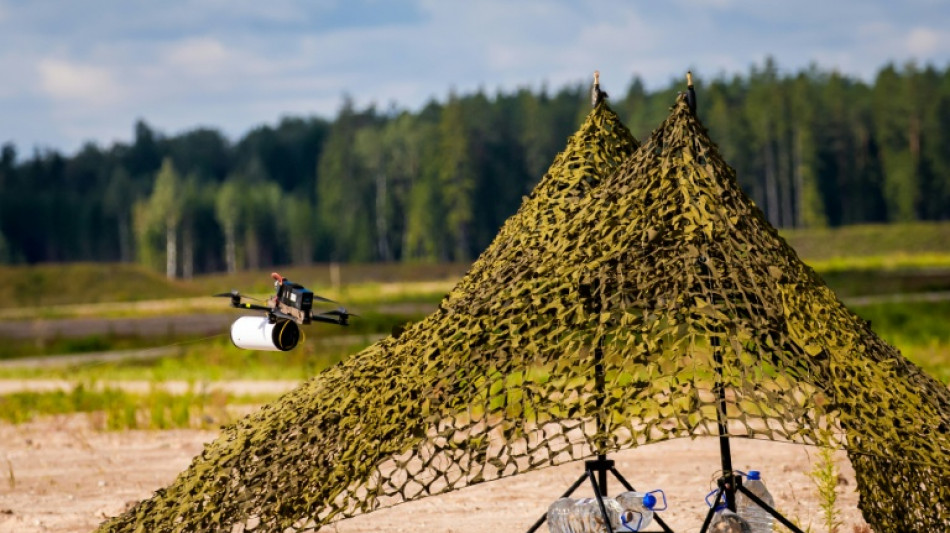
Baltic startups take aim at deterring Russia on NATO's eastern flank / Photo: Gints Ivuskans - AFP/File

 Botched US execution leaves murderer unconscious on ventilator: lawyers
 Cornell rape case exposes sexual violence at US colleges

 France held by Italy in Zidane's homecoming after Olise stunner

 Ethiopian pro-government militia claims Tigray airport as regional tensions spike

 Ohtani shaking off injuries as Dodgers launch MLB post-season

 Sea levels to rise in California as coastal wave surges up west coast

 New rallies urged in France as protests disrupt over 730 schools

 Djokovic survives China Open scare, Sabalenka starts strong
 King Charles to evoke colonial 'darkest days' on Caribbean tour

 Tesla shares jump after global car sales top estimates

 DR Congo Ebola outbreak killed more than 4,000: official figures

 Djokovic survives China Open scare against wildcard world no. 104
 Lula, Bolsonaro trade blows in final scramble for votes in Brazil

 New clashes erupt as protests disrupt over 560 French schools
 NY governor vows to close loophole after alleged Cornell gang rape

 Ethiopia Tigray rebels pushed back as regional tensions spike

 Stocks rise, yields fall as US job numbers disappoint

 Man City verdict a 'big topic' for England players, says Tuchel

 NY attorney general tasked with investigating alleged Cornell gang rape

 China widens military footprint with Laos air base

 G7 talks as US pressures Europe over diesel stocks
 Man City launch appeal against explosive financial ruling
 Swiss president to quit government
 Europe rejects US threats over diesel stocks, urges joint G7 action

 Philippines tennis star Eala says 'I get overwhelmed sometimes'
When Russia launched its full-scale invasion of Ukraine, Rapolas Markevicius was managing a private equity fund in Lithuania -- a country on NATO's eastern flank that fears it might be Moscow's next target.
Four-and-a-half years later, his new startup Pdkinematics builds precision guidance systems that help drones strike targets more accurately even when GPS signals are jammed, which are supplied to both Ukraine and its European allies.
He is one of several startup founders in the Baltics trying to invigorate the region's defensive capabilities, as NATO's eastern members face their own hybrid threats from Russia and its close ally Belarus.
"The beginning of the war was kind of a call for action for us," Markevicius told AFP.
After Russia's February 2022 invasion, he launched a research and development programme to "understand what kind of technologies we could actually deliver to the battlefront", working with his co-founder from the space-tech sector.
As states across NATO's eastern flank face a raft of hostile actions from Moscow and Minsk ranging from drone incursions to cyberattacks, experts say startups like his are improving the region's economic resilience and helping to deter Russian aggression.
- 'Scalable solutions' -
An active startup scene has developed in Lithuania and its fellow Baltic states of Estonia and Latvia in the decades since their transition from Soviet-controlled command economies.
It is even home to several companies that are now well known far from the Baltics, such as Vinted, Bolt and Skype.
Entrepreneurs are filling gaps left by traditional arms contractors.
The conflict in Ukraine has seen a massive technological shift in warfare, with drones and robots taking on much of the fighting.
That has put a premium on quick development as well as the capacity to rapidly scale up production.
"The current technology that will drive, and is currently driving, the transition of European arms must be as scalable as it must be high-tech," Markevicius said.
And, he added, it is usually startups that are "creating quite efficient, cost-efficient and scalable solutions".
- 'Tried and tested' -
The Baltic states have some of the highest defence spending in all of NATO in relative terms -- Lithuania directs 5.3 percent of GDP to defence, the most of NATO's 32 members.
Governments are more open to working with less experienced contractors given the speed at which warfare is transforming.
The Lithuanian Armed Forces provide access to fields and airspace every month as a practical testing grounds for emerging technologies.
The Ukraine war is also giving companies real-time feedback on how their technologies fare against the Russian military.
"You can test your product with Ukraine, with Lithuanian soldiers, with any NATO soldiers," said Elvinas Kukys, CEO and founder of Luna Robotics, a startup developing advanced imaging systems for FPV drones.
In that environment, defence startups across the region have been able to attract significant foreign investment.
"The Baltic states have really been tried and tested over the past four years about how they needed to restructure their economies, reorient and really invest in their defence capabilities," said Mario Bikarski, Senior Europe Analyst at risk intelligence company Verisk Maplecroft.
"They are really now some of the best-prepared countries to withstand a wide range of new forms of attacks," he added.
- 'A new normal' -
A burgeoning defence startup sector "is not something that is going to stop a potential Russian attack", Milan Trajkovic, an analyst at Fitch, told AFP.
"But it does probably make it more difficult," he added.
Invest Lithuania (IL), which helps foreign firms invest in the country, said the Baltics' position next to Russia means some investors require reassurance.
"We understand that this is the new normal," said its director Elijius Cevelis.
He said meetings between investors and government ministries -- sometimes involving confidential information -- can help calm some fears and promote a better image of the country and region.
"We have many international troops, we have armour, we have vehicles, we have everything we haven't had before," he said.
R.J.Fidalgo--PC



