To the Moon and beyond: NASA's Artemis program / Photo: Simon MALFATTO - AFP

 Split loyalties for Indian football fans at Brazil friendly

 India-Pakistan blockbuster brings cricket fever to Japan baseball field

 Wong waiting on Rafa after winning Asian Games tennis gold

 With Russia next door and rising costs, Latvia goes to the polls

 Penalty hero rues empty seats as Games hosts Japan win football gold

 North Korea fires ballistic missile after Seoul's apology demand

 US regulator finds Boeing 737 MAX software bug 'not a safety concern'

 Ohtani 'managing' injuries as Dodgers launch MLB post-season

 Botched US execution leaves murderer unconscious on ventilator: lawyers

 Cornell rape case exposes sexual violence at US colleges

 France held by Italy in Zidane's homecoming after Olise stunner

 Ethiopian pro-government militia claims Tigray airport as regional tensions spike

 Ohtani shaking off injuries as Dodgers launch MLB post-season

 Sea levels to rise in California as coastal wave surges up west coast

 New rallies urged in France as protests disrupt over 730 schools

 Djokovic survives China Open scare, Sabalenka starts strong

 King Charles to evoke colonial 'darkest days' on Caribbean tour

 Tesla shares jump after global car sales top estimates

 DR Congo Ebola outbreak killed more than 4,000: official figures

 Djokovic survives China Open scare against wildcard world no. 104

 Lula, Bolsonaro trade blows in final scramble for votes in Brazil

 New clashes erupt as protests disrupt over 560 French schools

 NY governor vows to close loophole after alleged Cornell gang rape

 Ethiopia Tigray rebels pushed back as regional tensions spike

 Stocks rise, yields fall as US job numbers disappoint

The Artemis program is NASA's plan to return humans to the Moon as a stepping stone for an eventual voyage to Mars.
Twelve men walked on the Moon between 1969 and 1972 and one of the goals of Artemis is to put the first woman and person of color on the lunar surface.
The first test flight of an uncrewed Artemis rocket is to take place on Monday.
The name Artemis was chosen to echo that of the Apollo program.
Artemis, in Greek mythology, was the twin sister of Apollo and a goddess associated with the Moon.
Here is an overview of the Artemis program:
- Artemis 1: test flight -
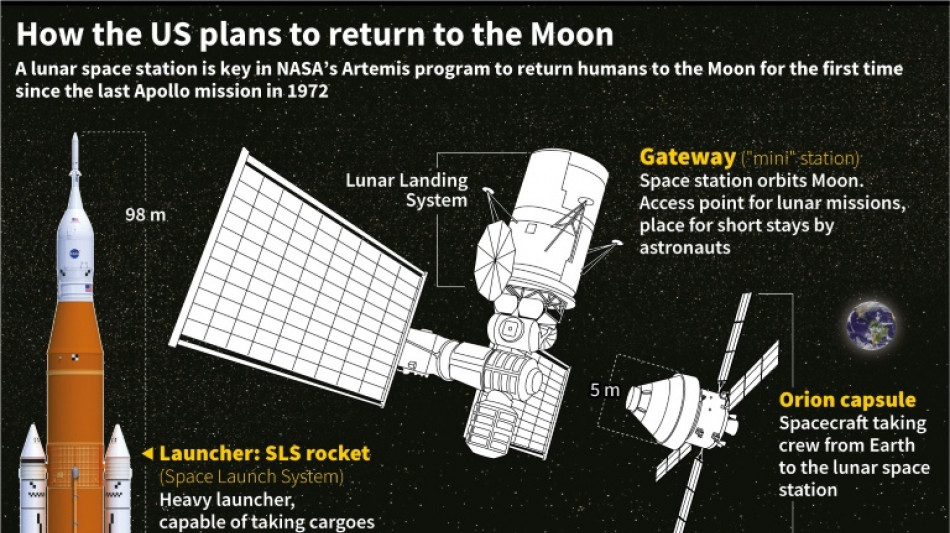
Artemis 1 is a test flight of the 322-foot (98-meter) Space Launch System rocket and the Orion crew capsule that sits on top.
Blastoff is scheduled for 8:33 am (1233 GMT) on Monday from the Kennedy Space Center in Florida.
Mannequins equipped with sensors will take the place of crew members on the flight, recording vibration, acceleration and radiation levels.
Orion will orbit the Moon before splashing down in the Pacific Ocean.
- Artemis 2: first crew -
Planned for 2024, Artemis 2 will be a crewed flight that will orbit the Moon but not land on the surface, similar to what Apollo 8 did.
The four members of the crew will be named before the end of the year. A Canadian is expected to be among them.
- Artemis 3: Moon landing -
The third Artemis mission will be the first to put astronauts on the Moon since Apollo 17 in December 1972.
NASA, for the first time, will land a crewed spacecraft on the southern pole of the Moon, where water in the form of ice has been detected.
Previous Moon landings took place near the equator.
Artemis 3 is scheduled for 2025 but may not take place until 2026 at the earliest, according to an independent audit of the program.
Starting with Artemis 3, NASA plans to launch crewed missions about once a year.
- SpaceX Moon lander -
NASA has selected Elon Musk's SpaceX to build the Moon lander for Artemis 3.
SpaceX's Starship, which is still under development, will serve as a shuttle from the Orion crew capsule to the lunar surface and back.
- Gateway space station -
The Artemis program also calls for the construction of a space station called Gateway that will orbit the Moon.
The launch of the first two elements -- the living quarters module and power and propulsion system -- is planned for late 2024 at the earliest by a SpaceX Falcon Heavy rocket.
Orion crews would be responsible for assembly of Gateway.
Astronauts would spend between 30 to 60 days in Gateway and would eventually have access to a lander that would allow them to travel to the Moon and back.
Gateway would also serve as a stopping point for any future trip to Mars.
- Destination Mars -
The ultimate objective of the Artemis program is what NASA calls the "next giant leap -- human exploration of Mars."
NASA will use knowledge gained from Artemis about next generation spacesuits, vehicles, propulsion, resupply and other areas to prepare for a trip to Mars.
The goal is to learn how to maintain a human presence in deep space for a long period.
Creating a "base camp" on the Moon is part of the plan with astronauts staying on the lunar surface for up to two months.
While a trip to the Moon takes just a few days, a voyage to Mars would take a minimum of several months.
A.P.Maia--PC



