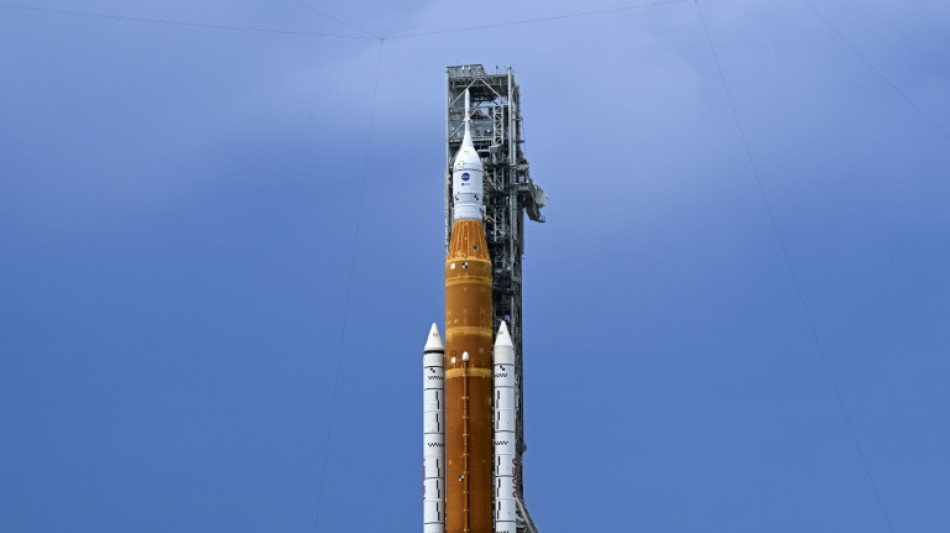
NASA postpones rocket launch to Moon after fuel leak / Photo: CHANDAN KHANNA - AFP

 Split loyalties for Indian football fans at Brazil friendly

 India-Pakistan blockbuster brings cricket fever to Japan baseball field

 Wong waiting on Rafa after winning Asian Games tennis gold

 With Russia next door and rising costs, Latvia goes to the polls

 Penalty hero rues empty seats as Games hosts Japan win football gold

 North Korea fires ballistic missile after Seoul's apology demand

 US regulator finds Boeing 737 MAX software bug 'not a safety concern'

 Ohtani 'managing' injuries as Dodgers launch MLB post-season

 Botched US execution leaves murderer unconscious on ventilator: lawyers

 Cornell rape case exposes sexual violence at US colleges

 France held by Italy in Zidane's homecoming after Olise stunner

 Ethiopian pro-government militia claims Tigray airport as regional tensions spike

 Ohtani shaking off injuries as Dodgers launch MLB post-season

 Sea levels to rise in California as coastal wave surges up west coast

 New rallies urged in France as protests disrupt over 730 schools

 Djokovic survives China Open scare, Sabalenka starts strong

 King Charles to evoke colonial 'darkest days' on Caribbean tour

 Tesla shares jump after global car sales top estimates

 DR Congo Ebola outbreak killed more than 4,000: official figures

 Djokovic survives China Open scare against wildcard world no. 104

 Lula, Bolsonaro trade blows in final scramble for votes in Brazil

 New clashes erupt as protests disrupt over 560 French schools

 NY governor vows to close loophole after alleged Cornell gang rape

 Ethiopia Tigray rebels pushed back as regional tensions spike

 Stocks rise, yields fall as US job numbers disappoint

NASA on Saturday scrapped a second attempt to get its new 30-story rocket off the ground and send its uncrewed test capsule toward the Moon after engineers detected a fuel leak.
With millions around the globe and hundreds of thousands on nearby beaches waiting for the historic launch of the massive Space Launch System (SLS), a leak near the base of the rocket was found as ultra-cold liquid hydrogen was being pumped in.
"The launch director waived off today’s Artemis I launch," NASA said in a statement. "Multiple troubleshooting efforts to address the area of the leak... did not fix the issue."
Though the area around the launch site was closed to the public, an estimated 400,000 people had gathered nearby to see -- and hear -- the most powerful vehicle that NASA has ever launched climb into space.
The initial launch attempt on Monday was also halted after engineers detected a fuel leak and a sensor showed that one of the rocket's four main engines was too hot.
Early Saturday, launch director Charlie Blackwell-Thompson had given the go-ahead to start filling the rocket's tanks with cryogenic fuel.
About three million liters of ultra-cold liquid hydrogen and oxygen were due to be pumped into the spacecraft, but the process soon hit problems.
No new date for another try was immediately announced.
After the latest delay, there are backup opportunities on Monday or Tuesday. After that, the next launch window will not be until September 19, due to the Moon's position.
The purpose of the Artemis 1 mission is to verify that the Orion capsule, which sits atop the SLS rocket, is safe to carry astronauts in the future.
Mannequins equipped with sensors are standing in for astronauts on the mission and will record acceleration, vibration and radiation levels.
- Apollo's twin sister -
It will take several days for the spacecraft to reach the Moon, flying around 60 miles (100 kilometers) at its closest approach. The capsule will fire its engines to get to a distant retrograde orbit (DRO) of 40,000 miles beyond the Moon, a record for a spacecraft rated to carry humans.
The trip is expected to last around six weeks and one of its main objectives is to test the capsule's heat shield, which at 16 feet in diameter is the largest ever built.
On its return to Earth's atmosphere, the heat shield will have to withstand speeds of 25,000 miles per hour and a temperature of 5,000 degrees Fahrenheit (2,760 degrees Celsius) -- roughly half as hot as the Sun.
Artemis is named after the twin sister of the Greek god Apollo, after whom the first Moon missions were named.
Unlike the Apollo missions, which sent only white men to the Moon between 1969 and 1972, Artemis missions will see the first person of color and the first woman step foot on the lunar surface.
A government audit estimates the Artemis program's cost will grow to $93 billion by 2025, with each of its first four missions clocking in at a whopping $4.1 billion per launch.
The next mission, Artemis 2, will take astronauts to the Moon without landing on its surface.
The crew of Artemis 3 is to land on the Moon in 2025 at the earliest, with later missions envisaging a lunar space station and a sustainable presence on the lunar surface.
According to NASA chief Bill Nelson, a crewed trip to the red planet aboard Orion, which would last several years, could be attempted by the end of the 2030s.
P.Queiroz--PC



