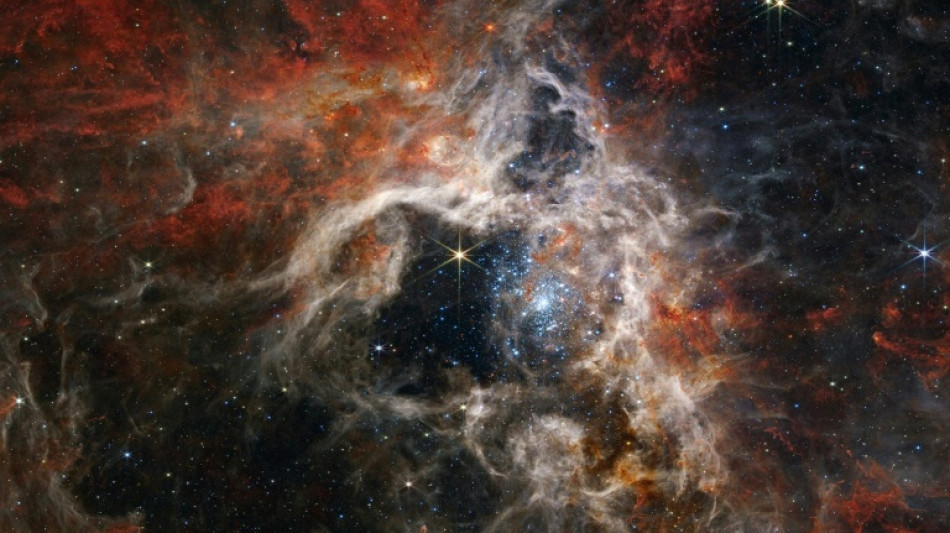
NASA's Webb catches Tarantula Nebula / Photo: Space Telescope Science Institut - NASA/AFP

 Split loyalties for Indian football fans at Brazil friendly

 India-Pakistan blockbuster brings cricket fever to Japan baseball field

 Wong waiting on Rafa after winning Asian Games tennis gold

 With Russia next door and rising costs, Latvia goes to the polls

 Penalty hero rues empty seats as Games hosts Japan win football gold

 North Korea fires ballistic missile after Seoul's apology demand

 US regulator finds Boeing 737 MAX software bug 'not a safety concern'

 Ohtani 'managing' injuries as Dodgers launch MLB post-season

 Botched US execution leaves murderer unconscious on ventilator: lawyers

 Cornell rape case exposes sexual violence at US colleges

 France held by Italy in Zidane's homecoming after Olise stunner

 Ethiopian pro-government militia claims Tigray airport as regional tensions spike

 Ohtani shaking off injuries as Dodgers launch MLB post-season

 Sea levels to rise in California as coastal wave surges up west coast

 New rallies urged in France as protests disrupt over 730 schools

 Djokovic survives China Open scare, Sabalenka starts strong

 King Charles to evoke colonial 'darkest days' on Caribbean tour

 Tesla shares jump after global car sales top estimates

 DR Congo Ebola outbreak killed more than 4,000: official figures

 Djokovic survives China Open scare against wildcard world no. 104

 Lula, Bolsonaro trade blows in final scramble for votes in Brazil

 New clashes erupt as protests disrupt over 560 French schools

 NY governor vows to close loophole after alleged Cornell gang rape
 Ethiopia Tigray rebels pushed back as regional tensions spike

 Stocks rise, yields fall as US job numbers disappoint

A stellar nursery nicknamed the Tarantula Nebula has been captured in crisp detail by NASA's Webb telescope, revealing hitherto unseen features that deepen scientific understanding, the agency said Tuesday.
Officially known as 30 Doradus, the region of space is characterized by its dusty filaments that resemble the legs of a hairy spider, and has long been a favorite for astronomers interested in star formation.
Thousands of young stars, distant background galaxies, and the detailed structure of the nebula's gas and dust structures were viewable for the first time thanks to Webb's high resolution infrared instruments.
Webb operates primarily in the infrared spectrum, because light from objects in the distant cosmos has been stretched into this wavelength over the course of the universe's expansion.
The telescope's primary imager, Near-Infrared Camera (NIRCam), found the cavity in the center of the nebula was hollowed out by radiation carried on stellar winds emanating from a cluster of massive young stars, which appear as pale blue dots.
Webb's Near-Infrared Spectrograph (NIRSpec), which analyzes light patterns to determine the composition of objects, caught one young star in the act of shedding a cloud of dust from around itself.
The same star was previously thought to be at a later stage of formation, already well on the way to clearing its dusty bubble.
The region was also imaged using the Mid-infrared Instrument (MIRI), which uses longer wavelengths of infrared to pierce through dust grains that absorb or scatter shorter wavelengths.
This faded the hot stars and clarified the cooler regions, revealing never-before-seen points of light within the stellar nursery, which indicate protostars that are still gaining mass.
Astronomic interest in the Tarantula Nebula stems from its similar chemical composition to gigantic star-forming regions observed a few billion years after the Big Bang, a period called the "cosmic noon" when star formation peaked.
At just 161,000 light-years away, Tarantula is a readily viewable example of this flourishing period of cosmic creation.
Webb should also provide scientists the opportunity to gaze at distant galaxies from the actual era of cosmic noon, and compare it to observations of Tarantula, to understand similarities and differences.
Operational since July, Webb is the most powerful space telescope ever built, with astronomers confident it will herald a new era of discovery.
B.Godinho--PC



