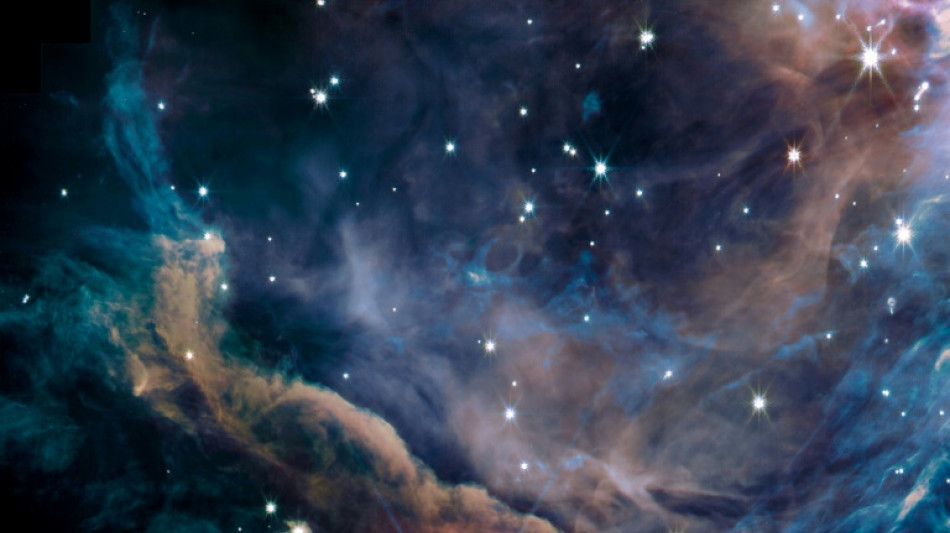
Webb telescope captures 'breathtaking' images of Orion Nebula / Photo: Handout - NASA/ESA/CSA/AFP

 Split loyalties for Indian football fans at Brazil friendly
 India-Pakistan blockbuster brings cricket fever to Japan baseball field

 Wong waiting on Rafa after winning Asian Games tennis gold

 With Russia next door and rising costs, Latvia goes to the polls

 Penalty hero rues empty seats as Games hosts Japan win football gold

 North Korea fires ballistic missile after Seoul's apology demand

 US regulator finds Boeing 737 MAX software bug 'not a safety concern'

 Ohtani 'managing' injuries as Dodgers launch MLB post-season

 Botched US execution leaves murderer unconscious on ventilator: lawyers

 Cornell rape case exposes sexual violence at US colleges

 France held by Italy in Zidane's homecoming after Olise stunner

 Ethiopian pro-government militia claims Tigray airport as regional tensions spike

 Ohtani shaking off injuries as Dodgers launch MLB post-season

 Sea levels to rise in California as coastal wave surges up west coast

 New rallies urged in France as protests disrupt over 730 schools

 Djokovic survives China Open scare, Sabalenka starts strong

 King Charles to evoke colonial 'darkest days' on Caribbean tour

 Tesla shares jump after global car sales top estimates

 DR Congo Ebola outbreak killed more than 4,000: official figures

 Djokovic survives China Open scare against wildcard world no. 104

 Lula, Bolsonaro trade blows in final scramble for votes in Brazil

 New clashes erupt as protests disrupt over 560 French schools

 NY governor vows to close loophole after alleged Cornell gang rape
 Ethiopia Tigray rebels pushed back as regional tensions spike

 Stocks rise, yields fall as US job numbers disappoint

The wall of dense gas and dust resembles a massive winged creature, its glowing maw lit by a bright star as it soars through cosmic filaments.
An international research team on Monday revealed the first images of the Orion Nebula captured with the James Webb Space Telescope, leaving astronomers "blown away."
The stellar nursery is situated in the constellation Orion, 1,350 light-years away from Earth, in a similar setting in which our own solar system was birthed more than 4.5 billion years ago.
Astronomers are interested in the region to better understand what happened during the first million years of our planetary evolution.
The images were obtained as part of the Early Release Science program and involved more than 100 scientists in 18 countries, with institutions including the French National Centre for Scientific Research (CNRS), Western University in Canada, and the University of Michigan.
"We are blown away by the breathtaking images of the Orion Nebula," Western University astrophysicist Els Peeters said in a statement.
"These new observations allow us to better understand how massive stars transform the gas and dust cloud in which they are born," she added.
Nebulas are obscured by large amounts of dust that made it impossible to observe with visible light telescopes, such as the Hubble Space Telescope, Webb's predecessor.
Webb however operates primarily in the infrared spectrum, penetrating the dust.
This revealed numerous spectacular structures, down to the scale of 40 astronomical units, or the size of our solar system.
These include dense filaments of matter, which could birth new generations of stars, as well as forming stellar systems that consist of a central proto-star surrounded by a disc of dust and gas, in which planets form.
"We hope to gain understanding about the entire cycle of star birth," said Edwin Bergin, University of Michigan chair of astronomy and a member of the international research team.
"In this image we are looking at this cycle where the first generation of stars is essentially irradiating the material for the next generation. The incredible structures we observe will detail how the feedback cycle of stellar birth occurs in our galaxy and beyond."
Webb is the most powerful space telescope ever built, boasting a primary mirror measuring 6.5 meters (more than 21 feet) that is made up of 18 hexagonal, gold-coated segments, as well as a five-layer sunshield the size of a tennis court.
A.Magalhes--PC



