Agrograde Introduces AI Optical Sorter for Arecanut Processing

 US Government Questions Effectiveness of Waymo’s School Bus Software Fix

 Panthers expected to begin 2027 NRL season away from new stadium

 Sweet As app launches restaurant discovery platform

 MLA seeks inquiry into reported sectarian gestures on Ormeau Road

 Louise O’Reilly attacks Simon Harris over unemployment remarks

 Virginia overwhelms Arkansas 91-72 behind balanced scoring

 Second major storm brings destructive winds and outages to British Columbia

 Godzilla Minus Zero leads North American box office with $31.6m

 Advocate calls for coordinated support for children facing trafficking

 Dianna Russini Details 'Nightmare' Scandal Aftermath, Announces New Media Venture

 Pennsylvania Democrats secure state trifecta in midterm elections

 Godzilla Minus Zero sets foreign-language box-office opening record

 Villeneuve teases James Bond casting at Los Angeles museum gala

 Nottinghamshire launches specialist rural crime policing team

 China confirms talks over possible Xi-Putin-Trump summit

 Rail journey offers a slower route to a Berlin city break

 Arsenal control title race as Manchester United fall into bottom three

 Suspected Krakow gunman dies after attack that killed six

 Carrick backs Dalot after hostile reception from Manchester United fans

 Belgian PM Bart De Wever Given New Deadline to Resolve €10 Billion Budget Deadlock

 $1.8 Billion Pledged for Biodiversity at COP17 as Monaco Reaffirms Commitment
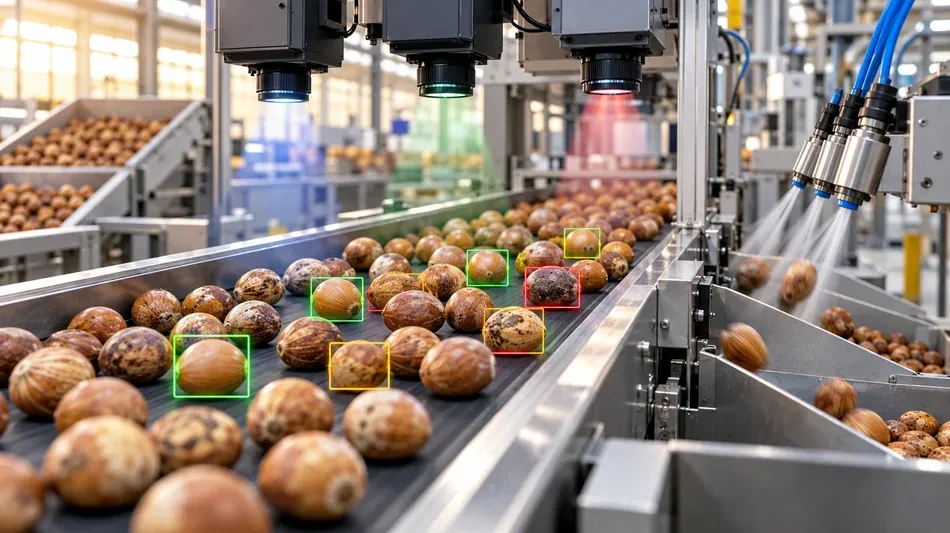
Agrograde has launched an AI-based optical sorting system for arecanut, designed to automate grading while identifying quality defects in processing lines.
Agrograde has launched an AI-based optical sorting system for arecanut, designed to automate grading while identifying quality defects in processing lines.
Agrograde, a physical AI startup building technologies that make fresh produce packhouses autonomous, has introduced an AI-powered optical sorting system developed specifically for arecanut, with the first commercial deployment installed at Vikas Traders in Mangaluru.
As reported by Agrograde, the system can process up to about one tonne of arecanut per hour and enables the Mangaluru facility to process close to eight tonnes a day. It uses computer vision and AI to inspect individual nuts, identify defects and automatically separate rejected material from accepted produce.
The system is created to address one of the persistent challenges in the arecanut supply chain, that is maintaining consistent quality while sorting and processing large volumes of nuts. Unlike conventional colour-sorting machines that primarily identify differences in colour, Agrograde’s system uses computer vision and AI to inspect individual arecanut for external defects that may not be distinguishable through colour alone.
When initially commissioned, the arecanut sorting system recorded about 75 per cent sorting accuracy. With more commercial data becoming available from operations, the AI models have since been updated, taking accuracy to about 89 per cent, with further improvements expected as the system keeps learn from additional data, the company stated.
Before automation, Vikas Traders relied heavily on manual inspection and sorting. as reported by the company, an individual worker could manually inspect and sort roughly two bags a day, while a team of around 15 people could process about 40-45 bags a day. The availability of skilled manpower also influenced how quickly consignments could be inspected, packed and dispatched.
The automated system now offers a more predictable processing capacity. It also generates a quality summary after every lot, among them information on size distribution, defects identified, defect intensity and the number of nuts packed, giving the business additional data to monitor quality.
The system works by using Agrograde’s patent-pending vector technology that captures 10-12 images per nut. Agrograde’s proprietary AI models analyse the images within milliseconds and identify visible defects before the sorting mechanism separates the rejected material from the accepted lot. The models have been trained using lakhs of crop images and run on high-performance computing infrastructure powered by NVIDIA, it stated.
Making warehouses autonomous
Quoting Rakeshkumar Barai, Co-Founder of Agrograde, a media statement stated: “Our machines are designed after studying multiple characteristics of a crop. We study how a product rolls, glides, the residue it leaves, the amount of dust that comes with the product, the amount of force that is needed to gently sort the product, and the variations across different varieties. We also understand the current process to understand the nuances in quality assessment.
“We have a dedicated team that conducts this research which enables us to develop one of the best AI-powered optical sorters rivalling even imported technologies. It took us almost five months and three product iterations to build India’s first autonomous optical sorter for arecanuts. This AI sorter has made warehouse operations almost completely autonomous. We are also grateful to the team at Vikas Traders for trusting us and helping us customise our technology for the arecanut supply chain.”
Raj Padaliya from Vikas Traders stated: “I was curious to see if AI and robotics can be deployed in the arecanut industry. I was looking for technologies which could make our entire warehouse autonomous and fast. We were excited to know that there is an Indian startup working on this, and we worked with them closely to try out multiple versions. Finally, we had success and now our sorting process is almost completely autonomous. We are the first private company in the arecanut industry to adopt such sophisticated and high-level AI technology. I’m amazed at the level of hardware development that Indian startups are doing.”
F.Santana--PC