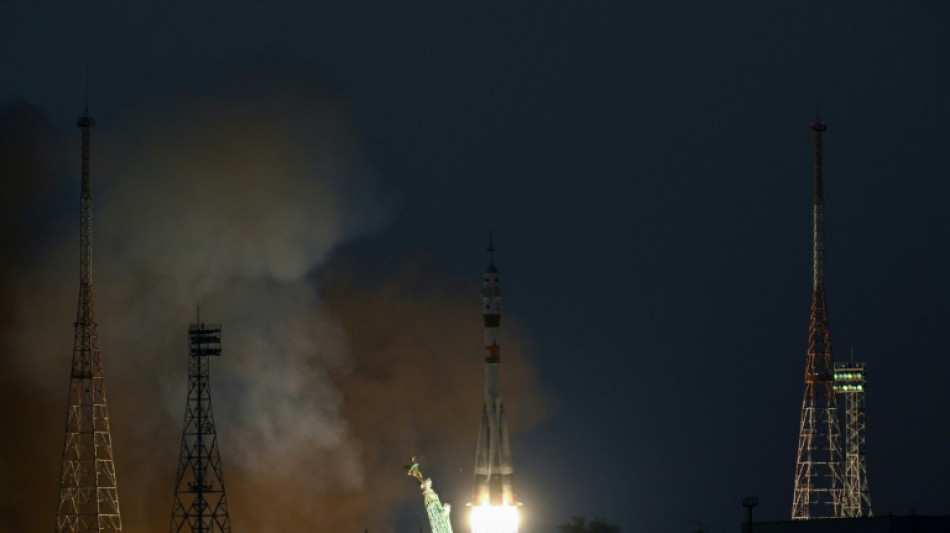
American, Russians reach space station as war rages in Ukraine / Photo: NATALIA KOLESNIKOVA - AFP

 'Glad it's over': Kim powers to Games gold and military exemption

 After 11 World Cups, football finally comes home for one Indian fan

 Marc Marquez wins sprint at Japan MotoGP, Martin grabs pole

 Alcaraz fends off Arnaldi to reach Japan Open quarters

 Antonelli tops times in final practice at Bahrain GP
 Gauff digs deep to beat Osorio in China Open second round
 Fresh protests to hit Spain after housing measures defeated
 'He's here with me': Japan cycle queen dedicates gold to late brother
 Japan Olympic chief says 'lot more' athletes at Games than expected
 Asian carmakers besting US rivals at home, China poised to strike

 Widgets & Web Offers All-Inclusive Investor Relations Websites for Public Companies, IPOs and SPACs

 Adams named new US captain to 2030 World Cup

 China a better influence in Latin America than US: poll

 Judge pauses construction of border project in Texas national park

 Belgium's De Bruyne fires double to sink Turkey, France held by Italy

 US jobs data boosts stocks as oil prices dip

 US Supreme Court to hear high-stakes climate case
 Trump expected to name intel chief Clayton as AI czar: reports
 Argentina unveils passports-for-investment scheme

 Brazil election debate chaos sparks censorship row
 England's Carse charged by cricket body over nightclub incident
 Amazon vows $1 bn for data center towns, decries 'myths'
 Oil prices drop on G7 fuel release, US jobs data boosts stocks

 G7 agrees deal to ease global energy supply concerns
 Spain's government dealt blow as lawmakers reject housing bills
A US astronaut and two Russian cosmonauts have arrived safely at the International Space Station (ISS), NASA said Wednesday, after blasting off on a Russian-operated flight in a rare instance of cooperation between Moscow and Washington.
The Russian space agency Roscosmos and NASA both distributed live footage of the launch from Kazakhstan and commentators speaking over the feed said it was stable and the crew was "feeling well".
NASA's Frank Rubio and Russia's Sergey Prokopyev and Dmitry Petelin made up the crew that launched from the Russia-leased Baikonur cosmodrome at 1354 GMT.
The three will spend six months on the ISS along with three other Russian cosmonauts, three other US astronauts and one Italian.
Rubio is the first US astronaut to travel to the ISS on a Russian Soyuz rocket since President Vladimir Putin sent troops into pro-Western Ukraine on February 24.
In response, Western capitals including Washington have hit Moscow with unprecedented sanctions and bilateral ties have sunk to new lows.
Space is one of the last remaining areas of cooperation between the two countries.
Russia's only active female cosmonaut, Anna Kikina, is expected to travel to the orbital station in early October aboard a SpaceX Crew Dragon.
She will become only the fifth professional woman cosmonaut from Russia or the Soviet Union to go into space, and the first Russian to fly aboard a spacecraft of SpaceX, the company of billionaire Elon Musk.
Russian cosmonauts and Western astronauts have sought to steer clear of the conflict that is raging back on Earth, especially when in orbit together.
A collaboration among the United States, Canada, Japan, the European Space Agency and Russia, the ISS is split into two sections: the US Orbital Segment and the Russian Orbital Segment.
- Russia leaving ISS -
At present, the ISS depends on a Russian propulsion system to maintain its orbit, about 250 miles (400 kilometres) above sea level, with the US segment responsible for electricity and life support systems.
Tensions in the space field have grown since Washington announced sanctions on Moscow's aerospace industry -- triggering warnings from Russia's former space chief Dmitry Rogozin, an ardent supporter of the Ukraine war.
Rogozin's recently appointed successor Yuri Borisov later confirmed Russia's long-mooted move to leave the ISS after 2024 in favour of creating its own orbital station.
US space agency NASA called the decision an "unfortunate development" that would hinder scientific work on the ISS.
Space analysts say construction of a new orbital station could take more than a decade, and Russia's space industry -- a point of national pride -- would not be able to flourish under heavy sanctions.
The ISS was launched in 1998 at a time of hope for US-Russia cooperation following their Space Race competition during the Cold War.
During that era, the Soviet space programme boomed. It boasted a number of accomplishments that included sending the first man into space in 1961 and launching the first satellite four years earlier.
Experts say Roscosmos is now a shadow of its former self and has in recent years suffered a series of setbacks, including corruption scandals and the loss of a number of satellites and other spacecraft.
Russia's years-long monopoly on manned flights to the ISS is also gone, to SpaceX, along with millions of dollars in revenue.
T.Vitorino--PC



